The Time Traveller's Dossier : Apple Think Different - The Broadcast Paradigm
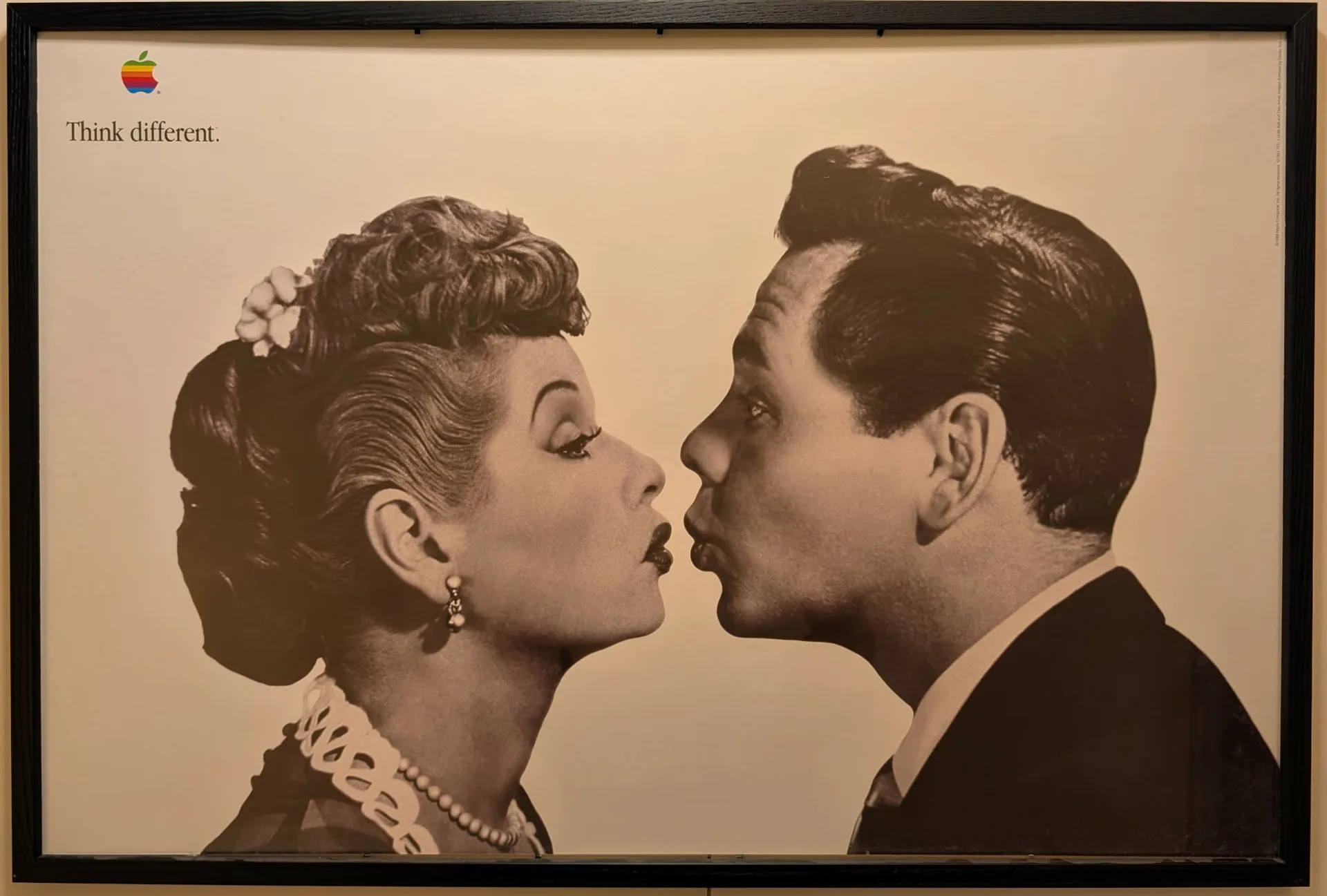
A collision of epochs captured within the boundaries of a wooden frame. The mid-century golden age of television broadcast engineering intersects directly with the turbulent dawn of the personal computing revolution. The year is 1997. A technology conglomerate stands precisely on the precipice of total financial annihilation. They possess no revolutionary hardware to deploy to the consumer market. Therefore, they make a strategic decision to weaponize a philosophy. They resurrect archival, black-and-white portraits extracted from the year 1954. They deploy these specific images to fundamentally reprogram the psychology of a demoralized global workforce. They utilize them to violently shift the established paradigm of consumer consciousness. This physical artifact is not a conventional corporate advertisement. It is a meticulously engineered, highly strategic cultural manifesto. It signifies a definitive historical shift in human-computer interaction. It documents the critical transition from an industry obsessed with the sterile, mathematical metrics of machine processing power, toward a future entirely reliant on the boundless potential of human artistic intuition.
Category: Technology
The History
The Silicon Valley Death Spiral The context begins in the late 1990s. The corporate entity known as Apple Computer is hemorrhaging capital at an unsustainable velocity. They are, according to internal financial metrics, exactly ninety days away from absolute insolvency and total operational dissolution. The broader personal computer industry is suffocating under the weight of its own profound lack of imagination. The physical landscape of technology is entirely dominated by monolithic, identical beige plastic towers. The overarching market narrative is strictly monopolized by corporate giants operating comfortably within the Wintel duopoly. The foundational language of technology has been aggressively reduced to a sterile, uninspiring "spec war." Marketing departments scream at consumers using the cold mathematics of megahertz. They sell the raw volume of megabytes. They promote the rotational speeds of hard disk drives. It is an economic ecosystem completely devoid of humanity. It treats the human user as a mere mechanical operator, an interchangeable component required to input data into a machine. The return of Steve Jobs to the company is not merely an administrative change in executive leadership. It is a desperate, highly necessary spiritual intervention. Jobs observes the dangerously fractured product lines. He analyzes the deeply demoralized corporate culture. He fundamentally understands that Apple cannot survive a war of technical specifications against established monopolies. They must completely rewrite the underlying rules of engagement. The Antithesis of the Spec War The strategic mandate is handed down to the advertising agency TBWA\Chiat\Day. The operational parameters are nearly impossible: rebuild the global perception of the brand without showcasing a single new product. The revolutionary iMac G3, the machine intended to save the company, is still months away from physical reality. The agency team, guided by the strategic direction of Lee Clow and Craig Tanimoto, develops a radically contrarian concept. "Think Different." It is a deliberate, grammatically provocative strike against IBM’s deeply entrenched corporate slogan, "Think." The campaign establishes absolute, unbreakable visual rules. There will be no computers displayed in the imagery. There will be no technical specifications listed. There will be no mention of software capabilities. Instead, the campaign will exclusively feature the faces of the twentieth century’s most significant cultural rebels. The innovators. The misfits. The troublemakers. The underlying message is profound in its strategic simplicity. Apple is deliberately aligning its brand not with other silicon manufacturers, but with the historical architects of human progress. They are whispering a revolutionary promise directly to the consumer. You are not a data entry clerk. You are an artist. You are a creator. And we are engineering the instruments for your impending rebellion. The Unlikely Rebels of Hollywood Among the pantheon of globally recognized geniuses—Einstein, Gandhi, Picasso, Ali—one specific poster stands out for its profound subtlety. It features the profiles of Lucille Ball and Desi Arnaz. To the uninitiated observer, they are merely the highly successful stars of a beloved 1950s sitcom, "I Love Lucy." They are viewed simply as entertainers. But to the meticulous archivist, to the historian of media infrastructure and technological evolution, their inclusion is an act of profound recognition. In the early 1950s, the television industry was a rigid, unforgiving, and highly controlled mechanical apparatus. It was entirely governed by powerful radio network executives based in New York. It was restricted by strict, unspoken, yet heavily enforced rules regarding race, gender, and acceptable formats. Lucille Ball, a white American woman, was married to Desi Arnaz, a Cuban-born bandleader. When they pitched a television program based entirely on their real-life dynamic, the network executives recoiled in terror. An interracial marriage broadcast on national television was considered a catastrophic financial risk. Corporate sponsors threatened to withdraw funding. The network explicitly demanded that Ball cast a different, statistically "acceptable" actor to portray her husband. She categorically refused. This was their primary act of profound, unyielding rebellion. They did not compromise their vision to appease a fearful corporate structure. Instead, they circumvented the network entirely, taking their performance on a national tour to prove their undeniable cultural resonance. They forced the network's hand through sheer, undeniable public demand. But their rebellion was not merely social; it was a deeply technological revolution that would permanently alter the medium. Engineering the Archival Masterpiece During the 1950s, standard television protocol dictated that programs were broadcast live from studios in New York. If a program was to be transmitted to the West Coast, it was recorded using an inferior process called kinescope. This process involved aiming a 16mm film camera directly at a glowing television monitor. The resulting visual artifact was grainy, blurry, and fundamentally degraded. It was transient, disposable entertainment. Arnaz and Ball firmly desired to remain in Los Angeles. The network absolutely refused to absorb the exorbitant costs of transmitting a live coaxial signal across the continent. They also refused to accept the degraded quality of a standard kinescope recording for their flagship broadcast. Faced with this insurmountable logistical obstacle, the couple formed their own independent entity: Desilu Productions. They agreed to take a significant personal pay cut to finance the physical production themselves. In exchange, they demanded a clause that would change history: one hundred percent ownership of the resulting physical film material. The network executives, operating under the assumption that television broadcasts possessed no financial value beyond their initial airing, eagerly signed the contract. This remains the greatest financial miscalculation in the history of broadcast media. To solve the critical visual quality issue, Arnaz collaborated with Karl Freund, a legendary cinematic structural engineer. Freund was the visual architect responsible for the cinematography of foundational cinematic masterpieces like "Metropolis" and "Dracula." Together, Arnaz and Freund invented the modern, multi-camera television format. They placed three 35mm motion picture cameras in front of a live, physical studio audience. They meticulously lit the soundstage not for transient television, but for permanent, high-resolution cinema. They recorded the physical performances, the dialogue, and the audience reactions onto high-grade archival film stock. This engineered process changed the structural reality of the medium forever. The Economics of Immortality By making the crucial decision to shoot exclusively on 35mm film, Desilu Productions inadvertently invented the concept of the rerun. They successfully created a pristine, high-resolution, permanent archive of every single recorded episode. Because they legally owned the physical celluloid film, they effectively invented the highly lucrative economics of television syndication. They built an unprecedented financial empire. Desilu aggressively expanded, eventually becoming one of the largest independent television production studios on the planet. They provided the physical infrastructure and studio space for monumental, culture-defining franchises like "Star Trek," "Mission: Impossible," and "The Untouchables." Lucille Ball subsequently ascended to become the first woman to head a major Hollywood production studio. They were never merely actors reading a script. They were the structural engineers of the modern entertainment industry complex. They were the primary pioneers of independent media ownership. They identified a broken, restrictive, monopolized broadcast system, and they utilized technology to redesign its fundamental architecture. The Intersection of Art and Architecture This profound historical context is precisely why their archival image hangs on the wall of a silicon technology company in 1998. Steve Jobs frequently articulated the philosophy that Apple exists exactly at the intersection of advanced technology and the liberal arts. Lucille Ball represents the ultimate manifestation of the liberal arts. She is impeccable comedic timing, deep human empathy, physical intuition, and pure, unadulterated artistic brilliance. Desi Arnaz represents the underlying technology. He is the structural engineer, the visionary executive producer, the bold inventor of a completely new broadcast medium. Together, they form a flawlessly complete, symbiotic creative system. They perfectly embody the exact conceptual synergy that Apple was desperately trying to sell to the digital age. The Macintosh computer is the modern equivalent of their revolutionary 35mm camera array. The individual user sitting at the keyboard is the independent director. The poster functions as a silent, yet immensely powerful communication to the consumer. It commands them to take these digital tools and construct their own modern Desilu. It urges them to maintain absolute ownership of their intellectual masters. It is a profound message of ultimate creative empowerment cleverly disguised as a corporate advertisement. The strategic utilization of a 1954 archival photograph to actively sell a 1998 vision of the digital future is a testament to the absolute timelessness of true innovation. It mathematically proves that while physical hardware inevitably becomes obsolete, the underlying human spirit of rebellion remains permanently relevant.
The Paper
This artifact fundamentally transcends its initial purpose as an ephemeral piece of corporate marketing material. It has definitively transitioned into the status of a permanent historical document. The heavy-stock paper physically bears the subtle, undeniable markers of the late 1990s lithographic offset printing process. The chosen matte finish aggressively absorbs ambient light, purposefully demanding a direct, highly intentional engagement from the viewer. The grayscale reproduction of the original 1954 photograph is expertly achieved through a complex matrix of microscopic halftone dots. These meticulously arranged dots create a profound illusion of depth, perfectly mimicking the continuous tone and silver halide grain of the original 35mm film stock. The stark monochromatic field is violently, intentionally disrupted by the six-color Apple logo placed in the upper left quadrant. The individual CMYK pigments of the rainbow emblem are deeply saturated, sitting heavily upon the paper's porous surface. In the lower margin, microscopic, precise typographic rendering secures the essential copyright data. The text reads "1998 Apple Computer, Inc." sitting directly adjacent to "1954 TEC." and references Desilu, too, LLC. Two completely disparate eras of human history are permanently, physically fused into a single plane of existence.
The Rarity
Class A - Strategic Corporate Asset. The inherent value of this specific artifact is not dictated by the fluctuating mechanisms of consumer scarcity, but by its profound contextual gravity. These large-format "Think Different" posters were explicitly categorized as non-retail assets. They were never officially authorized for direct consumer purchase. They were strategic tools, distributed exclusively to authorized educational institutions, high-level retail partners, and specific corridors within Apple corporate facilities. Their primary function was to serve as psychological anchors during a period of violent corporate transition. The vast majority of these prints were systematically destroyed or discarded following the campaign's conclusion. To locate a surviving specimen, uncreased, structurally sound, and meticulously preserved behind protective framing, is exceptionally rare. It is a surviving battle standard from the pivotal war that saved the digital revolution.
Cite this article
- MLA
- Naodhinsuk, Ronin. “The Time Traveller's Dossier : Apple Think Different - The Broadcast Paradigm.” The Record Institute, 18 September 2026, https://therecord.institute/journal/the-time-travellers-dossier-apple-think-different-the-broadcast-paradigm.
- APA
- Naodhinsuk, R. (2026, September 18). The Time Traveller's Dossier : Apple Think Different - The Broadcast Paradigm. The Record Institute. https://therecord.institute/journal/the-time-travellers-dossier-apple-think-different-the-broadcast-paradigm
- CHICAGO
- Naodhinsuk, Ronin. 2026. “The Time Traveller's Dossier : Apple Think Different - The Broadcast Paradigm.” The Record Institute, September 18, 2026. https://therecord.institute/journal/the-time-travellers-dossier-apple-think-different-the-broadcast-paradigm.