The Time Traveller's Dossier : Armstrong Montina Corlon - The Synthetic Forest Shift
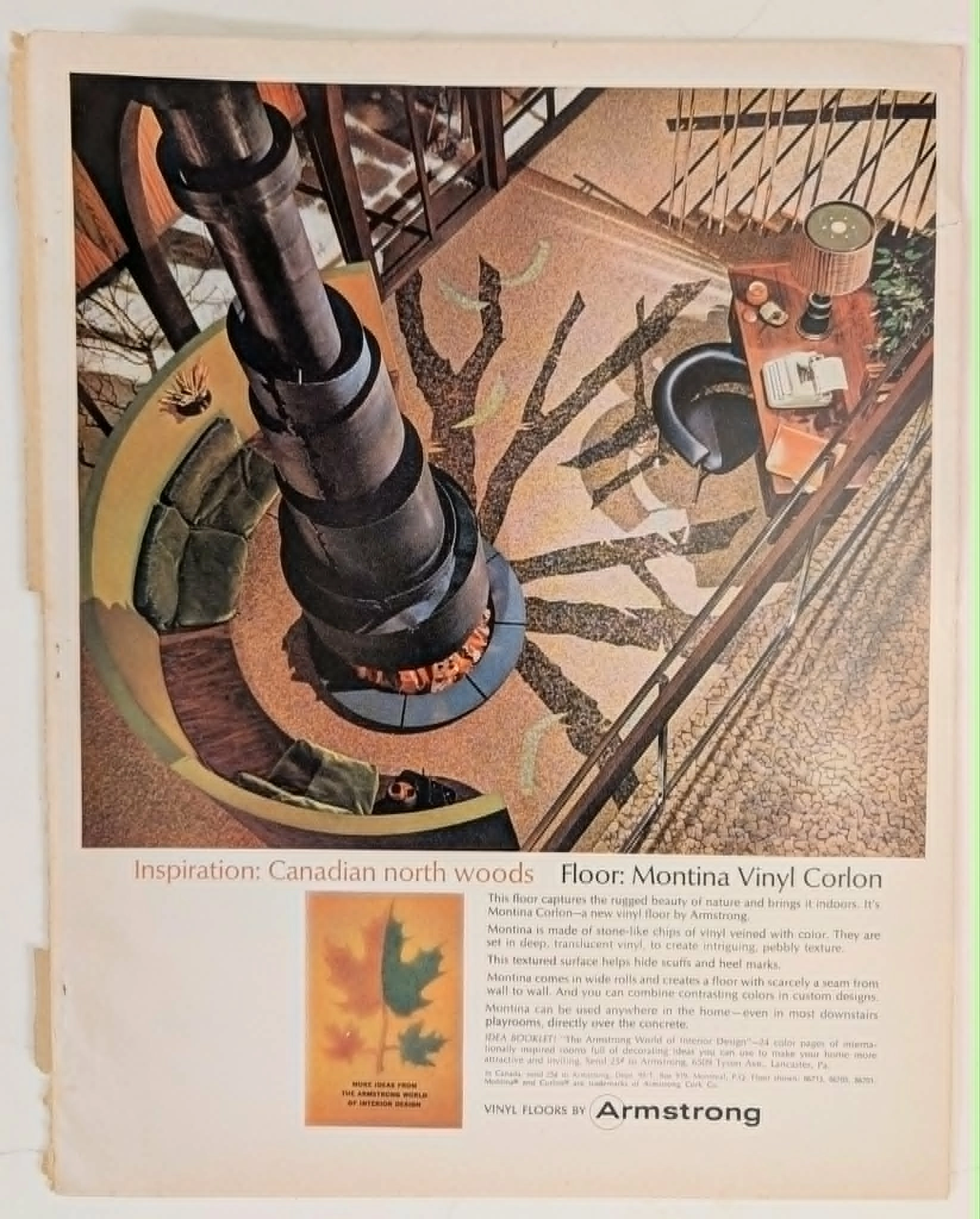
A problem existed in the mid-century home. The foundation was changing. Houses were moving outward, spreading across the American landscape on flat concrete slabs. Basements were evolving from subterranean storage to domestic living spaces. But concrete is brutal. It is cold. It is damp. It is unyielding. Wood warped. Linoleum became brittle. Stone was an economic impossibility for the middle class. The solution required alchemy. It required a material that did not exist in nature, engineered to perfectly mimic nature. Armstrong introduced Montina Vinyl Corlon. This advertisement is not merely selling a floor. It is documenting a profound shift in human habitation. The moment we stopped harvesting the forest to build our homes, and began synthesizing petrochemicals to simulate the forest floor. The promise of continuous, seamless, indestructible nature. Delivered in a wide roll.
Category: Technology
Brand: Armstrong
The History
The Architecture of Subterranean Expansion To understand this artifact, we must examine the domestic geography of the era. The post-war economic boom radically altered the American footprint. Millions of homes were constructed at a staggering pace. To optimize speed and cost, builders shifted away from complex raised foundations with crawlspaces. They poured concrete slabs. Furthermore, the basement—historically a dark, damp cellary reserved for coal furnaces and root storage—was being rebranded. It became the "playroom." The "rec room." The downstairs den. But a psychological and physical barrier remained. Concrete is hostile to human comfort. It transmits cold. It traps moisture. Traditional organic materials failed miserably in this new subterranean environment. Hardwood warped, expanded, and rotted when placed directly over a damp slab. Natural stone was prohibitively expensive to quarry, transport, and install for the average suburban family. Asphalt tiles were cheap but visually dismal and prone to chipping. Linoleum, reliant on oxidized linseed oil, was water-resistant but lacked the structural flexibility and structural depth required for this new architectural era. The middle class had space, but they lacked the material science to inhabit it comfortably. The market demanded a bridge. A bridge between the unforgiving reality of industrial concrete and the psychological need for domestic warmth. The Polymer Resolution Armstrong Cork Company, originally founded in 1860, had survived a century by adapting its material focus. By the mid-20th century, they recognized that the future was synthetic. Polyvinyl chloride (PVC) was the key. While vinyl had been used in flooring prior to this, it was often in the form of rigid composite tiles. The true engineering breakthrough was the development of high-quality sheet vinyl. Montina Corlon was the apex of this pursuit. The advertisement describes it technically, yet poetically: "stone-like chips of vinyl veined with color. They are set in deep, translucent vinyl, to create intriguing, pebbly texture." This is a masterpiece of chemical engineering masquerading as organic happenstance. Armstrong engineers discovered how to extrude opaque, colored chips of PVC and suspend them within a clear, translucent polymer matrix. This created a three-dimensional depth. It wasn't just a picture of stone printed on a flat surface. It possessed the optical illusion of real river pebbles captured in clear ice. The texture was functional. The uneven surface was mathematically calculated to scatter light. This scattering hid scuffs, concealed heel marks, and obscured the inevitable debris of a bustling household. It was a floor designed to forgive human error. The Eradication of the Seam The most critical technical achievement highlighted in the artifact is the phrase: "scarcely a seam from wall to wall." Prior to sheet vinyl, floors were an assembly of parts. Planks of wood. Squares of tile. Strips of linoleum. Every joint was a vulnerability. Every seam was a trap for dust, water, and decay. Seams interrupted the visual flow. Armstrong's wide rolls of Corlon changed the spatial perception of the home. By rolling out a continuous, unbroken surface, the room expanded. The floor ceased to be a collection of units and became a singular, monolithic entity. This wall-to-wall continuity mirrored the mid-century modern architectural ethos of open floor plans. The interior was no longer compartmentalized. Space was meant to flow. The seamless floor was the foundational canvas for this new way of living. It also provided an unparalleled hygienic barrier. In an era increasingly obsessed with domestic sanitation, a floor with no cracks was a triumph of scientific cleanliness. It allowed families to push comfortable living spaces "directly over the concrete" of their basements, effectively doubling the usable square footage of the American home through sheer chemical resilience. The Simulacra of the North Woods The concept of "Biophilia"—the innate human desire to connect with nature—is heavily exploited in this artifact. As the 1960s progressed, society became increasingly mechanized, synthesized, and focused on the Space Age. The Cold War pushed technological advancement to terrifying, sterile extremes. In response, domestic interior design retreated into the organic. The "Canadian north woods" theme is highly deliberate. It evokes a rugged, untamed wilderness. It is an appeal to the pioneer spirit, safely contained within a temperature-controlled room. Look at the architectural choices within the image. The room features a "conversation pit"—a sunken seating area that forces occupants into an intimate, circular geometry. This was a radical departure from the traditional living room focused on a television or a flat hearth. It simulates a prehistoric gathering space. At the center of this pit is a massive, suspended cylindrical fireplace. It is black, industrial, and heavy, yet it functions as an indoor campfire. It is the primitive hearth rendered in space-age steel. The vinyl floor surrounds it, mimicking the pebble-strewn edge of a forest stream. It is a highly controlled, synthetic recreation of the wilderness. Humanity was conquering nature outside, while simultaneously paying immense sums to replicate its aesthetic inside. The Democratization of Design Doctrine In the lower corner of the artifact, we see the offer for "The Armstrong World of Interior Design"—a 24-page booklet available for 25 cents. This was a masterstroke of corporate strategy. Armstrong was not just manufacturing vinyl; they were manufacturing taste. Competitors like Congoleum-Nairn or Kentile sold flooring. Armstrong sold an entire domestic philosophy. By distributing millions of these idea booklets, Armstrong positioned itself as the absolute authority on modern living. The 25-cent fee was nominal, barely covering postage, but it ensured that the recipient was invested. It was an educational tool designed to convince the middle-class homemaker that she, too, could possess the sophisticated, architect-designed spaces seen in elite magazines. The booklet taught consumers how to coordinate colors, how to utilize open plans, and, crucially, how continuous sheet vinyl was the mandatory foundation for this new, modern life. The artifact demonstrates the exact moment when high-end architectural concepts, like the suspended fireplace and the sunken lounge, were packaged and sold to the suburban masses, underwritten by the profits of the petrochemical industry.
The Paper
The physical artifact is a product of high-volume web offset printing, standard for dominant mid-century publications. Estimated weight is 65-75 GSM. The paper is mechanically pulped, highly acidic, and engineered for immediate mass consumption rather than archival preservation. We observe distinct CMYK halftone dot patterns in the microscopic structure, a testament to the analog color separation process of the era. The aging process is evident. The edges show signs of oxidation and light degradation, commonly referred to as "foxing" or yellowing. This physical deterioration stands in stark, ironic contrast to the product it advertises. The paper rots, while the vinyl Corlon it depicts was engineered to outlast the very house it was installed in. The artifact records time through its decay.
The Rarity
Class B: Contextually Invaluable. Physical copies of this specific advertisement are not statistically rare. Armstrong saturated the media landscape, placing these full-page spreads in publications with circulations in the tens of millions. However, its true rarity lies in its pristine documentation of a paradigm shift. It captures the exact intersection of polymer chemistry, mid-century architectural trends, and the psychological marketing of synthetic nature. Finding one in unblemished condition is a task of moderate difficulty, but its value is purely intellectual and historical. It is an essential textbook page in the history of domestic material science.
Cite this article
- MLA
- Naodhinsuk, Ronin. “The Time Traveller's Dossier : Armstrong Montina Corlon - The Synthetic Forest Shift.” The Record Institute, 29 May 2026, https://therecord.institute/journal/the-time-travellers-dossier-armstrong-montina-corlon-the-synthetic-forest-shift.
- APA
- Naodhinsuk, R. (2026, May 29). The Time Traveller's Dossier : Armstrong Montina Corlon - The Synthetic Forest Shift. The Record Institute. https://therecord.institute/journal/the-time-travellers-dossier-armstrong-montina-corlon-the-synthetic-forest-shift
- CHICAGO
- Naodhinsuk, Ronin. 2026. “The Time Traveller's Dossier : Armstrong Montina Corlon - The Synthetic Forest Shift.” The Record Institute, May 29, 2026. https://therecord.institute/journal/the-time-travellers-dossier-armstrong-montina-corlon-the-synthetic-forest-shift.