The Time Traveller's Dossier : Asbestos Ltd - The Lethal Trade Shift
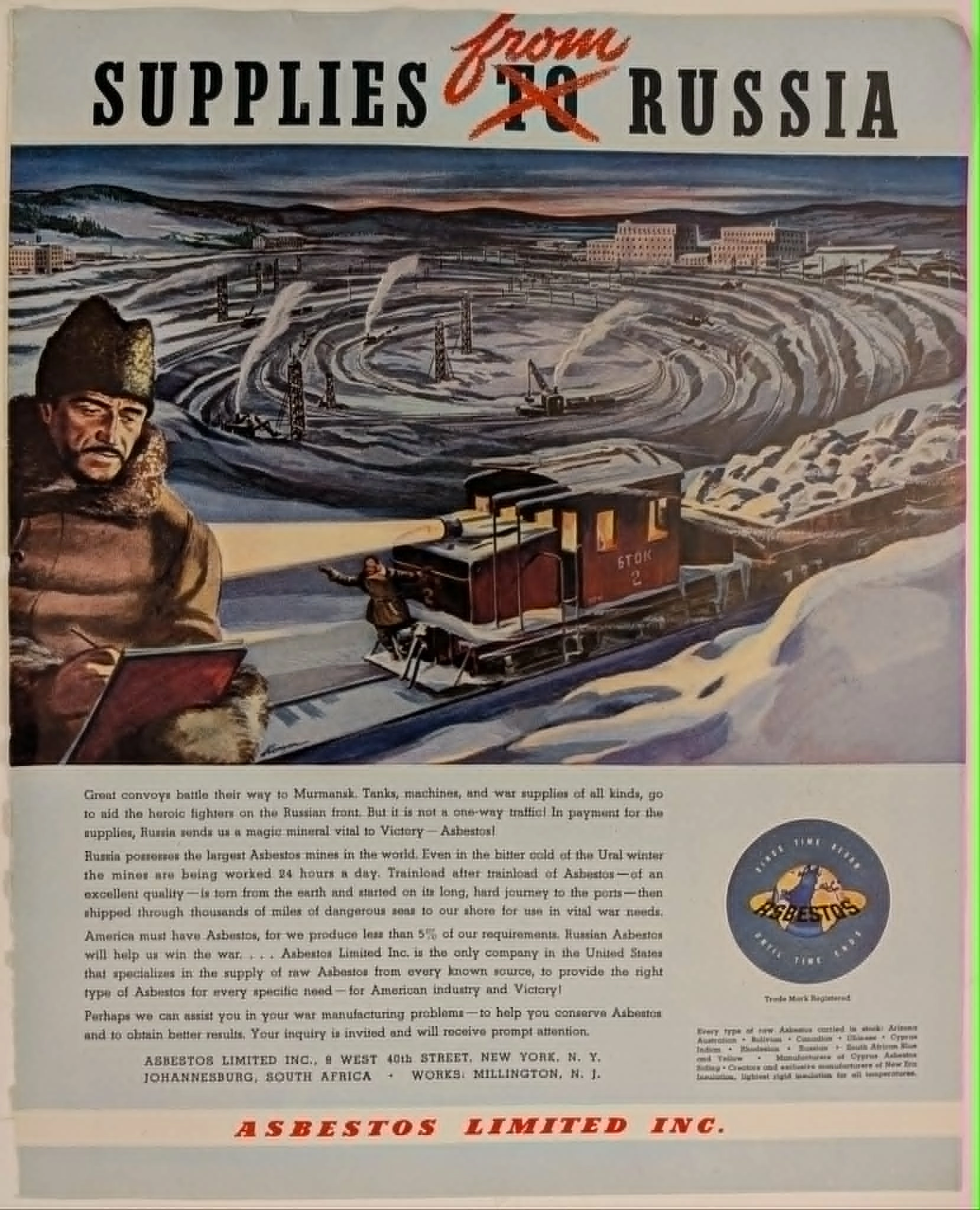
Then, international trade was an economic luxury. It was measured in profit margins, peacetime tariffs, and the slow transit of commercial goods. It was an exchange of surplus. Now, we observe the terrifying pivot. Trade weaponized as a mechanism of absolute survival. An exchange of mechanized armor for toxic salvation. This artifact documents a critical geopolitical inflection point during the crucible of the Second World War. It is not merely a vintage print advertisement for a mining corporation. It is the physical manifestation of a philosophical and logistical rebellion against isolationism. The Asbestos Limited Inc. advertisement represents a precise historical moment when ideological enemies—the capitalist United States and the communist Soviet Union—were forced into a state of absolute, symbiotic codependence. By applying the stark, transactional language of supply and demand to the brutal realities of the Eastern Front, the document reveals the chilling normalization of a toxic mineral. It frames what is now known as a lethal geological hazard as the ultimate, indispensable ingredient for global liberation.
Category: Other
The History
The Geopolitical Architecture of the Arctic Run To comprehend the profound historical significance of this archival document, we must meticulously reconstruct the geopolitical architecture of the early 1940s. The world was firmly gripped by the overarching chaos of a mechanized global conflict. The Soviet Union was bleeding out on the Eastern Front, locked in a macroscopic, ideological, and existential standoff against the advancing Axis powers. To keep the Soviet war machine functioning, the Allies initiated the perilous Arctic convoys. These fleets of heavily laden merchant vessels departed from Iceland and the United Kingdom, navigating the treacherous, freezing waters of the Barents Sea to reach the northern Soviet ports of Murmansk and Archangel. In this era, the fundamental trajectory of military logistics was strictly linear and unimaginably brutal. The mandate was clear and unrelenting: supply the front, regardless of the staggering human and material cost. Great convoys battled their way through submarine wolf packs and relentless aerial bombardment. They carried tanks, machines, and war supplies of all kinds to aid the fighters holding the line. This was the physical reality of the Lend-Lease policy. However, the prevailing domestic sentiment in America still harbored remnants of isolationist hesitation. The public needed to understand that this massive outlay of American industrial capital was not merely an act of geopolitical charity. It was a calculated, necessary transaction. The Asbestos Paradox: The Magic Mineral This brings us to the core narrative of the advertisement: the return cargo. The document explicitly states that the transit to Murmansk was not a one-way traffic. In direct payment for the armor and supplies, the Soviet Union sent back something deemed equally vital to the Allied war effort. They sent asbestos. To the modern observer, this exchange appears fundamentally absurd, even tragic. We now universally recognize asbestos as a lethal carcinogen, responsible for countless deaths through mesothelioma and asbestosis. Yet, to understand the historical shift, we must adopt the technological mindset of 1942. During the Second World War, asbestos was literally viewed as a "magic mineral". It was an absolute necessity for industrialized warfare. The American war machine was running at an unprecedented, frantic capacity. Every Liberty ship sliding down the slipways required tons of asbestos for pipe insulation, boiler linings, and fireproofing. Every Sherman tank required asbestos for its brake linings and clutch facings. The factories churning out munitions required rigid, high-temperature insulation to prevent catastrophic fires. The artifact bluntly highlights a terrifying logistical vulnerability: America produced less than five percent of its own domestic asbestos requirements. The United States possessed the industry to win the war, but it lacked the specific raw material needed to keep that industry from literally burning itself to the ground. Russian asbestos was not a luxury; it was the fireproof spine of the American arsenal. The Typographical Psychology of the Shift The visual genius of this artifact lies in its typographic manipulation. The headline originally reads "SUPPLIES TO RUSSIA". However, the word "TO" has been violently crossed out with a textured, red crayon-like stroke, and the word "from" has been aggressively scrawled above it. This is not a mere design choice. It is a profound psychological pivot. The hand-drawn stroke quality of the red crayon acts as an immediate visual disruptor. It forcibly redirects the American reader's assumption. It shatters the narrative of American paternalism (sending supplies to Russia) and replaces it with a narrative of vital codependence (receiving supplies from Russia). The red color choice subtly evokes the Soviet identity, merging the concept of the communist state with the lifeblood of American manufacturing. This typographic shift engineered a change in public perception, transforming the distant, freezing Russian front into a critical node in the local American supply chain. The Industrial Crucible of the Urals The text delves deeply into the grueling physical reality of resource extraction. It notes that Russia possesses the largest asbestos mines in the world. It paints a grim, awe-inspiring picture of the Ural winter, where mines were being worked twenty-four hours a day despite the bitter cold. Trainload after trainload of this excellent quality mineral was torn from the earth. This description serves a dual purpose. Firstly, it elevates the Soviet miner to the status of a frontline combatant, struggling against the earth and the elements to secure victory. Secondly, it reassures the American industrialist that the supply line, though forged in ice and danger, is robust and continuous. The asbestos is described as starting a long, hard journey to the ports, then being shipped through thousands of miles of dangerous seas. It contextualizes the raw material, infusing the inert white rock with the narrative weight of wartime sacrifice. Corporate Hubris and the Illusion of Eternity Perhaps the most chilling element of this historical document is the corporate branding of Asbestos Limited Inc. The company boldly positions itself as the singular, specialized entity capable of solving America's manufacturing problems. They claim to be the only company in the United States specializing in the supply of raw asbestos from every known global source. This corporate confidence reaches its zenith in their registered trademark logo. The emblem depicts the globe, wrapped in a golden ring, with the word "ASBESTOS" boldly stamped across the equator. Surrounding the earth is a deeply prophetic and tragically ironic motto: "SINCE TIME BEGAN... UNTIL TIME ENDS". In the 1940s, this projected unshakeable permanence and reliability. Today, viewed through the lens of modern medical science, it reads as a grim epitaph. The mineral's indestructible nature—the very quality that made it a "magic" wartime insulator—is exactly what makes it eternally lethal when inhaled into human lungs. The corporation unknowingly branded their product as a permanent, undying curse upon the industrial workforce. The Globalization of the Lethal Trade Finally, the document underscores the vast, intricate web of global wartime commerce. Despite the world being fractured by total war, the supply chain remained a complex, international organism. Asbestos Limited Inc. lists their available stock, revealing a staggering geographical reach. They carried raw asbestos from Arizona, Australia, Bolivia, Canada, China, Cyprus, India, Rhodesia, Russia, and South Africa. They specifically note carrying South African Blue and Yellow varieties. This exhaustive list proves that even amidst the greatest conflict in human history, the extraction and transport of critical industrial materials transcended all borders. The world was burning, yet the ships continued to move the fireproofing across the oceans. This artifact captures the exact historical moment when globalized trade ceased to be about luxury and became a strict, unforgiving mathematics of wartime survival.
The Paper
The physical medium of this historical artifact is a standard wartime, machine-calendered magazine stock. The relentless aging process is highly evident. The lignin locked within the original, low-cost wood pulp is slowly oxidizing over the decades. This quiet chemical decay creates authentic, aged paper textures along the margins, resulting in a distinct, warm yellowing. These aged paper textures are not flaws; they are essential structural elements of its historical aesthetic accuracy. It is a flat illustration of reality, waiting to be interpreted. The original printing utilizes a precise offset lithographic process, presenting the scene in a distinct flat illustration style that prioritizes bold communication over subtle nuance. To fully appreciate the weight of this document, one must strictly preserve the original flat illustration style and respect the physical degradation. The paper is not merely a passive carrier of ink. It is a physical, degrading witness to its era, silently recording the slow passage of time through its deteriorating, acidic fibers.
The Rarity
Classification: Class B - Contextual Artifact. From a purely material and physical standpoint, this object possesses relatively low inherent scarcity. General circulation industry journals and magazines of the 1940s were mass-printed and distributed widely across the United States. However, its true archival value is derived entirely from its immense contextual significance. It is a pristine, physical record of a highly specific psychological shift in wartime supply chain rhetoric. It captures the exact, chilling moment when a lethal carcinogen was hailed as the savior of the free world, and when ideological enemies were bound together by the logistical necessity of a "magic mineral." Surviving copies with this specific, aggressive geopolitical framing elevate its status significantly.
Cite this article
- MLA
- Naodhinsuk, Ronin. “The Time Traveller's Dossier : Asbestos Ltd - The Lethal Trade Shift.” The Record Institute, 31 May 2026, https://therecord.institute/journal/the-time-travellers-dossier-asbestos-ltd-the-lethal-trade-shift.
- APA
- Naodhinsuk, R. (2026, May 31). The Time Traveller's Dossier : Asbestos Ltd - The Lethal Trade Shift. The Record Institute. https://therecord.institute/journal/the-time-travellers-dossier-asbestos-ltd-the-lethal-trade-shift
- CHICAGO
- Naodhinsuk, Ronin. 2026. “The Time Traveller's Dossier : Asbestos Ltd - The Lethal Trade Shift.” The Record Institute, May 31, 2026. https://therecord.institute/journal/the-time-travellers-dossier-asbestos-ltd-the-lethal-trade-shift.