The Time Traveller's Dossier: BBS Wheels 1986 - The Golden Age of IMSA GTP
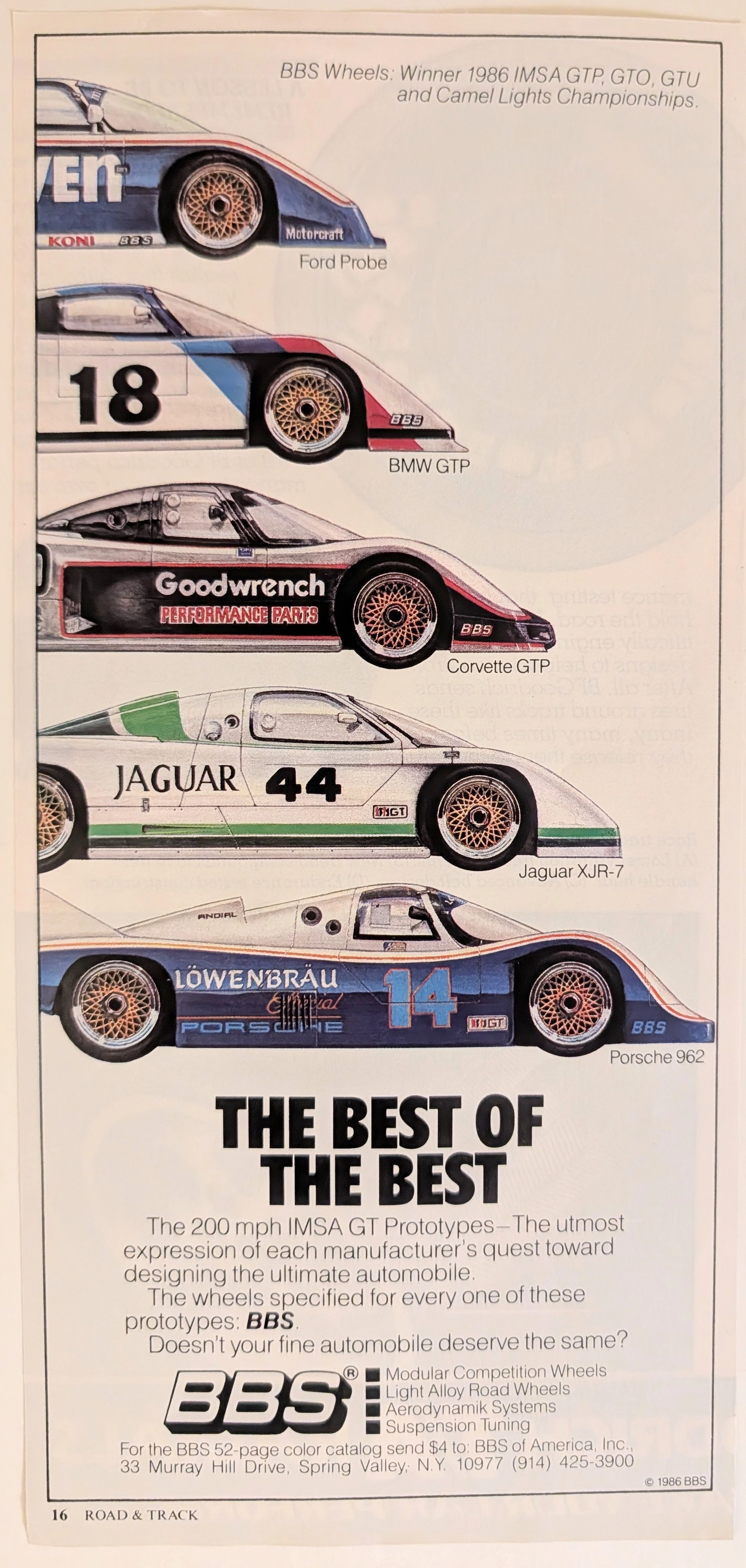
Then, sports car racing was an unrestricted, high-speed arms race. It was an era where manufacturers threw massive budgets at experimental aerodynamics and terrifying turbocharged horsepower, resulting in 200-mph ground-effect monsters that rattled the teeth of spectators. Now, top-tier endurance racing is strictly governed by "Balance of Performance" regulations to ensure parity, and the cars are heavily restricted by standardized hybrid systems. The problem for an automotive enthusiast in 1986 was how to capture a piece of this cutting-edge, million-dollar racing technology for their own street car. The solution, masterfully presented in this advertisement, was BBS. If the fastest, most advanced cars on earth relied on their modular wheels to survive 24 hours of grueling abuse, surely they were good enough for your driveway. This artifact is a portal. It transports us to the paddock of the Daytona International Speedway or Road Atlanta in the mid-1980s. It documents the absolute zenith of the IMSA GTP (Grand Touring Prototype) era, serving as a visual "Who's Who" of legendary race cars, all united by a single, golden component.
Category: Automotive
Brand: BBS
The History
The IMSA GTP Era: A 200-mph Arms Race To understand the historical gravity of this single page, one must understand the era it represents. The 1980s IMSA GTP championship in North America (alongside Group C in Europe) is widely considered the greatest era of sports car racing. There were few rules regarding engine size or design; the primary restriction was fuel consumption. This led to wildly different engineering philosophies sharing the same track. You had Porsche's efficient twin-turbo flat-sixes battling Jaguar's massive, screaming naturally aspirated V12s, Corvette's thunderous pushrod V8s, and BMW's compact, highly-stressed turbocharged four-cylinders. This advertisement captures that incredible grid in profile. The Unifying Component: The BBS Modular Wheel Despite the vastly different engines and aerodynamic philosophies of these five cars, they all shared the exact same wheels: BBS. BBS (Baumgartner Brand Schiltach) revolutionized motorsport with the 3-piece modular wheel. By utilizing a forged aluminum center, a spun aluminum outer rim, and an inner barrel—all bolted together—racing teams could infinitely adjust wheel widths and offsets track-by-track without needing to cast entirely new wheels. Furthermore, the iconic "cross-spoke" or mesh design (born from the BBS RS and racing derivatives) provided incredible structural rigidity and brake-cooling properties while remaining astonishingly light. A Roster of Legends The advertisement casually stacks five of the most iconic race cars of the decade: Ford Probe: The Zakspeed/Roush-developed front-engine oddity that challenged the mid-engine status quo. BMW GTP: A fire-breathing, notoriously difficult-to-drive prototype powered by the same engine block that won BMW the Formula 1 World Championship. Corvette GTP: Hendrick Motorsports' beautifully brutal mid-engine V8 machine. Jaguar XJR-7: Group 44's elegant, V12-powered contender adorned in the classic white and green Quaker State livery. Porsche 962: Specifically, the iconic Löwenbräu-sponsored 962 driven by legends Al Holbert and Derek Bell—arguably the most successful prototype race car in history.
The Paper
This artifact is a pristine example of 1980s enthusiast magazine stock, specifically clipped from page 16 of Road & Track (as indicated by the footer). Unlike the cheap, high-lignin pulp of the 1940s or 60s, this is a glossy, coated paper designed to hold the vibrant colors of modern commercial printing. The printing technique is high-quality offset lithography. When viewing the macro photographs, the intricate liveries of the cars and the complex, golden mesh of the BBS wheels break down into distinct, sharp CMYK halftone rosette patterns. The ability to render the metallic gold of the wheel centers and the polished silver of the outer lips using only standard cyan, magenta, yellow, and black ink is a testament to the high production values of 1980s automotive publishing.
The Rarity
Classification: Class S (Cultural Ephemera - High Contextual Value) While 1980s car magazines are easily found, clean, full-page advertisements that catalog the IMSA GTP grid so perfectly are highly prized by motorsport historians, model builders, and vintage car culture enthusiasts. It is a highly efficient primary document that proves BBS's absolute monopoly on top-tier motorsport during this era.
Cite this article
- MLA
- Naodhinsuk, Ronin. “The Time Traveller's Dossier: BBS Wheels 1986 - The Golden Age of IMSA GTP.” The Record Institute, 21 April 2026, https://therecord.institute/journal/the-time-travellers-dossier-bbs-wheels-1986-the-golden-age-of-imsa-gtp.
- APA
- Naodhinsuk, R. (2026, April 21). The Time Traveller's Dossier: BBS Wheels 1986 - The Golden Age of IMSA GTP. The Record Institute. https://therecord.institute/journal/the-time-travellers-dossier-bbs-wheels-1986-the-golden-age-of-imsa-gtp
- CHICAGO
- Naodhinsuk, Ronin. 2026. “The Time Traveller's Dossier: BBS Wheels 1986 - The Golden Age of IMSA GTP.” The Record Institute, April 21, 2026. https://therecord.institute/journal/the-time-travellers-dossier-bbs-wheels-1986-the-golden-age-of-imsa-gtp.