The Time Traveller's Dossier : BEL Micro Eye Supreme - Covert Radar Evolution
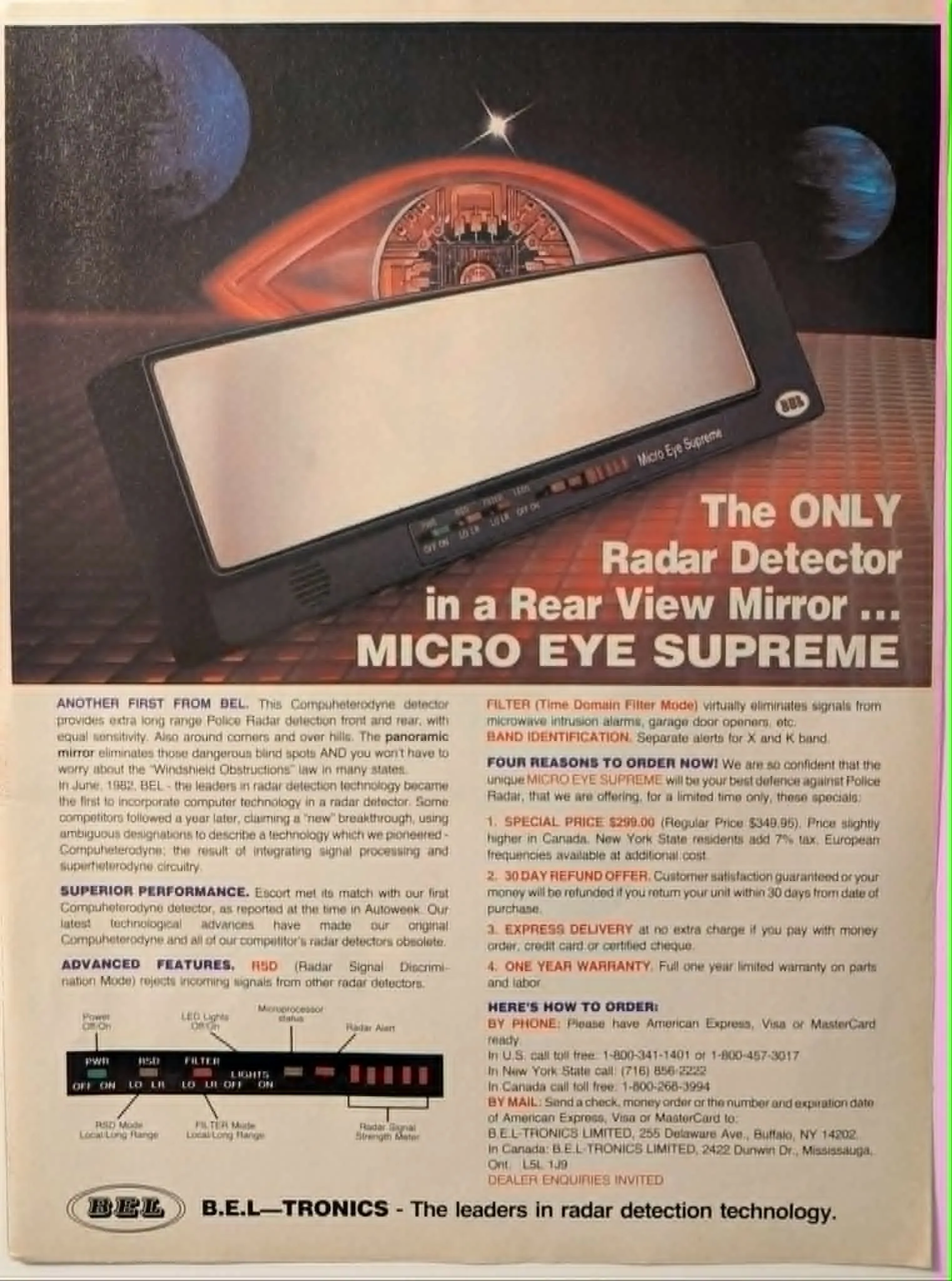
The American highway was once an open frontier. By the early 1980s, it had become a monitored grid. Velocity was strictly legislated. The airwaves were saturated with invisible nets of law enforcement microwave frequencies. Drivers sought defense mechanisms. Early solutions were crude, visible, and legally ambiguous. B.E.L-Tronics presented a paradigm shift. They took counter-surveillance technology. They miniaturized it. They fused it with digital logic processing. Most importantly, they hid it in plain sight. The Micro Eye Supreme did not simply detect radar. It weaponized the vehicle's existing architecture. It turned the rear-view mirror into an oracle of invisible threats.
Category: Technology
The History
The Architecture of Authority The year is 1982. The American landscape is governed by a singular, unyielding metric. The National Maximum Speed Law. Enacted in 1974 as a response to global fuel scarcity, it capped movement at fifty-five miles per hour. By the subsequent decade, the fuel crisis had receded. The law, however, remained rigidly in place. It mutated from an ecological mandate into an apparatus of continuous state surveillance. It became a mechanism for municipal revenue generation. Law enforcement weaponized the microwave. X-band and K-band radar guns proliferated. Invisible electromagnetic nets were cast across the asphalt. The motorist was no longer a free traveler. The motorist was a tracked data point. To drive was to be monitored. To exceed the boundary was to be taxed. The radar gun became the ultimate, unseen arbiter of velocity. A quiet war was declared on the interstate. The Technological Insurgency A civilian counter-measure emerged from the private sector. The radar detector. Initially, it was a crude instrument. A bulky, conspicuous box of early solid-state electronics. It perched awkwardly on the dashboard. It clung to the windshield via unreliable suction cups. It was a flawed shield. It functioned as a beacon, signaling intent to highway patrols. It invited smash-and-grab theft in urban centers. It actively obstructed the driver's physical field of view. It was a blunt instrument for a delicate problem. B.E.L-Tronics observed this structural flaw. They understood that true defense requires stealth. They did not simply refine the internal circuitry. They redefined the external vessel. They sought camouflage within the car's native geometry. They identified the rear-view mirror. An object inherently designed for surveillance. A tool strictly built to observe the past, the wake of the vehicle. BEL engineered it to listen forward, into the invisible future. The Compuheterodyne Shift The technological leap required was highly precise. Superheterodyne circuitry was already establishing itself as the industry standard. It functioned by mixing incoming high-frequency signals with a local oscillator frequency. This created a lower, manageable intermediate frequency. It drastically increased detection range and sensitivity. However, in a rapidly modernizing world, sensitivity was a liability. The environment was becoming electrically noisy. Microwave intrusion alarms in commercial sectors. Automatic garage door openers in residential zones. The early 1980s environment was saturated with false positives. A detector that alerts to everything is essentially alerting to nothing. BEL introduced the microprocessor to the equation. They branded this synthesis "Compuheterodyne." It was the calculated marriage of analog microwave reception and digital logic processing. The silicon chip became the gatekeeper of the alert system. It analyzed the incoming signal signature. It discriminated against the noise. It identified the distinct, continuous footprint of police radar. This shifted the paradigm from mere detection to active signal analysis. The "Time Domain Filter Mode" functioned as a localized logic gate. It was dedicated entirely to rejecting irrelevant data. The detector ceased to be a dumb receiver screaming at the void. It calculated. It evaluated. It informed. The Interface of the Unseen Examine the physical control panel integrated into the mirror. It is embedded directly into the lower bezel, beneath the reflective glass. PWR. RSD. FILTER. LIGHTS. The nomenclature is highly technical. RSD: Radar Signal Discrimination. It offers a binary choice. Local or Long Range. This is an acknowledgment of shifting operational environments. The cluttered urban density versus the isolated, open highway. The LED array acts as the primary communicator. It is a sequential, physical manifestation of an invisible threat's proximity. The closer the microwave source, the higher the illumination sequence. It is a silent, visual heartbeat of impending danger. The brilliance of this interface lies in its ergonomics. It is integrated directly into the driver's natural visual scan cycle. Eyes inherently flick to the mirror to check the rearward state. With the Micro Eye Supreme, that same glance simultaneously checks the forward frequency spectrum. The physical blind spots created by traditional dashboard detectors are entirely eliminated. The legal ambiguity of state "windshield obstruction" laws is neatly bypassed. To a police officer standing outside the vehicle, the device is completely inert. It is a masterpiece of covert automotive engineering. The Market Battlefield The advertisement's copy is aggressive and strategically targeted. It explicitly aims at the apex predator of the radar market. Escort. Cincinnati Microwave’s dominant champion. BEL confidently declares that Escort has met its match. They leverage the authoritative weight of Autoweek magazine to validate their claim. They establish a firm historical timeline. June 1982. They stake their claim to the pioneer status of integrating computer technology in radar detection. They accuse their competitors of slow, delayed imitation. They actively dissect the marketing language of their rivals. They call out "ambiguous designations." BEL demands technical clarity and structural superiority. The price is set at $299.00. In the economic context of the early 1980s, this is a substantial premium investment. Adjusted for inflation, it approaches a thousand modern dollars. This is not an impulsive accessory purchase. It is a calculated, strategic risk assessment by the consumer. The upfront capital cost of the hardware is weighed against the compounding, long-term costs of infractions. Rising insurance premiums. Municipal fines. Accumulated points on a driver's license. The Micro Eye Supreme is positioned strictly as a financial asset. A self-paying defense mechanism. The Metaphysics of the Mirror Consider the profound philosophical shift this artifact represents. The automobile is traditionally viewed as a transparent pod of transit. The Micro Eye Supreme transforms the civilian vehicle into a stealth craft. It introduces the concept of active electronic warfare to the daily commute. The driver is elevated from a passive traveler to an operative. They engage in continuous, low-level signal intelligence gathering. SIGINT for the interstate highway system. The mirror is an incredibly profound choice of housing. By definition, a mirror reflects the visible light of the past. It shows the driver what they have left behind. It shows the driver who is pursuing them in the physical realm. By housing the radar detector within it, the mirror acquires a dual, almost supernatural nature. It reflects the visible past. It simultaneously predicts the invisible future. It senses the unseen trap waiting ahead. The device bridges temporal awareness. It serves as a localized, technological oracle. The End of an Era This specific design paradigm was ultimately an evolutionary dead end. The mirror-integrated detector did not survive into the modern era. The reasons are structural and technological. Automotive design underwent a radical shift in the late 1990s and 2000s. Rear-view mirrors became heavily integrated with native vehicle electronics. Auto-dimming electrochromic glass became standard. Digital compass displays were embedded. Telematics systems like OnStar claimed the mirror housing. The aftermarket sector could no longer easily replace the factory mirror without losing core vehicle functions. The real estate was reclaimed by the original manufacturers. Furthermore, the technology of speed enforcement evolved. Laser speed measurement, or LIDAR, emerged as a primary tool. LIDAR operates on entirely different physical principles. It requires a highly precise line of sight. Law enforcement targets the reflective surfaces of license plates and headlights. A radar detector mounted high on the windshield within a mirror is poorly positioned to detect a narrow, focused laser beam aimed at the bumper. The threat matrix fundamentally changed. The armor became structurally obsolete. Detectors returned to the dashboard. Or they migrated behind the front grille in complex, expensive custom installations. The Micro Eye Supreme remains a pristine fossil of a very specific transitional period. A singular moment in history when total consumer concealment was achieved through the functional replacement of a basic automotive component.
The Paper
The physical artifact is a standard magazine insert from the mid-1980s. The paper weight is light, approximately 80 to 90 GSM. It features a high-gloss finish, typical of premium automotive publications of the era. The printing method is a standard four-color CMYK offset lithography. Under macro observation, the halftone dot pattern is clearly visible. The registration of the B.E.L-Tronics logo reveals slight color bleed, a hallmark of high-volume rotary presses. The black ink of the cosmic void background has oxidized slightly over the decades. It has lost its absolute depth, transitioning to a very dark, matte charcoal. The paper fibers have stiffened with time, indicating an acidic wood-pulp base. This page was not designed for archiving. It was designed for immediate, disposable consumption. Its survival is accidental. It is a fragile membrane of cellulose that successfully recorded a permanent shift in consumer technology.
The Rarity
Classification: Class A (Contextually Rare) Physically, this advertisement can be found in vintage automotive magazines. It is not exceptionally scarce in terms of raw volume. However, its conceptual rarity is immense. It documents a discontinued evolutionary branch of consumer electronics. It captures the exact moment digital processing was introduced to counter-surveillance. The value is derived entirely from its status as a technological milestone. It is a primary source document for the history of electronic civil disobedience. It is highly prized by archivists of early automotive computing.
Cite this article
- MLA
- Naodhinsuk, Ronin. “The Time Traveller's Dossier : BEL Micro Eye Supreme - Covert Radar Evolution.” The Record Institute, 15 June 2026, https://therecord.institute/journal/the-time-travellers-dossier-bel-micro-eye-supreme-covert-radar-evolution.
- APA
- Naodhinsuk, R. (2026, June 15). The Time Traveller's Dossier : BEL Micro Eye Supreme - Covert Radar Evolution. The Record Institute. https://therecord.institute/journal/the-time-travellers-dossier-bel-micro-eye-supreme-covert-radar-evolution
- CHICAGO
- Naodhinsuk, Ronin. 2026. “The Time Traveller's Dossier : BEL Micro Eye Supreme - Covert Radar Evolution.” The Record Institute, June 15, 2026. https://therecord.institute/journal/the-time-travellers-dossier-bel-micro-eye-supreme-covert-radar-evolution.