The Time Traveller's Dossier : Boeing Bomarc - Selling Armageddon
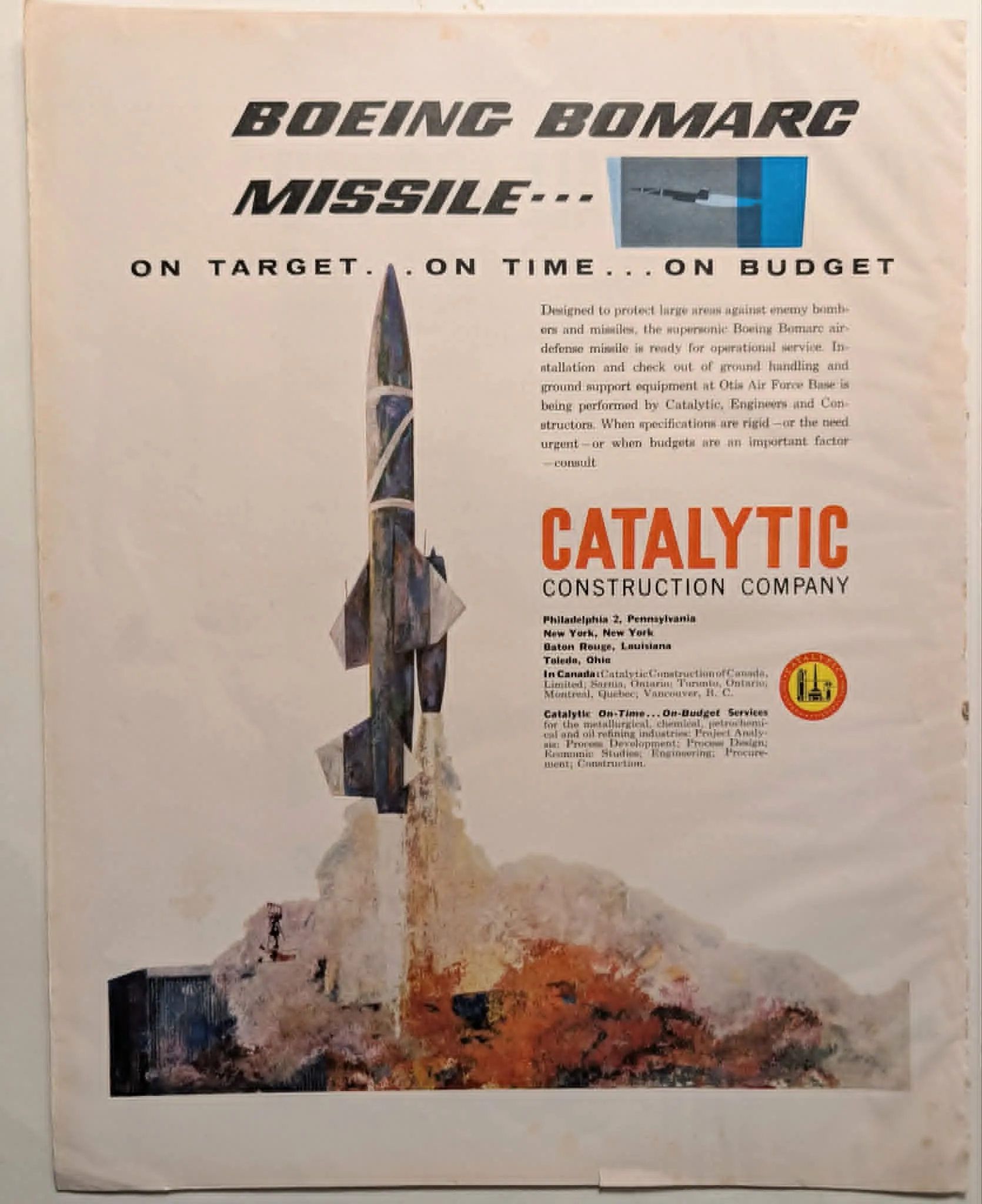
The artifact before us presents a chilling paradox of mid-century capitalism. It is a corporate advertisement for the Catalytic Construction Company. To the untrained eye, it is merely a promotional piece for an engineering firm boasting about a successful government contract. To the strategic archivist, it is the exact moment the apocalypse was domesticated. Then, the creation of war machines was a sovereign secret, hidden behind the closed doors of national arsenals. Now, the infrastructure of total annihilation is proudly displayed as a B2B marketing portfolio. This document captures the historical shift where the military-industrial complex emerged from the shadows to solicit shareholders. It is an engine of psychological normalization. It took the supersonic terror of a nuclear-tipped interceptor missile and wrapped it in the banal, reassuring metrics of middle-management efficiency.
Category: Technology
The History
The Paradigm of the Pilotless Interceptor To understand this artifact, one must first understand the climate of absolute dread that permeated the late 1950s. The Cold War was not merely a diplomatic standoff; it was a looming, physical threat. The Soviet Union had developed long-range strategic bombers capable of flying over the North Pole to deliver thermonuclear payloads to North American cities. The United States required a shield. The answer was the Boeing CIM-10 Bomarc, depicted blazing upward in this advertisement. The Bomarc was not a conventional weapon. It was a ramjet-powered, supersonic, surface-to-air missile designed to intercept bomber fleets hundreds of miles away. More crucially, it was designed to carry a W40 nuclear warhead. It was a robotic suicide drone meant to detonate a nuclear blast in the upper atmosphere to vaporize incoming threats. This was the reality of the weapon. Yet, this advertisement strips away the existential horror of atmospheric nuclear detonation. It reduces the Bomarc to a mere product, a widget requiring ground support equipment. This represents a monumental shift in how society processed the concept of defense. The unthinkable was mathematically sterilized. The Birth of the Military-Industrial B2B Prior to World War II, the American defense industry was largely dormant during peacetime. Weapons were built by the government in federal armories. The post-war era, however, saw the permanent mobilization of a wartime economy in peacetime. President Dwight D. Eisenhower would later famously warn of this specific phenomenon: the military-industrial complex. This artifact is that warning manifested in ink and paper. Catalytic Construction Company did not build the missile itself. They were contracted to build the ground handling and support equipment at Otis Air Force Base in Massachusetts. They built the nest for the electronic bird of prey. By placing this advertisement in a trade magazine, Catalytic was signaling a profound shift in corporate strategy. Government defense contracts were no longer acts of quiet patriotism; they were highly lucrative, heavily marketed badges of honor. The company is aggressively leveraging its role in national survival to attract civilian clients in the metallurgical, chemical, and petrochemical industries. They are stating, implicitly: If the United States government trusts us to engineer the infrastructure for nuclear defense, you can trust us to build your oil refinery. The Metrics of Survival: On Target, On Time, On Budget The true psychological weight of this artifact lies in its headline. "ON TARGET... ON TIME... ON BUDGET". These are the sacred incantations of project management. They are the metrics of a successful quarterly earnings report. Applying these specific corporate buzzwords to a weapon of mass destruction creates a jarring, almost hallucinatory cognitive dissonance. The artifact represents a society desperately trying to impose order on the chaos of the atomic age. If a nuclear interceptor system can be delivered "on budget," then perhaps the threat it counters is also manageable. It is the ultimate domestication of the apocalypse. The advertisement tells the reader that the end of the world is just another logistical challenge to be solved by American engineering. This shift in messaging was vital for maintaining public and economic stability. If the population remained in a constant state of unmitigated panic, the consumer economy would collapse. By framing the Bomarc through the lens of corporate efficiency, the defense industry provided a strange, synthetic comfort. The Continental Fortress and Industrial Expansion Examine the geographical footprint proudly listed in the lower left quadrant. Philadelphia. New York. Baton Rouge. Toledo. And in Canada: Sarnia, Toronto, Montreal, Vancouver. This is not merely a list of regional offices. It is a map of the new industrial empire. The 1950s saw the rapid expansion of petrochemical and refining industries, driven by the explosive growth of automobile ownership and suburban sprawl. Catalytic Construction Company was perfectly positioned at the nexus of these two booming sectors: military defense and petroleum processing. The artifact records the integration of the North American economy. The inclusion of Canadian cities highlights the collaborative defense strategy of NORAD (North American Aerospace Defense Command), linking the two nations in a unified radar and missile shield against the Soviet threat. The infrastructure of civilian energy and military defense became inextricably linked, built by the same hands, engineered by the same minds, and marketed in the same magazines. The Atmospheric Dissonance of the Era To fully grasp the archival weight of this document, one must place it back into its temporal context. Imagine the original reader, perhaps an executive sitting in a waiting room in 1959. Outside the window, there is a bustling 1950s street, filled with the optimism of chrome-bumpered cars and postwar prosperity. Inside the room, a crackling radio delivers a mix of upbeat jazz and tense geopolitical news briefs. There is a warm, nostalgic, era-appropriate background atmosphere. It is an environment of supreme comfort and rising living standards. Yet, resting on the coffee table is this magazine, calmly offering the services of the men who build the launch pads for nuclear missiles. The artifact is a physical bridge between the sunny optimism of mid-century consumerism and the dark, subterranean paranoia of the Cold War. It is this exact dissonance that makes the document a critical historical record. It proves that humanity did not tremble constantly in the shadow of the bomb; instead, we incorporated the bomb into our daily commerce, printed it on glossy paper, and used it to sell engineering services.
The Paper
The physical manifestation of this artifact tells a story of mass distribution and organic decay. It is printed on standard commercial magazine stock, likely hovering around 100 GSM. This was paper engineered for ephemeral consumption, not historical preservation, yet it has survived. The printing method relies on mid-century offset lithography. Under strict archival magnification, the imagery dissolves into a rigid, mechanical matrix of CMYK halftone dots. However, despite the industrial printing process, the artwork retains a powerful hand-drawn stroke quality. The flames of the missile exhaust maintain the erratic, organic texture of a human artist's brush, contrasting sharply with the cold geometry of the typography. Time has claimed its share of the artifact. The once-pristine white borders now exhibit a distinct aged paper texture. There is noticeable edge oxidation and faint liquid staining in the upper margins, proving this document lived in the physical world. It is a fragile survivor of a forgotten corporate war.
The Rarity
Within the strict taxonomy of 'The Record Institute', this artifact is classified as Class B. It is not a one-of-a-kind original painting, nor is it a highly classified government blueprint. It was mass-produced in trade journals. However, its true rarity stems entirely from its contextual value. Most commercial magazines from this era were discarded, recycled, or lost to environmental degradation. Finding a pristine, unclipped page that perfectly encapsulates the exact intersection of Cold War military infrastructure and corporate B2B marketing is increasingly difficult. It holds significant historical weight not because it is monetarily priceless, but because it is a flawless, unedited mirror reflecting the psychological state of the American military-industrial complex at its absolute peak.
Cite this article
- MLA
- Naodhinsuk, Ronin. “The Time Traveller's Dossier : Boeing Bomarc - Selling Armageddon.” The Record Institute, 4 July 2026, https://therecord.institute/journal/the-time-travellers-dossier-boeing-bomarc-selling-armageddon.
- APA
- Naodhinsuk, R. (2026, July 4). The Time Traveller's Dossier : Boeing Bomarc - Selling Armageddon. The Record Institute. https://therecord.institute/journal/the-time-travellers-dossier-boeing-bomarc-selling-armageddon
- CHICAGO
- Naodhinsuk, Ronin. 2026. “The Time Traveller's Dossier : Boeing Bomarc - Selling Armageddon.” The Record Institute, July 4, 2026. https://therecord.institute/journal/the-time-travellers-dossier-boeing-bomarc-selling-armageddon.