The Time Traveller's Dossier : Bronze Medusa of Nemi - The Discarded Memory of Rome
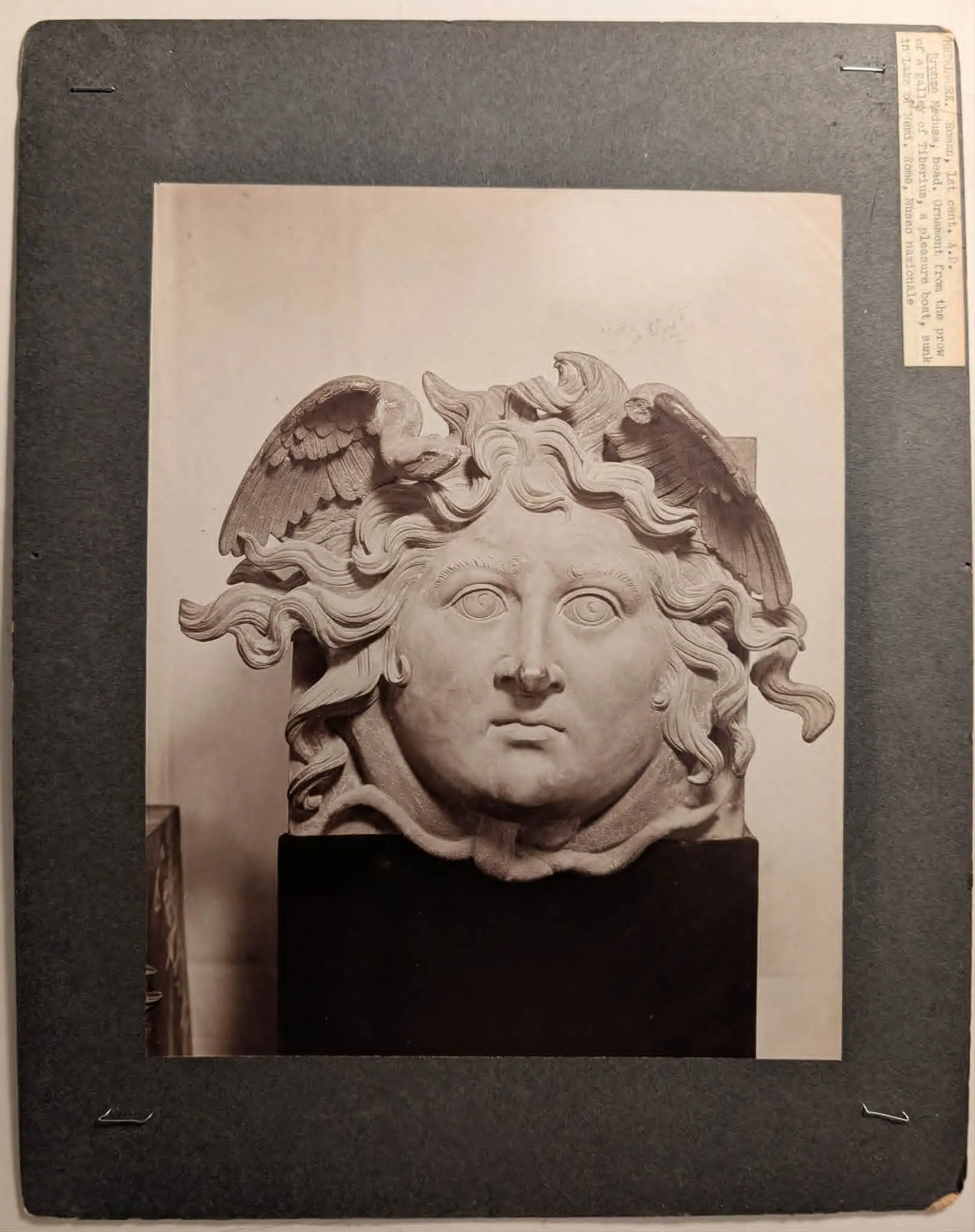
A physical record of a lost physical object. A photograph capturing an antiquity. An institution claiming ownership. An institution relinquishing ownership. The artifact before us is not a Roman bronze. It is a piece of heavy, industrial chipboard. It holds a gelatin silver print. It bears the ink of typewriters and the heavy impressions of bureaucratic rubber stamps. It is a layered document of time, recording an object that survived two thousand years underwater, only to be photographed, cataloged, and eventually purged from human memory by the very institution sworn to protect it. We are looking at a proxy. A ghost of a ghost. The bronze Medusa once adorned a sunken imperial pleasure barge. It was resurrected, photographed, and then likely destroyed in the fires of war. This photograph remained. It sat in a wooden drawer in the Pacific Northwest. It educated generations. Then, it became obsolete. The ink stamp labeled it "DISCARDED." The shift is absolute. We moved from valuing the heavy, physical representation of knowledge to demanding frictionless, weightless data. This board is the casualty of that shift.
Category: Other
The History
The Object Under the Water The narrative begins in the 1st century A.D. The Roman Empire is at its zenith. The metallurgical mastery of the era is unparalleled. Copper and tin are mined, smelted, and poured into molds of wet clay and sand. The artisan crafts a Medusa. The Gorgon. The protector. Her face is heavy. Her eyes are wide, fixed, and unblinking. She wears wings upon her head, and serpents coil beneath her chin. This is not art for a gallery. This is functional, apotropaic hardware. She is bolted to the prow of a massive wooden vessel. The galleys of Lake Nemi. The typewritten label on the artifact attributes the boat to Tiberius. Modern archaeological consensus assigns these floating palaces to Caligula. The exact emperor matters less than the function. These were not warships. They were floating monuments of decadence. Temples of indulgence built on a small, volcanic crater lake in the Alban Hills. They featured marble floors, plumbing, and bronze ornaments. Then, the empire fractures. The ships sink. They settle into the freezing, anaerobic mud at the bottom of Lake Nemi. For nearly two millennia, the bronze Medusa sits in absolute darkness. The water preserves the metal. The mud encases the craftsmanship. The Roman Empire falls. The Middle Ages pass. The Renaissance blooms. Industrialization reshapes the earth. The Medusa waits in the dark. The Resurrection and the Fire In the late 1920s, a monumental engineering feat is executed. Under the directive of Benito Mussolini’s fascist government, Lake Nemi is partially drained. Massive industrial pumps run for years. The water level drops. The mud cracks. The ancient timber emerges to face the sun for the first time in nineteen hundred years. The bronze Medusa is detached from the rotting prow. It is cleaned. It is brought to a museum in Rome. The Museo Nazionale Romano, as the label dictates. It is placed under artificial light. A large-format camera is positioned before it. A shutter clicks. Light burns the image of the Gorgon onto a silver halide emulsion. The photograph is developed. This act of photography is the crucial axis of our artifact. In 1944, during the retreat of German forces in World War II, a fire breaks out in the Museum of the Roman Ships at Nemi. The majority of the recovered timbers and countless artifacts are reduced to ash. The physical reality of the Nemi ships is erased. The primary object is gone. The secondary object—the photograph—suddenly inherits the weight of a primary source. The proxy becomes the only proof of existence. The Institutional Migration The photograph is duplicated and disseminated. A print travels across the Atlantic. It arrives in the United States. It enters the labyrinth of the Seattle Public Library system. The early to mid-20th-century library was a fortress of physical knowledge. Before the internet democratized visual information, a citizen of Seattle could not simply search for Roman metalwork. To see the world, one had to access the Picture File. Librarians curated massive collections of mounted photographs. They functioned as the custodians of global visual culture. The print is affixed to a thick, rigid board. This is not an aesthetic choice. It is a structural necessity. The board must survive the handling of thousands of hands. It must withstand being pulled from filing cabinets, placed on study tables, and passed across reference desks. A librarian feeds a small paper strip into a manual typewriter. The keys strike the ribbon. The metal letters transfer carbon ink onto the paper. "METALWORK. Roman, 1st cent. A.D. Bronze Medusa, head." The label is glued to the top left corner. The artifact is indexed. It is assigned a number. "8209." It is stamped with heavy black ink. The photograph is no longer just an image. It has been absorbed into a bureaucracy. It has become institutional property. The Command of Preservation Flip the board over. The reverse side tells the story of institutional authority. A stamp reads: "Use no thumb tacks, gummed tape or mark in any way". This is an instruction of preservation. The library recognizes the value of the image. A thumb tack would pierce the emulsion, creating a permanent void in the visual data. Gummed tape would leave acidic residue, degrading the paper over decades. A mark would alter the historical record. The library commands the user to respect the physical boundary of the artifact. The user is permitted to look, but not to alter. The board is heavy. It commands respect. For decades, it functions perfectly. It is a portal connecting a rainy city in the Pacific Northwest to a volcanic lake in ancient Rome. It teaches art history. It provides reference for sculptors. It fulfills its mandate. The Shift: The Bureaucracy of the Purge Time accelerates. The late 20th and early 21st centuries introduce the great digitization. Archives are scanned. Databases are built. The cloud replaces the cabinet. The physical Picture File becomes a liability. It takes up square footage. It requires climate control. It demands physical maintenance. Why keep a heavy, decaying piece of chipboard when a high-resolution JPEG can be summoned to a screen in milliseconds? The shift occurs. The library decides to deaccession the physical archive. The archivist pulls board 8209 from the drawer. A new rubber stamp is pressed into an ink pad. It is brought down hard on the back of the board. "DISCARDED. THIS IS NO LONGER PROPERTY OF THE SEATTLE PUBLIC LIBRARY." This stamp is a legal severing. It is an abdication of responsibility. The institution that once commanded users to "Use no thumb tacks" to protect the artifact now declares it worthless. The paradox is profound. The library protected the image for decades, ensuring it survived intact, only to deliberately expel it from the timeline of their protection. The artifact transitions from a protected educational tool to cultural detritus. It is thrown away. Yet, it survives the purge. It enters the secondary market. It is salvaged by a collector, an archivist, or an observer of history. It sits before us now. A survivor of the Roman collapse, the Nemi mud, the museum fire, and the digital purge. It is a monument to the shifting definition of memory.
The Paper
The substrate is a dense, multi-ply chipboard, likely weighing between 800 and 1000 GSM. It is industrial, utilitarian, and designed strictly for durability, not beauty. Its surface is heavily textured, composed of compressed, recycled paper fibers. The color is a muted, oxidized brown, indicative of lignin degradation over several decades. The photographic print attached to the front is a silver gelatin print. It lacks a halftone dot pattern, confirming it is an actual developed photograph, not a mechanically reproduced lithograph. The tonal range is stark. The blacks are deep and metallic, while the highlights are softly blown out by the harsh, direct studio lighting used by the original museum photographer. The labels are typed on acidic paper, which has yellowed significantly faster than the photograph. The typewriter ribbon ink exhibits micro-feathering along the edges of the letters, a result of the ink bleeding into the paper fibers over time. The rubber stamps on the reverse tell a story of chemical interaction. The ink of the "DISCARDED" stamp is a fast-drying, oil-based pigment. It sits atop the rough fibers. In contrast, the faded blue ink of the "Seattle Public Library" stamp has absorbed deeply into the board, losing its crisp edge as the moisture spread microscopically through the cellulose matrix. The hand-written numbers "8209" are rendered in a thick, carbon-heavy ink, possibly India ink, applied with a felt-tipped or heavily loaded dip pen.
The Rarity
Classification: Class S This artifact achieves a Class S rating not through material preciousness, but through deep contextual layering. A standard vintage photograph of a Roman bronze is relatively common. A discarded library mount is also common. However, the intersection of these specific elements elevates its rarity. It is a photograph of an artifact that was likely destroyed in WWII, making the image functionally primary. Furthermore, the explicit, aggressive stamping of the library’s bureaucratic life cycle—from the protective "Use no thumb tacks" to the ultimate, legally binding "DISCARDED"—transforms the board from a mere frame into a self-contained historical document. It is a perfect, isolated case study in how human societies index, protect, and eventually abandon their physical memories.
Cite this article
- MLA
- Naodhinsuk, Ronin. “The Time Traveller's Dossier : Bronze Medusa of Nemi - The Discarded Memory of Rome.” The Record Institute, 25 June 2026, https://therecord.institute/journal/the-time-travellers-dossier-bronze-medusa-of-nemi-the-discarded-memory-of-rome.
- APA
- Naodhinsuk, R. (2026, June 25). The Time Traveller's Dossier : Bronze Medusa of Nemi - The Discarded Memory of Rome. The Record Institute. https://therecord.institute/journal/the-time-travellers-dossier-bronze-medusa-of-nemi-the-discarded-memory-of-rome
- CHICAGO
- Naodhinsuk, Ronin. 2026. “The Time Traveller's Dossier : Bronze Medusa of Nemi - The Discarded Memory of Rome.” The Record Institute, June 25, 2026. https://therecord.institute/journal/the-time-travellers-dossier-bronze-medusa-of-nemi-the-discarded-memory-of-rome.