The Time Traveller's Dossier : Brut 1980 - The Grooming Shift
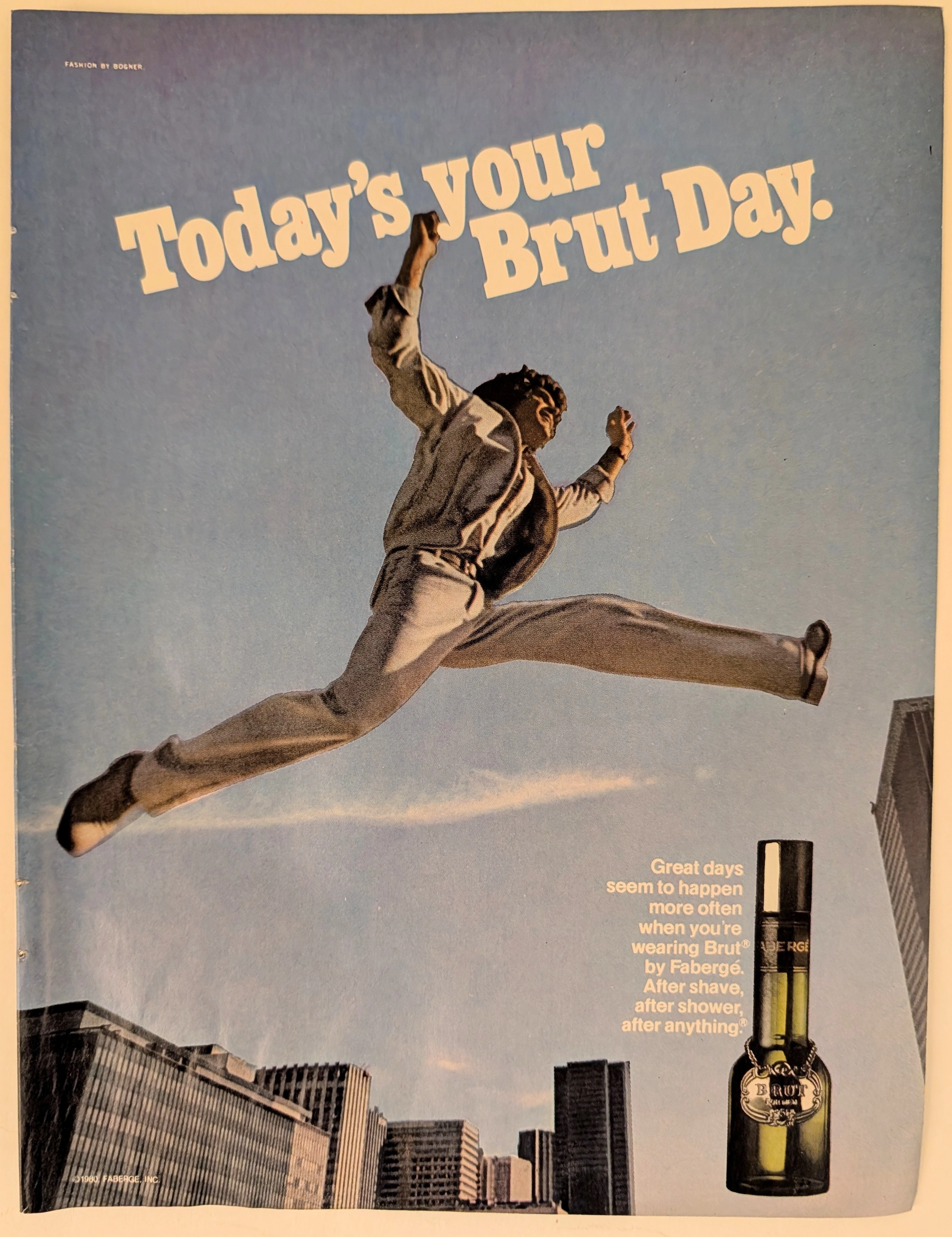
Then. Scent was a luxury. A scarce commodity housed in crystal. Reserved for the Sabbath. For the anniversary. For the rare, meticulously planned evening out. It was an occasion, not a routine. Now. Scent is utility. It is armor. It is a baseline expectation of modern societal engagement. The artifact before us marks the precise inflection point. The year is 1980. The moment male fragrance was deliberately uncoupled from the concept of "special occasions." It descended from the aristocratic shelf and embedded itself into the mundane rituals of the everyday man. "After shave, after shower, after anything." This is not merely advertising copy. It is a profound recalibration of masculine presentation. It is the engineered democratization of grooming.
Category: Beverage
Brand: Brut
The History
The Architecture of the Habit Loop The Chronology of Confidence To understand the gravity of this artifact, one must first dissect the temporal landscape of 1980. The United States was emerging from the dense, complicated malaise of the 1970s. Economic stagnation and geopolitical cynicism were beginning to yield to a new, aggressively optimistic paradigm. The dawn of the Reagan era was imminent. A decade of hyper-individualism, corporate ambition, and relentless kinetic energy was about to commence. Men were entering a new battlefield. The industrial floors were transitioning to corporate cubicles. The skyscraper was the new frontier. In this environment, physical labor was being replaced by psychological projection. Confidence became the primary currency. The modern man required a new kind of armor. Fabergé recognized this paradigm shift. They understood that the existing market for men's fragrance was fundamentally flawed. It was too precious. It was too rare. Brands like Aramis or Chanel were positioned as elite, aspirational, and consequently, infrequently used. Old Spice, while ubiquitous, was tied entirely to the act of shaving and carried the heavy, nostalgic scent of the previous generation. Brut identified the massive, unexploited territory in between: the everyday. Engineering the Everyday The masterstroke of Brut was the complete dismantling of friction. The copy on this artifact is a masterclass in behavioral engineering. "Great days seem to happen more often when you're wearing Brut by Fabergé." This sentence establishes a correlation between the application of the product and the success of the temporal period (the day). It is a promise of optimized reality. Then comes the definitive command: "After shave, after shower, after anything." Notice the progression. It begins with the traditional (after shave). It expands to the universal daily hygiene ritual (after shower). It culminates in the absolute removal of all boundaries (after anything). "After anything" is the philosophical core of this document. It dictates that there is no wrong time to apply the product. Finished a meeting? Apply Brut. Finished a tennis match? Apply Brut. Woke up? Apply Brut. This was the deliberate construction of a habit loop. Fabergé was not selling a bottle of scented liquid. They were selling a behavioral reflex. They normalized the concept that a man should constantly manage and refresh his olfactory footprint. They transformed fragrance from a luxury accessory into a daily utility. The Kinetic Wardrobe and the Bogner Connection Observe the subject of the artifact. He is not standing statically. He is not posing thoughtfully with a hand on his chin. He is suspended in mid-air. He is leaping. This kinetic energy is a direct reflection of the 1980s ethos. It is the visual manifestation of upward mobility. He is physically elevating himself above the dense, concrete geometry of the city below. The horizon is his floor. Crucially, we must analyze the wardrobe. The artifact explicitly credits "FASHION BY BOGNER." In 1980, Willy Bogner Jr. was redefining the intersection of athletic wear and premium lifestyle fashion. Bogner was famous for high-end ski apparel. It was the uniform of the wealthy at play. By outfitting the subject in Bogner, the ad agency fused athletic vigor with executive privilege. The man is not wearing a restrictive three-piece suit. He is wearing unstructured, active, yet inherently premium clothing. He is a man in motion. The clothing suggests that his "Brut Day" is not confined to a desk. It is expansive. It encompasses business, leisure, and physical exertion. The scent, therefore, must be capable of surviving and enhancing all these modalities. "After anything." The Monolith in Green Glass The visual semiotics of the Brut bottle cannot be ignored. While the subject flies, the bottle remains stubbornly, heavily grounded in the lower right quadrant. The design of the Brut bottle was a calculated exercise in masculine reassurance. At a time when men were still culturally hesitant about adopting extensive cosmetic routines, the packaging provided psychological safety. It is constructed of thick, heavy green glass. It resembles a flask or a premium liquor bottle. The silver medallion, hanging by a chain, evokes the imagery of a military dog tag or a championship medal. It does not look like a cosmetic. It looks like a trophy. It feels substantial and weighty in the hand. By designing a container that felt like a tool or a weapon of social conquest, Fabergé bypassed the traditional male resistance to perfumery. The bottle itself was an endorsement of traditional masculinity, even as the liquid inside pushed men toward modern vanity. The Historical Shift This single page of printed paper represents the death of the old grooming paradigm. Before this era, a man's scent was a byproduct of his soap or his shaving cream. After this era, a man's scent was a deliberate, curated, and constantly maintained projection of his identity. Brut paved the road for the body spray boom of the 1990s and 2000s. It laid the psychological foundation for the modern multi-billion dollar male grooming industry. Every modern advertisement that suggests a man needs a specific body wash, a specific deodorant, and a specific cologne to conquer his day owes its genetic lineage to this exact campaign. It taught the everyday man that vanity was not a weakness. It was a strategy.
The Paper
The physical artifact is a fragment of early 1980s mass-market periodical printing. Estimated at 60-70 GSM. Lightweight magazine stock. The surface features a calendared gloss finish, standard for high-circulation publications of the era. Under microscopic analysis, the CMYK halftone dot structure is pronounced, particularly in the vast expanse of the sky. The cyan layer carries the visual weight of the image, projecting the optimistic blue. Time, the ultimate archivist, has interacted with the chemistry of the ink and the wood pulp. A faint yellowing—acidic degradation—is visible at the extreme margins. The paper is a fragile membrane. It was designed to exist for a week, perhaps a month, on a coffee table or in a waiting room. It was ephemeral by design. Its survival 46 years later transforms it from commercial detritus into a sociological record. The scent of the original cologne it advertised has long vanished, replaced by the distinct, dry aroma of oxidizing lignin.
The Rarity
Classification: Class B Archival Justification: The artifact is not unique. Millions of identical impressions were violently pressed into existence by massive rotary cylinders across the globe. It populated the pages of Time, Sports Illustrated, and Newsweek. However, intrinsic value in the archive is not determined solely by scarcity of production, but by scarcity of survival and weight of context. Pristine, untorn copies that successfully evade the recycling bin, the damp basement, and the incinerator are increasingly rare. Its true value is sociological. It is a Class B artifact because it serves as a foundational baseline text for understanding the evolution of modern consumer behavior. It is a perfectly preserved specimen of a paradigm shift.
Cite this article
- MLA
- Naodhinsuk, Ronin. “The Time Traveller's Dossier : Brut 1980 - The Grooming Shift.” The Record Institute, 9 April 2026, https://therecord.institute/journal/the-time-travellers-dossier-brut-1980-the-grooming-shift.
- APA
- Naodhinsuk, R. (2026, April 9). The Time Traveller's Dossier : Brut 1980 - The Grooming Shift. The Record Institute. https://therecord.institute/journal/the-time-travellers-dossier-brut-1980-the-grooming-shift
- CHICAGO
- Naodhinsuk, Ronin. 2026. “The Time Traveller's Dossier : Brut 1980 - The Grooming Shift.” The Record Institute, April 9, 2026. https://therecord.institute/journal/the-time-travellers-dossier-brut-1980-the-grooming-shift.