The Time Traveller's Dossier : C-54 Skymaster - The Logistics Shift
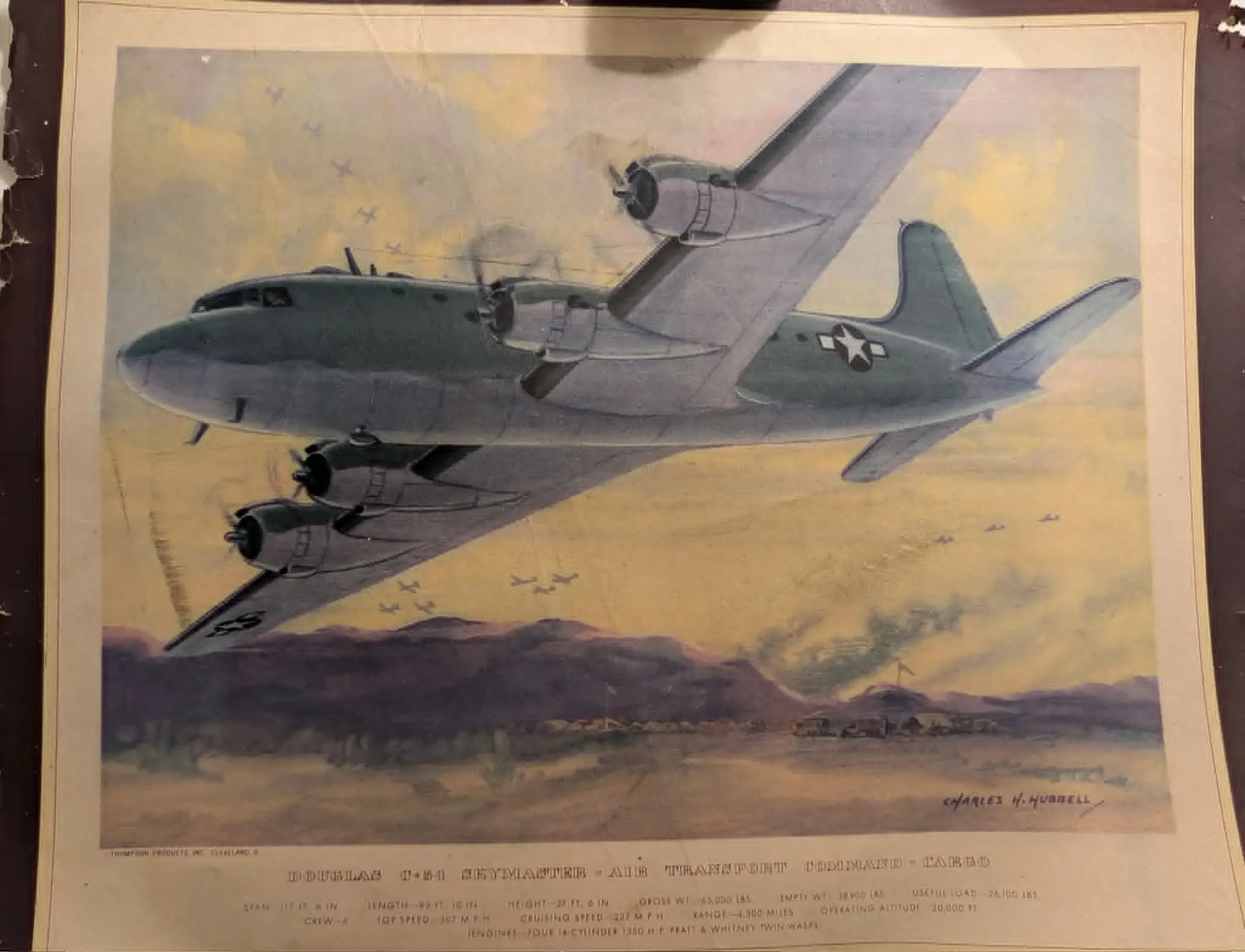
Before this artifact, geography dictated the limits of human endeavor. Oceans were insurmountable moats. Time was measured in the slow, agonizing transit of nautical miles. Then came the mechanical bridge. This lithograph of the Douglas C-54 Skymaster represents the exact moment when the world shrank. It chronicles the shift from tactical, localized warfare to the era of global, intercontinental logistics. War was no longer won merely by the men holding the rifles; it was won by the relentless, airborne supply chains that kept them fed, armed, and alive. The problem was the tyranny of distance in a two-front global conflict. The solution was the heavy, four-engine cargo transport. This decaying print, commissioned by an aerospace parts manufacturer, is not merely a portrait of an airplane. It is the visual manifesto of the modern, interconnected supply chain. It is the blueprint of globalism, born from the absolute necessity of survival.
Category: Technology
The History
The Tyranny of Distance and the Logistical Imperative To understand the gravity of this artifact, one must understand the absolute paralysis of distance in the early 1940s. The theater of operations was not a battlefield; it was the entire planet. The Allied forces faced a logistical nightmare unprecedented in human history. To move blood plasma, artillery shells, and personnel from the factories of the American Midwest to the jungles of Burma or the battered airfields of Britain required maritime convoys. These ships took weeks, constantly hunted by submerged predators, losing thousands of tons of vital cargo to the cold depths of the Atlantic and Pacific. A conflict defined by massive oceans required a mechanical vessel that could effectively ignore them. The Douglas C-54 Skymaster was the definitive answer to this logistical crisis. It was not a bomber. It carried no armaments. It was an industrial artery. Operated primarily by the Air Transport Command (ATC), the C-54 bypassed the perilous surface of the earth entirely. It established the concept of the global air bridge. The artifact before us captures this behemoth in its natural element, banking over a desolate, sun-baked landscape, dragging the concept of modern logistics in its wake. The shift was profound: time replaced distance as the primary metric of military strategy. Anatomy of a Global Freighter The typography at the base of the print reads like a holy text for industrial engineers. Every specification listed is a testament to the conquering of physics. "SPAN 117 FT. 6 IN" and "LENGTH 93 FT. 10 IN" denote a footprint of staggering proportions for the era. This was a flying warehouse. But it is the weight metrics that reveal the true narrative. "GROSS WT.—65,000 LBS." and "USEFUL LOAD—26,100 LBS." These numbers represent a fundamental shift in aviation capabilities. Thirteen tons of useful cargo meant that entire disassembled vehicles, hundreds of thousands of rounds of ammunition, or dozens of wounded soldiers on stretchers could be vaulted across the sky at a "CRUISING SPEED—227 M. P. H." This sheer mass was hauled into the troposphere by the mechanical heartbeats explicitly credited on the print: "ENGINES—FOUR 14-CYLINDER 1350 H. P. PRATT & WHITNEY TWIN-WASPS". These specific powerplants were marvels of radial engine design, providing the reliability required to cross the Atlantic Ocean without the luxury of emergency landing strips. The stated "RANGE—4,300 MILES" meant that London, Cairo, and Honolulu were no longer distant worlds; they were simply the next stop on an airborne schedule. The Patronage of Thompson Products This artwork was not commissioned by the military, nor by Douglas Aircraft. The subtle text at the bottom left corner reads: "©THOMPSON PRODUCTS, INC., CLEVELAND, O." This detail unlocks the economic and industrial ecosystem of the era. Thompson Products was a massive manufacturer of automotive and aircraft engine valves. They did not build the plane, but they built the critical, high-stress components that prevented those Pratt & Whitney engines from tearing themselves apart at an "OPERATING ALTITUDE—20,000 FT." During the war, industrial manufacturers engaged in fierce, patriotic marketing. By commissioning high-end lithographs of the aircraft that utilized their parts, Thompson Products inextricably linked their corporate identity with the pinnacle of Allied technological supremacy. This artifact is a masterclass in industrial B2B (business-to-business) marketing disguised as patriotic art. It served to boost morale on factory floors while silently asserting the company’s indispensable role in the victory. The shift here is the maturation of the military-industrial complex, where civilian manufacturing and military deployment became a singular, unified organism. Hubbell's Industrial Romanticism The signature in the bottom right, "CHARLES H. HUBBELL", belongs to one of the most prolific and respected aviation artists of the 20th century. Hubbell was contracted by Thompson Products to create annual calendars featuring meticulously accurate paintings of contemporary aircraft. Hubbell’s genius lay in his ability to fuse sterile engineering with atmospheric romance. He did not simply draft the C-54; he placed it within a breathing, atmospheric world. The muted yellows and dusty purples of the landscape contrast with the cold, militaristic olive drab of the fuselage. Hubbell managed to capture the immense weight of the aircraft while simultaneously rendering it suspended, graceful, and deeply powerful. His work elevated the machine from a tool of war to an icon of human progress. He documented the shift from canvas-and-wire biplanes to aluminum leviathans, freezing the rapid acceleration of aerospace technology into accessible, beautiful imagery for the American public. The Paradigm Shift in Global Economics The C-54 Skymaster did not simply win a war; it laid the foundation for the modern world. The logistical networks established by the Air Transport Command using this aircraft became the direct blueprint for the post-war global civilian airline industry. When the conflict ended, these military C-54s were stripped of their olive drab paint, fitted with passenger seats, and rebranded as the Douglas DC-4. The air routes they had pioneered over the Atlantic and the Pacific were handed over to commercial entities. The "RANGE—4,300 MILES" that was once used to deliver munitions was now used to deliver businessmen, tourists, and international mail. The shift from the C-54 to the DC-4 marks the exact genesis of globalization. The overnight shipping industry, the accessibility of international travel, and the interconnected global economy all trace their lineage back to the heavy transport capabilities proven by this specific aircraft. This artifact is the birth certificate of the shrinking earth.
The Paper
This artifact is a commercial lithographic print, likely produced on a mid-weight, wood-pulp based paper stock, estimated between 150 and 200 GSM. It exhibits severe, systemic degradation that speaks volumes about its journey through time. The most striking physical characteristic is the catastrophic failure of the dark brown mounting border. This border, brittle and heavily fragmented, shows extreme lignin oxidation. The paper is literally consuming itself through intrinsic acidity. The torn edges and flaking corners suggest this print was once part of a larger, functional object—almost certainly a promotional calendar designed to hang in a machine shop, drafting room, or corporate office. It has been exposed to fluctuating humidity, sunlight, and rough handling. The CMYK halftone pattern, necessary for mass reproduction of Hubbell’s original watercolor, has softened over decades, creating a patina that merges the precision of the mechanical printing press with the organic, uncontrollable decay of natural fibers. It is an artifact recording its own slow demise.
The Rarity
Classification: Class B (Contextual Survivor). Millions of these Thompson Products calendar prints were produced and distributed across the United States during the 1940s. In pristine condition, they are moderately common in aviation ephemera markets. However, the value of this specific piece lies not in its market price, but in its brutalized, authentic condition. Its torn edges and oxidized paper elevate it from a pristine collectible to a surviving witness of the industrial era. It holds immense contextual value for archivists studying mid-century corporate marketing, the documentation of aerospace engineering, and the visual culture of the military-industrial complex.
Cite this article
- MLA
- Naodhinsuk, Ronin. “The Time Traveller's Dossier : C-54 Skymaster - The Logistics Shift.” The Record Institute, 26 June 2026, https://therecord.institute/journal/the-time-travellers-dossier-c-54-skymaster-the-logistics-shift.
- APA
- Naodhinsuk, R. (2026, June 26). The Time Traveller's Dossier : C-54 Skymaster - The Logistics Shift. The Record Institute. https://therecord.institute/journal/the-time-travellers-dossier-c-54-skymaster-the-logistics-shift
- CHICAGO
- Naodhinsuk, Ronin. 2026. “The Time Traveller's Dossier : C-54 Skymaster - The Logistics Shift.” The Record Institute, June 26, 2026. https://therecord.institute/journal/the-time-travellers-dossier-c-54-skymaster-the-logistics-shift.