The Time Traveller's Dossier : Campbell's Vegetable Beef - The Industrialization of Maternal Care
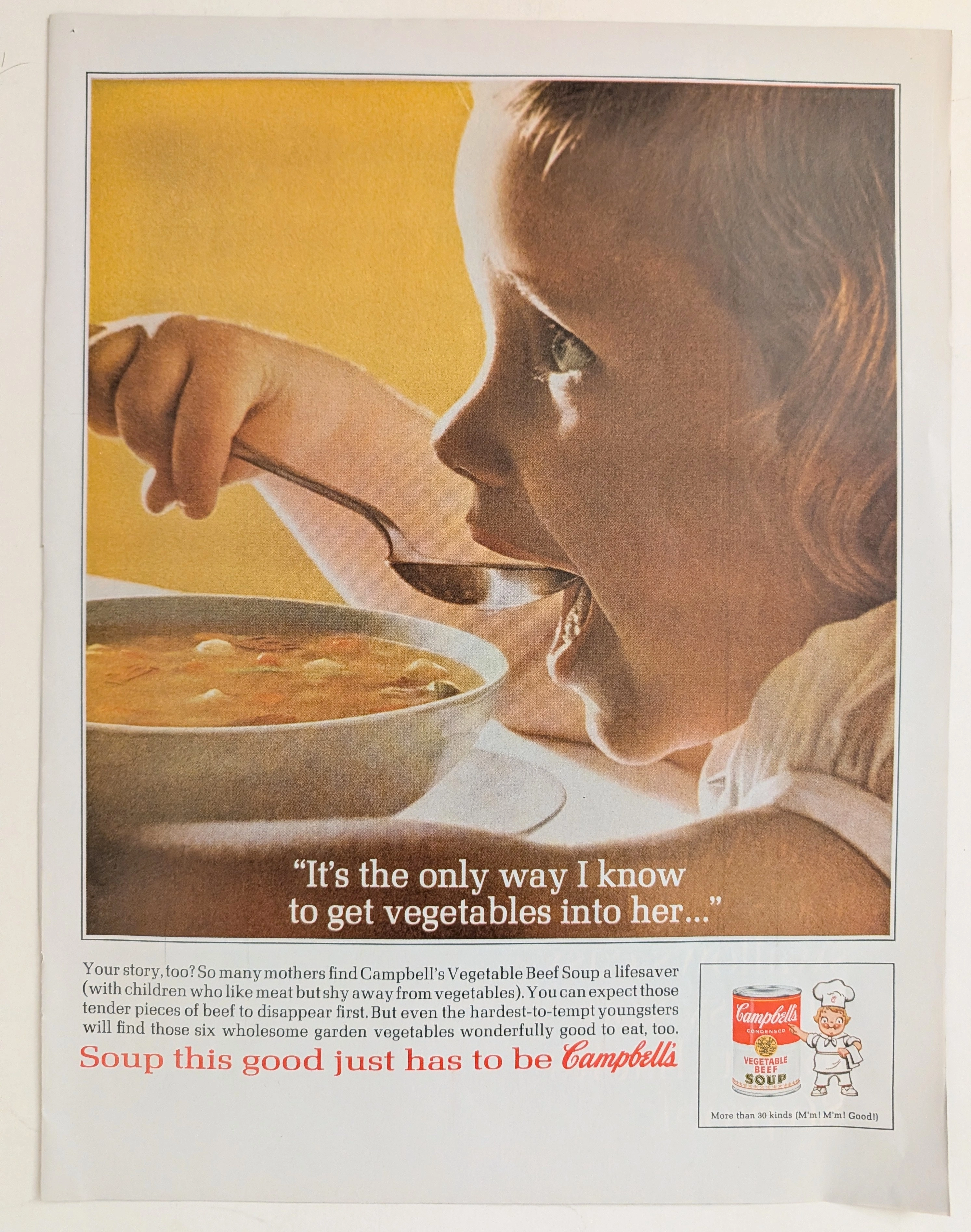
Then. The act of feeding a child was a localized, laborious mandate. It required the garden. It required the butcher. It required time. Vegetables were boiled into submission. Resistance at the dining table was a battle of wills. Maternal success was measured by the physical expenditure of calories to prepare food. Now. The artifact presents the intervention. The problem is no longer solved by time, but by chemistry and commerce. The corporation steps into the dining room. It offers a pact. It offers camouflage. Nutrition hidden within a sterilized, condensed matrix. The artifact marks the exact moment guilt was commodified, packaged, and sold back as convenience. The mother is absolved. The child is fed. The factory replaces the hearth.
Category: Food
Brand: campbell
The History
The Architecture of Domesticity To understand this artifact, one must understand the mid-century domestic theater. The post-war era built a specific cage for the nuclear family. The American suburbs expanded. The expectation of the homemaker crystallized. She was the architect of the household. She was the engineer of human capital. Yet, she was isolated. The multi-generational networks of child-rearing had fractured. The village was gone. In its place stood the supermarket aisle. This advertisement does not sell soup. It sells psychological relief. It addresses a universal point of friction: the child who refuses the vegetable. Historically, this friction was met with discipline or defeat. Here, it is met with industrial ingenuity. The text reads: "It's the only way I know to get vegetables into her..." This is not a slogan. It is a calculated confession. It mirrors the internal monologue of millions of women operating under the crushing weight of nutritional expectation. The artifact validates their fatigue. It establishes a dialogue between the unseen corporate entity and the exhausted caregiver. The corporation says: We see your struggle. We have engineered the solution. The Chemistry of Condensation We must strip away the nostalgia and look at the technological reality. The product depicted is a triumph of applied chemistry and logistics. Before Dr. John T. Dorrance, soup was heavy. It was mostly water. Shipping water across a continent was an economic failure. Dorrance, a chemist, altered the trajectory of mass consumption. He extracted the water. He created a dense, shelf-stable paste. The tin can became a vault. Inside the vault, the organic matter—the beef, the carrots, the peas—was suspended in a state of indefinite preservation. The thermal processing required to achieve this sterilization altered the texture. It softened the fibers of the vegetables. It homogenized the flavor profile. This was not an accident. It was the crucial mechanism of the camouflage. The "tender pieces of beef" and the "six wholesome garden vegetables" were suspended in a uniform broth that masked the bitter notes of raw flora. The child is not eating vegetables. The child is eating a standardized, palatable simulation of a meal, designed in a laboratory to bypass the biological defense mechanisms of the youthful palate. The Psychological Contract Look at the copy. "Your story, too? So many mothers find Campbell's Vegetable Beef Soup a lifesaver." The language is weaponized empathy. The word "lifesaver" is employed deliberately. It elevates a fifty-cent can of processed food to the level of critical intervention. The advertisement acknowledges the secret shame of the mother. The shame of the uneaten dinner. The shame of nutritional failure. The brand offers absolution. It shifts the burden of preparation from the individual to the industrial complex. The mother is no longer required to chop, simmer, and coax. She is only required to purchase, open, and heat. The artifact documents the transfer of trust. Trust was historically placed in the local butcher, the farmer, the soil. Here, trust is transferred to a mass-produced cylinder of steel, stamped with a red and white label. This was a monumental societal pivot. We surrendered the sovereignty of our kitchens to the efficiency of the assembly line. The Competitor Landscape Campbell's did not exist in a vacuum. Heinz. Progresso. Lipton. The mid-century market was a battlefield for pantry supremacy. Competitors offered dehydrated options. They offered ready-to-serve liquid. But Campbell's dominated through ubiquity and psychological anchoring. They did not merely sell taste. They sold consistency. A can of Vegetable Beef opened in New York tasted identical to a can opened in California. This standardization was reassuring in a rapidly changing world. While others competed on price or exotic ingredients, Campbell's competed on emotion. They deployed the "Campbell Kids"—seen here in the bottom right corner. These cherubic, genderless figures acted as trusted proxies. They softened the harsh reality of industrial food production. A factory in Camden, New Jersey, is cold. A plump, cartoon chef is warm. The competition fought over stomach share. Campbell's fought over, and won, the psychological real estate of the American mother. The Economic Engine The artifact is a byproduct of unprecedented economic expansion. The middle class had disposable income, but increasingly limited time. The post-war boom created an appetite for convenience that outpaced the desire for culinary tradition. Every element of this advertisement is designed to facilitate a transaction. The typography is clean. The message is linear. It is a machine for generating revenue. The promise of "More than 30 kinds" at the bottom is a declaration of industrial supremacy. It implies infinite choice, structured within a singular brand ecosystem. You never have to leave the red and white label. The corporation has categorized and canned every conceivable craving. This is the birth of the modern FMCG (Fast-Moving Consumer Goods) paradigm. Create the problem (the picky eater). Validate the anxiety (maternal guilt). Provide the proprietary solution (the can). The Permanent Shift Why does this piece of paper matter? Because it documents the exact moment we forgot how to feed ourselves. It marks the transition from active cultivation to passive consumption. Before this era, food was an act of labor. After this era, food became a product. The child in the photograph is not merely eating soup. She is ingesting a new ideology. She is being conditioned to accept highly processed, uniform flavors as the baseline of sustenance. The mother is not merely serving lunch. She is participating in the vast, invisible machinery of the post-war economy. The historical shift is absolute. We traded the complexity of the natural world for the predictable comfort of the tin can. And we thanked the corporation for the privilege. This artifact is not an advertisement. It is the charter document of our modern dietary submission.
The Paper
The physical matrix of this artifact tells a parallel story of mass production. It is printed on standard mid-century magazine stock, likely hovering around 60 to 70 GSM. It is thin. It was never meant to survive. It was engineered for a brief lifespan: to be glossed over, digested visually, and discarded. The printing method is a classic web offset lithography. Under magnification, the image dissolves into a rigid geometry of CMYK halftone dots. The warmth of the child's skin is an illusion constructed from microscopic overlapping circles of magenta and yellow. The paper is actively dying. Lignin, the natural polymer in the wood pulp, is reacting with atmospheric oxygen. This oxidation manifests as a slow, irreversible yellowing. The artifact is brittle at the margins. It carries the faint, dry scent of decaying cellulose and old ink. It is a fragile, deteriorating record of a permanent cultural shift.
The Rarity
Classification: Class A - The Ubiquitous Monument. In terms of pure scarcity, this artifact is common. Millions of copies were pressed into the pages of Life, Look, and The Saturday Evening Post. However, its rarity does not stem from its absence, but from its survival. Most were burned, pulped, or lined the bottoms of birdcages. Its true classification is driven by its immense contextual value. It is a pristine primary source documenting the mid-century commodification of family life. It holds a Class A designation because while you can easily find another copy, you cannot find a more perfect encapsulation of the era's psychological mechanics. It is a common key to a massive historical door.
Cite this article
- MLA
- Naodhinsuk, Ronin. “The Time Traveller's Dossier : Campbell's Vegetable Beef - The Industrialization of Maternal Care.” The Record Institute, 9 May 2026, https://therecord.institute/journal/the-time-travellers-dossier-campbells-vegetable-beef-the-industrialization-of-maternal-care.
- APA
- Naodhinsuk, R. (2026, May 9). The Time Traveller's Dossier : Campbell's Vegetable Beef - The Industrialization of Maternal Care. The Record Institute. https://therecord.institute/journal/the-time-travellers-dossier-campbells-vegetable-beef-the-industrialization-of-maternal-care
- CHICAGO
- Naodhinsuk, Ronin. 2026. “The Time Traveller's Dossier : Campbell's Vegetable Beef - The Industrialization of Maternal Care.” The Record Institute, May 9, 2026. https://therecord.institute/journal/the-time-travellers-dossier-campbells-vegetable-beef-the-industrialization-of-maternal-care.