The Time Traveller's Dossier : Caravelle vs Timex - The Jeweled Shift
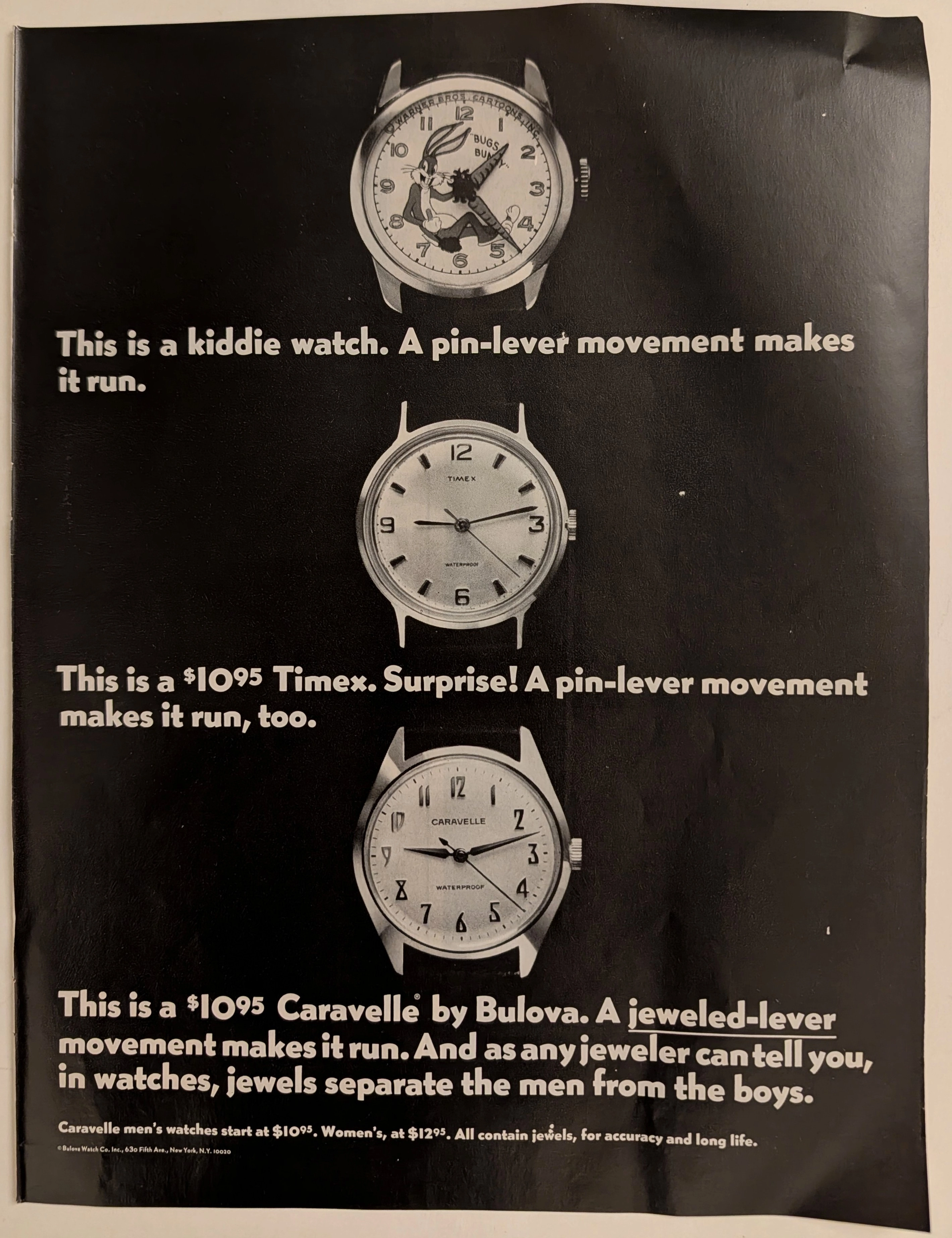
Time was once a luxury. Then, it became a commodity. Before this artifact, the consumer market accepted a bitter compromise: affordability meant fragility. The mid-20th century was dominated by the pin-lever escapement. It was a mechanism of planned obsolescence. It brought timekeeping to the masses, but at the cost of durability. The market leader, Timex, built an empire on this disposable architecture. Then came the shift. This advertisement is a tactical strike. It is not merely selling a watch; it is dismantling an empire’s foundation. By placing a children’s novelty item alongside a market leader, Bulova’s Caravelle executed a masterclass in comparative destruction. They solved the problem of the disposable watch by democratizing the jeweled movement. It changed the expectation of the working class. It declared that precision was no longer reserved for the elite. Affordability no longer required surrender.
Category: Fashion
Brand: ฺีBulova
The History
The Chronological Commoditization To understand the weight of this artifact, we must examine the landscape of the mid-20th century. Post-war America was a theater of immense economic expansion. The working class had disposable income, and the rhythm of society accelerated. Punctuality was no longer a virtue of the wealthy; it was an absolute requirement for the industrial and corporate machinery. Time had to be strapped to the wrist of every worker. Timex answered this call with brutal efficiency. They utilized the pin-lever movement. It was a triumph of cost-reduction. However, it was also an engineering compromise. The market accepted this compromise. A ten-dollar watch was expected to die. When it stopped ticking, it was discarded. The concept of "horology" was divorced from "utility." The masses bought utility. This artifact marks the exact moment that dichotomy was shattered. Bulova, a titan of traditional watchmaking, looked at the monopoly of the disposable watch and saw a vulnerability. They did not attack Timex on style. They attacked them on physics. The Anatomy of Friction and Failure The core of this artifact’s message lies in microscopic mechanics. A mechanical watch is essentially a coiled spring trying to uncoil, regulated by an escapement. This escapement consists of a mechanism locking and unlocking gear teeth, releasing energy in fractions of a second. This creates friction. Friction is the eternal enemy of the machine. In a pin-lever movement—the heart of both the Bugs Bunny watch and the Timex featured in the artifact—the pallets interacting with the escapement wheel are simple metal pins. Metal striking metal, millions of times a day. The wear is rapid. The degradation is inevitable. The mechanism is consuming itself from the inside out to provide the time. The jeweled-lever movement, previously reserved for expensive Swiss chronometers, replaces these metal pins with synthetic rubies. Ruby is corundum. It is immensely hard. It does not wear against the brass or steel of the gear train. The friction is reduced to a statistical anomaly. The lifespan of the machine increases exponentially. By offering a jeweled movement at
The Paper
The artifact survives on a mid-weight magazine stock, likely hovering between 70 and 90 GSM. It is born of acidic wood pulp, an inherently self-destructive material. Lignin within the paper reacts with oxygen and ultraviolet light. The paper is slowly burning itself over decades, yellowing at the edges, becoming brittle. It is a physical chronometer. The printing is a standard four-color CMYK halftone process, though heavily reliant on the Key (black) plate to generate the deep, crushing darkness of the background. Under a loupe, the crisp edges of the utilitarian sans-serif typography break down into a constellation of ink dots, sunk deeply into the porous, textured surface of the aged paper. The physical degradation of the page creates a profound irony. The paper, advertising the eternal durability of the jeweled movement, is itself succumbing to the friction of time.
The Rarity
Classification: Class A (High Contextual Value). The physical artifact is not inherently rare. As a mass-market magazine insert, hundreds of thousands were printed. Many survive in the dark corners of attics and archives. However, its contextual rarity is immense. Most advertisements of this era relied on lifestyle aspiration. They sold the dream. This artifact is rare because it sold the absolute, unvarnished mechanical truth. Finding comparative advertising this naked, this aggressive, and this structurally perfect in the 1960s horological sector is uncommon. Its value is not measured at an auction house, but in a syllabus on consumer psychology and strategic market warfare.
Cite this article
- MLA
- Naodhinsuk, Ronin. “The Time Traveller's Dossier : Caravelle vs Timex - The Jeweled Shift.” The Record Institute, 14 May 2026, https://therecord.institute/journal/the-time-travellers-dossier-caravelle-vs-timex-the-jeweled-shift.
- APA
- Naodhinsuk, R. (2026, May 14). The Time Traveller's Dossier : Caravelle vs Timex - The Jeweled Shift. The Record Institute. https://therecord.institute/journal/the-time-travellers-dossier-caravelle-vs-timex-the-jeweled-shift
- CHICAGO
- Naodhinsuk, Ronin. 2026. “The Time Traveller's Dossier : Caravelle vs Timex - The Jeweled Shift.” The Record Institute, May 14, 2026. https://therecord.institute/journal/the-time-travellers-dossier-caravelle-vs-timex-the-jeweled-shift.