The Time Traveller's Dossier : Cavalier Corporation - The Architecture of the American Home
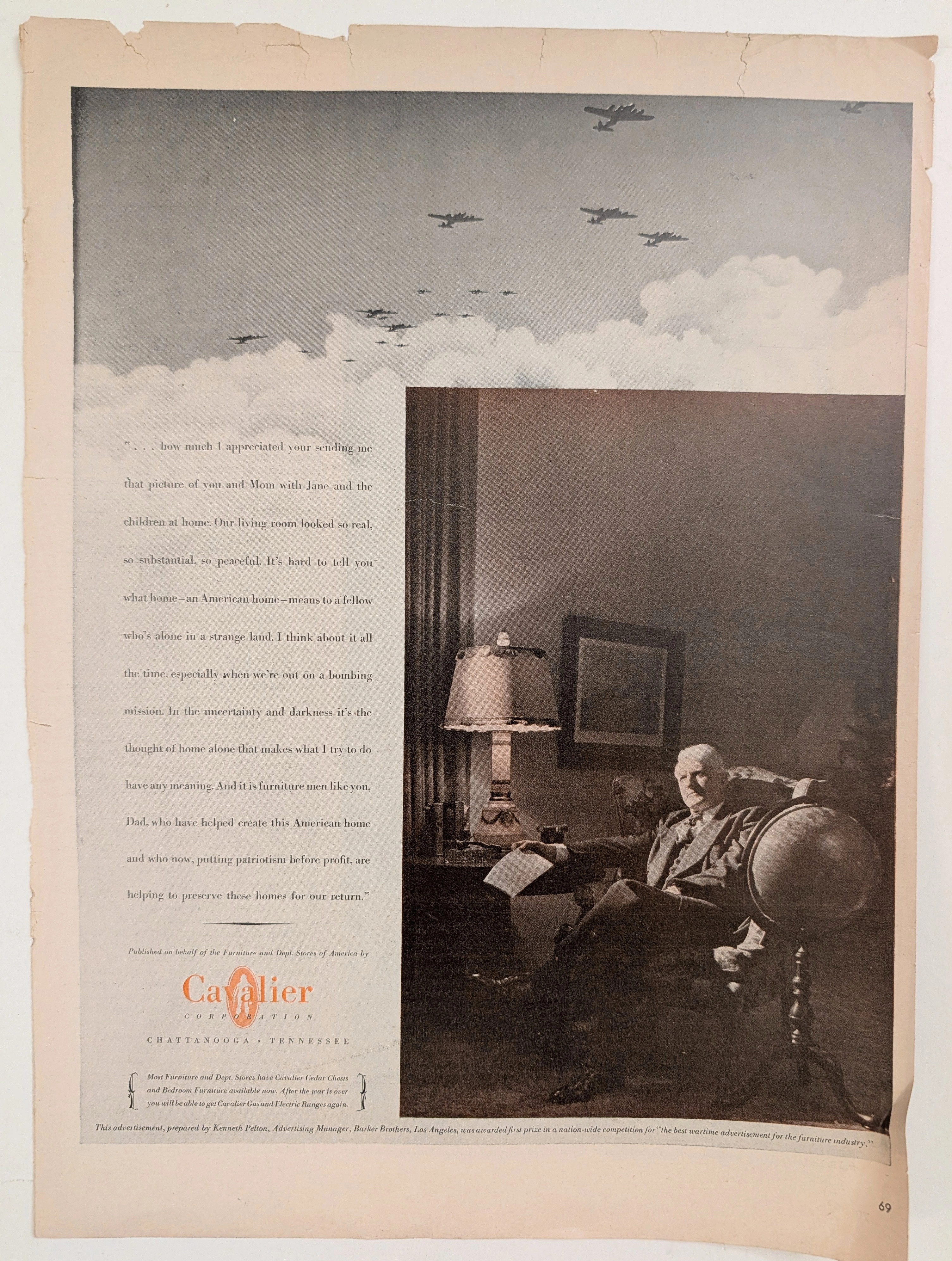
Then, a living room was merely an assembly of wood, upholstery, and domestic utility. Now, it is the psychological fortress of a world at war. The problem in the early 1940s was not the pursuit of interior design; it was the existential crisis of a nation plunging its youth into the freezing, flak-filled skies over foreign continents. The profound disconnect between the absolute terror of the front lines and the quiet safety of the home front threatened to fracture the national psyche. The solution, as masterfully articulated by the Cavalier Corporation in this artifact, was an ideological recalibration. This artifact is a portal. It transports us to the exact historical moment when the domestic furniture industry ceased selling physical comfort and began selling the very meaning of the war itself. It is an advertisement, yes. But deeper than that, it is a haunting manifesto of sacrifice, transforming retail furniture merchants into the silent, patriotic architects of the American soul. It captures the precise shift where a cedar chest became a temporal vault for a future that was, at the time, entirely uncertain.
Category: Other
Brand: Cavalier
The History
The Tactical and Psychological Reality of the Air War To understand this artifact, one must first understand the chilling reality of the high-altitude air war over Europe and the Pacific during the Second World War. The top half of this advertisement is dominated by the ominous silhouettes of what appear to be B-17 Flying Fortresses, soaring in formation above a dense, infinite bank of clouds. For the young men crewing these bombers, the war was a sensory nightmare. They operated in unpressurized cabins at twenty-five thousand feet, enduring sub-zero temperatures, deafening engine roar, and the constant, random terror of anti-aircraft flak and enemy interceptors. It was a realm of absolute mechanical hostility. Within this freezing, hostile environment, the human mind required an anchor to maintain sanity. The text of the advertisement provides this anchor through a fictionalized, yet deeply resonant, letter from a son to his father. The airman writes, "In the uncertainty and darkness it's the thought of home alone that makes what I try to do have any meaning." This is not a sentiment born of marketing frivolity; it is a profound observation of combat psychology. The American military did not fight for an emperor or a millennia-old empire; they were fighting, ideologically, for the preservation of the suburban living room. The furniture industry recognized this psychological truth and weaponized it. They positioned the physical home not as a place of retreat, but as the very core of the war aim. The Visual Dissonance: The Sky and the Study The brilliance of this artifact lies in its stark, uncompromising visual dissonance. The page is sharply divided into two distinct realms. Above, the ethereal, dangerous, and infinite sky, populated by machines of death. Below and to the right, the grounded, warm, and highly controlled environment of the father's study. The transition between these two worlds is bridged only by the written word—the text of the son's letter. Observe the meticulous set design of the father's domain. He sits in a robust, traditional wingback chair, the epitome of established comfort. Beside him is an ornate table lamp, casting a halo of warm, localized light that stands in sharp contrast to the cold, diffuse light of the cloud bank above. Most importantly, a large globe rests in the foreground. This is a highly calculated prop. The globe represents the massive, chaotic scale of the global conflict his son is engaged in, yet it is tamed, miniaturized, and placed safely within the confines of the American study. The father, a "furniture man," reads the letter in perfect safety, yet the advertisement does not accuse him of cowardice. Instead, it elevates his civilian occupation to a vital act of national preservation. The Industrial Pivot: Steel for War, Wood for Waiting Beneath the emotional rhetoric lies a stark industrial reality, highlighted by the text at the bottom: "Most Furniture and Dept. Stores have Cavalier Cedar Chests and Bedroom Furniture available now. After the war is over you will be able to get Cavalier Gas and Electric Ranges again." This single sentence encapsulates the entire economic upheaval of the American home front. Prior to the war, the Cavalier Corporation of Chattanooga, Tennessee, was a major manufacturer of gas and electric ranges. However, ranges require massive amounts of sheet steel, copper wiring, and chromium—the exact same strategic materials required to build Sherman tanks, M1 Garand rifles, and the B-17 bombers pictured in the sky. By mandate of the War Production Board, the domestic manufacture of consumer appliances was completely halted. Cavalier was forced to pivot its massive industrial capacity. While they likely took on military contracts, their civilian-facing brand had to rely on what was not restricted: wood. They continued to manufacture cedar chests and wooden bedroom sets. The cedar chest, in this context, becomes a powerful metaphor. A cedar chest is designed to protect its contents from moths and decay; it is a preservation tool. During the war, it became a literal holding place for trousseaus, hopes, and the promise of a postponed future, waiting for the young men to return from the sky. The Ideological Weaponization of the "American Home" This advertisement represents a fundamental shift in how the concept of "home" was marketed. Before the attack on Pearl Harbor, home furnishings were marketed based on aesthetics, status, and comfort. By 1944, those selling points were considered deeply inappropriate, if not outright unpatriotic. The nation was subject to rationing, price controls by the Office of Price Administration, and constant calls to buy War Bonds. The Cavalier Corporation, alongside the broader retail furniture industry, executed a masterful pivot. The son's letter states: "And it is furniture men like you, Dad, who have helped create this American home and who now, putting patriotism before profit, are helping to preserve these homes for our return." This is the invention of corporate social responsibility as a mechanism for wartime survival. The industry successfully argued that by maintaining the domestic economy and keeping retail storefronts open, they were not profiteering, but were actively maintaining the psychological baseline that the soldiers were fighting to protect. They transformed the act of buying a wooden chest into an act of civilian defiance against global fascism. Kenneth Pelton and the Masterclass in Institutional Advertising The small text at the very bottom of the page reveals the architect of this message: Kenneth Pelton, Advertising Manager for Barker Brothers in Los Angeles. The ad notes that it was awarded first prize in a nationwide competition for "the best wartime advertisement for the furniture industry." Pelton's genius was crafting a piece of "institutional advertising." Because physical goods were scarce, companies could not run traditional sales ads. If a store advertised a sale on stoves, they would sell out in an hour and anger hundreds of customers they could not supply. Instead, Pelton wrote an anthem. He did not sell a specific Cavalier product; he sold the entire concept of the retail furniture industry. By noting that it was "Published on behalf of the Furniture and Dept. Stores of America by Cavalier Corporation," the brand positioned itself as a magnanimous leader of a unified domestic front. It is a masterclass in B2B (business-to-business) and B2C (business-to-consumer) communication simultaneously. It reassured the consumer that their sacrifices were necessary, and it reassured the retail furniture salesman that his job was honorable. It represents the exact moment when American advertising realized that selling an ideology is vastly more powerful than selling a physical commodity.
The Paper
This artifact bears the profound physical scars of its temporal journey. The paper stock is a classic wartime newsprint or low-grade magazine stock, highly indicative of the material rationing of the era. The severe, jagged tearing and deep cracking visible along the top edge are textbook examples of acid degradation. Because high-quality bleaching agents and pure wood pulps were restricted for the war effort, wartime paper was heavily laden with lignin, which oxidizes rapidly upon exposure to light and air. The printing process is a high-volume offset lithography, utilizing a highly effective two-color process. Rather than the expensive and complex CMYK four-color process, the designers utilized a deep, rich monochrome base—ranging from stark black to soft charcoal grays—to render the photographic elements of the bombers and the study. This monochrome base is aggressively punctuated by a single spot color: the vibrant, almost luminous orange of the Cavalier Corporation logo. This was an economic necessity that evolved into a brilliant design choice; the orange cuts through the somber, gray reality of the war, drawing the eye instantly and establishing the brand as a beacon of hope amidst the darkness. The tactile reality of this page—brittle, highly textured, and visibly decaying—serves as a physical testament to the era of sacrifice it depicts.
The Rarity
Classification: Class S (Archival Significance - Masterpiece of Institutional Advertising) While wartime advertisements are generally common, this specific artifact ascends to Class S due to its documented historical pedigree. The explicit inclusion of the text denoting it as the first-prize winner in a nationwide competition transforms this page from a mere commercial insert into an officially recognized pinnacle of wartime propaganda design. It is a primary source document that captures the absolute apex of the industry's psychological strategy. Finding an intact, legible copy of an award-winning industry manifesto, complete with the nuanced spot-color printing and the poignant juxtaposition of the bombers and the study, is exceedingly rare. Its value lies not in consumer nostalgia, but in its profound academic utility as a study of corporate wartime survival.
Cite this article
- MLA
- Naodhinsuk, Ronin. “The Time Traveller's Dossier : Cavalier Corporation - The Architecture of the American Home.” The Record Institute, 18 April 2026, https://therecord.institute/journal/the-time-travellers-dossier-cavalier-corporation-the-architecture-of-the-american-home.
- APA
- Naodhinsuk, R. (2026, April 18). The Time Traveller's Dossier : Cavalier Corporation - The Architecture of the American Home. The Record Institute. https://therecord.institute/journal/the-time-travellers-dossier-cavalier-corporation-the-architecture-of-the-american-home
- CHICAGO
- Naodhinsuk, Ronin. 2026. “The Time Traveller's Dossier : Cavalier Corporation - The Architecture of the American Home.” The Record Institute, April 18, 2026. https://therecord.institute/journal/the-time-travellers-dossier-cavalier-corporation-the-architecture-of-the-american-home.