The Time Traveller's Dossier : Cavander's Army Club - The Linguistic Artillery of WWI
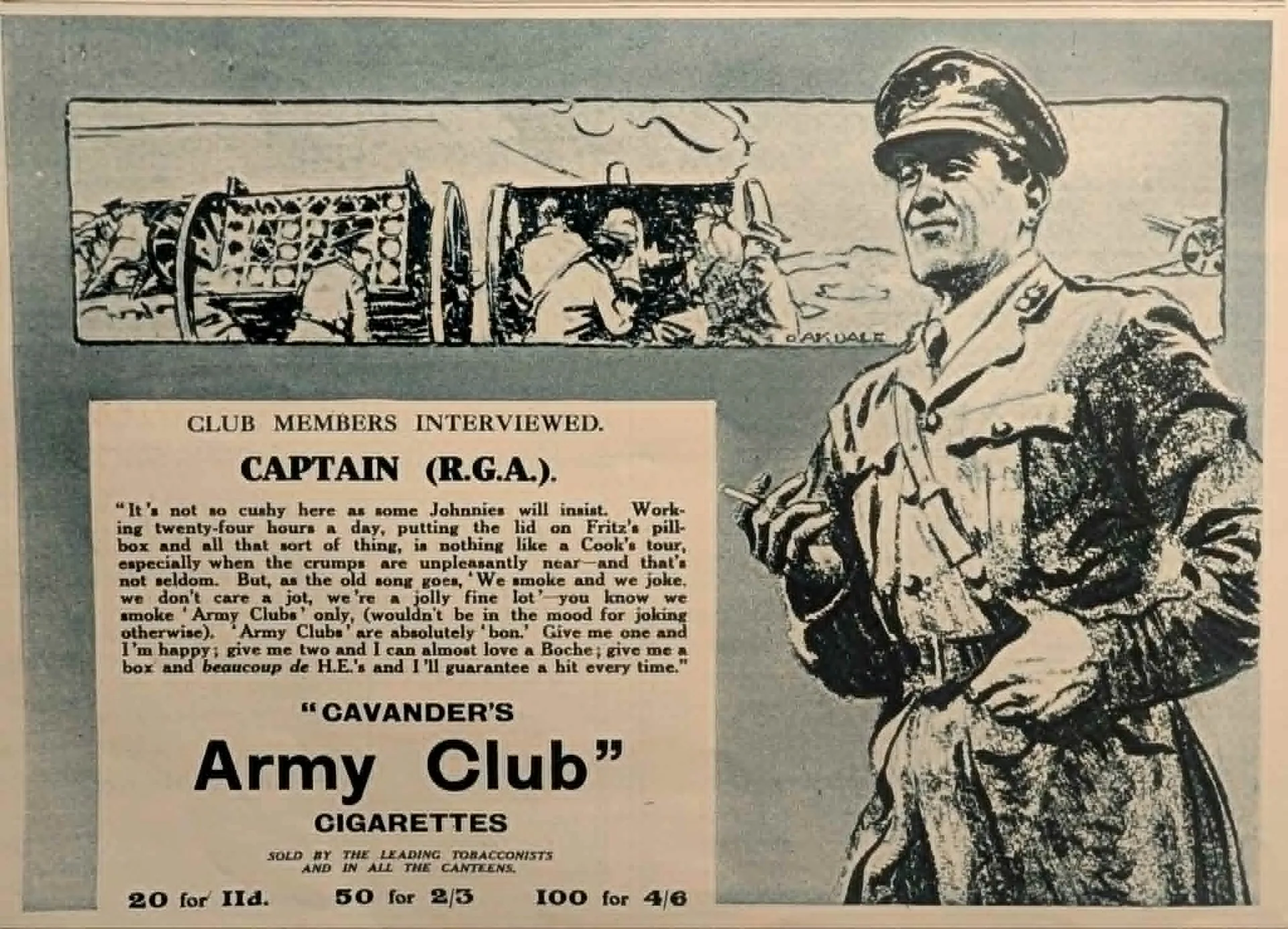
Before the turn of the twentieth century, tobacco was a luxury of the parlor. It was the domain of the aristocrat, the quiet reflection of the gentleman, the slow burn of a cigar over brandy. Then came the industrialization of human conflict. The artifact before us is not merely a commercial advertisement. It is a sociological anchor. It captures the exact moment when the cigarette transformed from a civilian indulgence into a military utility. This clipping for Cavander’s "Army Club" Cigarettes demonstrates a profound shift in consumer marketing: the weaponization of shared trauma, the normalization of trench slang in mass media, and the realization that an entire generation of men now required a neurochemical coping mechanism just to survive the day. The problem was no longer boredom. The problem was artillery fire. The solution was mass-produced, chemically uniform nicotine. This is the architecture of wartime survival, printed on cheap pulp.
Category: Tobacco
The History
The Mechanization of Coping Mechanisms Conflict is an engine. It accelerates technology. It accelerates death. It accelerates necessity. To understand this artifact, we must first understand the psychological landscape of the First World War. Between 1914 and 1918, the British Empire deployed millions of men into an environment completely alien to human evolutionary conditioning. The Western Front was a landscape of industrialized slaughter, characterized by the ceaseless, deafening roar of artillery. The human nervous system was not designed to withstand the constant threat of high-explosive obliteration. The cigarette emerged as a localized mechanism for psychological control. It was a brief, combustible moment of peace. Lighting a cigarette required focus. It required a steady hand. It provided a deep, measured inhalation of smoke that triggered a mild dopamine release, temporarily suppressing the paralyzing effects of fear and cold. The British War Office quickly realized that tobacco was not a luxury; it was a fundamental logistical requirement. It was as essential to morale as ammunition was to the rifles. By 1915, cigarettes were officially included in the rations of front-line soldiers. Cavander’s, a tobacco company established in 1775, recognized this unprecedented demographic shift. They understood that the post-Victorian market of gentlemen smoking loose leaf in mahogany rooms was gone. The new market was sitting in freezing mud in Flanders. The "Army Club" brand was engineered specifically to capture this reality. It positioned itself exactly on the borderline of aspiration and accessibility. It was marketed to officers—the "Captain"—but priced for the masses. The Birth of Trench Linguistics in Mass Media What makes this advertisement a supreme historical artifact is its text. It is a masterclass in the integration of trench linguistics into civilian commerce. Prior to this era, advertising copy was formal, polite, and strictly grammatical. This copy is entirely different. It speaks in the gritty, hybridized code of the trenches. It is written to signal in-group belonging. If you understood the ad, you understood the war. Let us dissect the linguistic payload. "It's not so cushy here as some Johnnies will insist." The word "cushy" was imported from India, derived from the Urdu word 'khushi', meaning pleasant or easy. The British Army, heavily stationed in India prior to the war, brought the word to Europe. "Johnnies" refers to naïve new recruits or civilians back home who did not understand the true nature of the front. "Putting the lid on Fritz's pill-box and all that sort of thing, is nothing like a Cook's tour..." "Fritz" was the universal, slightly diminutive slang for the German soldier. A "pill-box" was the dreaded concrete blockhouse armed with machine guns that decimated British infantry. The casual phrase "putting the lid on" minimizes the sheer horror of assaulting fortified positions. The reference to a "Cook's tour" is a dark, ironic nod to Thomas Cook & Son, the famous British travel agency. The contrast between a guided European holiday and the grim reality of trench warfare is stark and cynical. "...especially when the crumps are unpleasantly near—and that's not seldom." A "crump" was onomatopoeic slang. It described the distinct, terrifying sound of a German 5.9-inch heavy artillery shell detonating. "...give me two and I can almost love a Boche; give me a box and beaucoup de H.E.'s and I'll guarantee a hit every time." "Boche" was borrowed from French slang, a derogatory term for Germans. "Beaucoup" (much/many) reflects the linguistic hybridization that occurred as millions of working-class British men lived for years alongside French civilians. Finally, "H.E.'s" stands for High Explosives. This is not marketing copy. This is a cultural time capsule. It demonstrates how the trauma of a generation bypassed traditional censorship and polite society, embedding itself directly into the commercial vernacular of the daily newspaper. The Royal Garrison Artillery: Mathematics and Mud The visual and textual focus on a "Captain (R.G.A.)" is a highly calculated strategic choice. During the First World War, the British artillery was divided into two main branches: the Royal Field Artillery (R.F.A.) and the Royal Garrison Artillery (R.G.A.). The R.F.A. was mobile. They used lighter guns, moved quickly, and provided immediate support to the infantry. The R.G.A., however, was different. They were the masters of the heavy siege guns and massive howitzers. They were stationed further back from the immediate front line, calculating complex mathematical trajectories to drop massive high-explosive shells (the "beaucoup de H.E.'s") onto enemy pill-boxes and rail hubs. Choosing an R.G.A. Captain as the spokesman for "Army Club" cigarettes was a masterstroke of psychological branding. An R.G.A. officer was perceived as intelligent, calculating, calm under pressure, and responsible for immense destructive power. He was the ultimate professional of mechanized war. By associating the cigarette with the R.G.A. Captain, Cavander’s was selling stoicism. They were telling the consumer: "This is the cigarette of the man who mathematically calculates the destruction of the enemy while under fire. If it calms his nerves, it will calm yours." The Economic Architecture of Wartime Tobacco At the bottom of the artifact, the economic reality of 1910s Britain is permanently inked. "20 for 11d. 50 for 2/3. 100 for 4/6." These numbers represent the pre-decimalization currency of the British Empire: pounds, shillings, and pence. 11d means 11 pence (just under one shilling). 2/3 means 2 shillings and 3 pence. 4/6 means 4 shillings and 6 pence. In 1916, a British infantry private earned approximately one shilling a day. Therefore, a pack of 20 Cavander’s Army Club cigarettes cost nearly an entire day's wages for a private. This confirms the brand's positioning. It was not the absolute cheapest cigarette on the market—that title belonged to the infamous Woodbines, which were stronger, unfiltered, and deeply associated with the working-class infantry. Army Club was positioned slightly higher. It was the aspirational brand. It was the cigarette a civilian family would purchase and mail to the front in a care package, hoping to provide their son or husband with a taste of "officer-class" comfort. The scale of this economy was staggering. Billions of cigarettes were manufactured, shipped across the English Channel, and consumed in the mud. Tobacco companies grew into modern corporate titans on the back of this captive, highly stressed demographic. The war cemented the cigarette as a ubiquitous item of 20th-century consumer culture, paving the way for the massive tobacco industries of the post-war decades. The Societal Shift: From Aristocratic Vice to Democratic Necessity Ultimately, this artifact documents the democratization of smoking. Before the war, smoking was often tied to class and context. During the war, the trench became a great equalizer. An officer and a private might smoke different brands, but they were both chained to the same neurochemical need. The cigarette became a symbol of shared suffering, shared endurance, and shared humanity in an inhuman environment. When the men returned home in 1918 and 1919, they did not leave this habit in France. The physiological addiction and the psychological association with comfort came home with them. The civilian market was forever changed. Advertising no longer needed to sell tobacco as a luxury; it was now an ingrained daily necessity for millions of men. The artifact we are analyzing is the exact bridge between those two worlds. It is the moment the machinery of marketing aligned perfectly with the machinery of war.
The Paper
This artifact is printed on early 20th-century mechanical wood pulp paper, commonly known as newsprint. Unlike the rag-based papers of previous centuries, this material is highly acidic due to the retention of lignin from the wood fibers. The physical document is literally consuming itself over time. The yellowing, known to archivists as foxing, is a visible chemical reaction—an oxidation process that acts as a physical clock. The printing method utilizes a coarse half-tone screen, typical of high-speed rotary presses of the era. The black ink is carbon-based, pressed deep into the porous, un-coated fibers. The image possesses a tactile topography. It was designed to exist for a single day—read over a morning tea and discarded. Yet, it has survived. The ephemeral nature of the medium heavily contrasts with the permanent, generational trauma of the message it carries. It is a fragile vessel holding a very heavy history.
The Rarity
Classification: Class A (High Historical Resonance) In terms of physical scarcity, daily newspaper clippings from the World War I era are relatively common in national archives and private collections. However, its value is not determined by its market price, but by its immense contextual density. As a standalone piece of graphic design, it is standard. As a socio-linguistic artifact capturing the exact integration of military slang into civilian commerce, it is exemplary. It is an indispensable primary source for sociologists, military historians, and linguists studying the commercialization of the war effort.
Cite this article
- MLA
- Naodhinsuk, Ronin. “The Time Traveller's Dossier : Cavander's Army Club - The Linguistic Artillery of WWI.” The Record Institute, 3 July 2026, https://therecord.institute/journal/the-time-travellers-dossier-cavanders-army-club-the-linguistic-artillery-of-wwi.
- APA
- Naodhinsuk, R. (2026, July 3). The Time Traveller's Dossier : Cavander's Army Club - The Linguistic Artillery of WWI. The Record Institute. https://therecord.institute/journal/the-time-travellers-dossier-cavanders-army-club-the-linguistic-artillery-of-wwi
- CHICAGO
- Naodhinsuk, Ronin. 2026. “The Time Traveller's Dossier : Cavander's Army Club - The Linguistic Artillery of WWI.” The Record Institute, July 3, 2026. https://therecord.institute/journal/the-time-travellers-dossier-cavanders-army-club-the-linguistic-artillery-of-wwi.