The Time Traveller's Dossier : Champion - The Speed Shift
Then: The world moved at the pace of mechanics. Transportation was a slow, deliberate act of moving mass from one coordinate to another. Engines were hesitant. Ignition was a fragile negotiation between fuel, air, and timing. Now: The world demanded immediacy. The post-war era did not just want to travel; it wanted to accelerate. The problem was the hesitation of the machine. The misfire. The stalled launch. The solution was an engineered, reliable spark. A standardized pulse of artificial lightning. This document does not merely analyze an advertisement. It analyzes the exact moment human expectation shifted from "getting there" to "getting there first."
Category: Automotive
The History
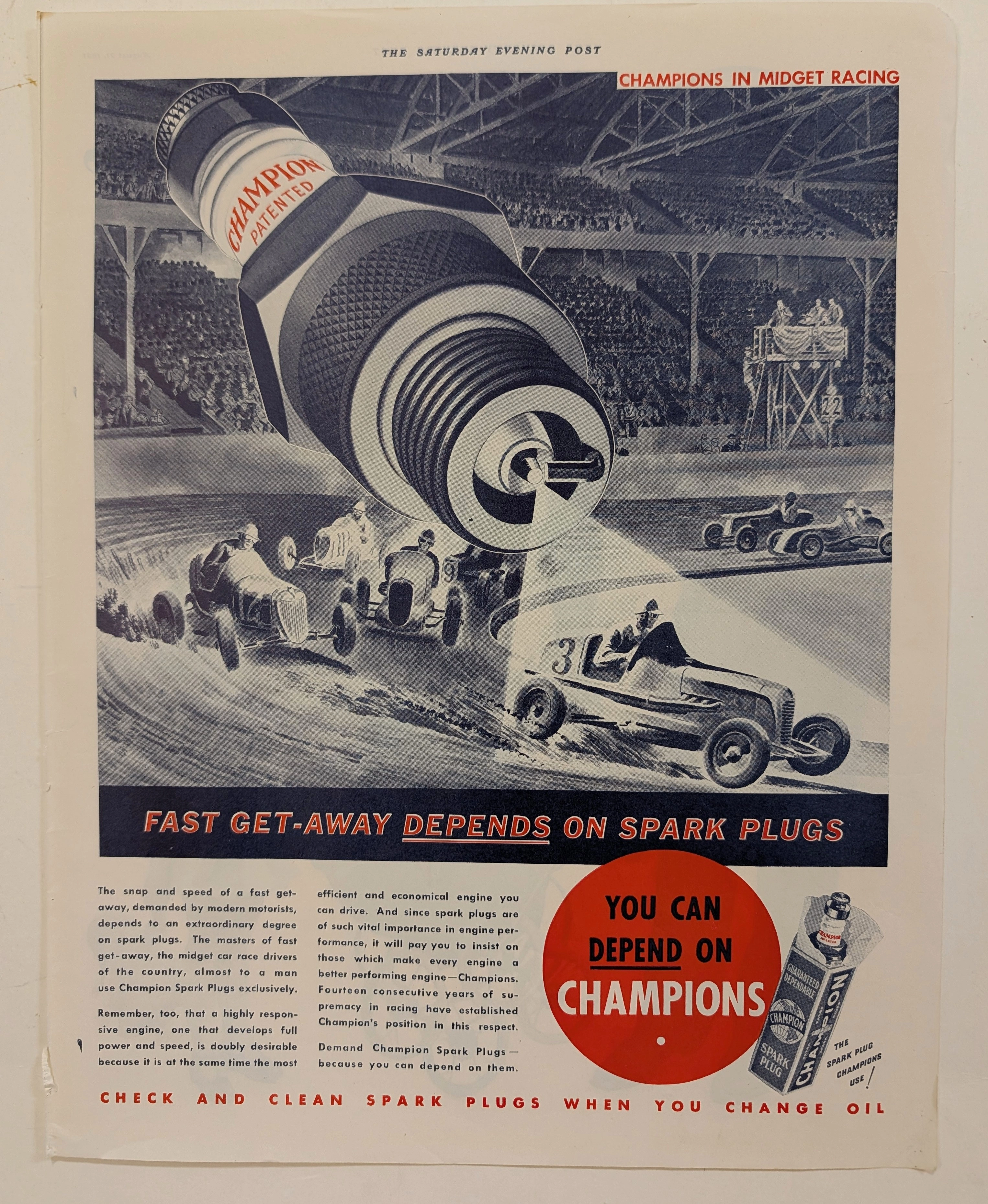
The Architecture of Acceleration To understand this artifact, one must first understand the era that necessitated it. The mid-20th century was a landscape fundamentally altered by the machinery of war. Factories that had spent years mass-producing aviation engines and mechanized armor were suddenly repurposed for civilian life. But the human psyche had also been permanently altered. The slow, agrarian patience of the pre-war years was gone. Society had witnessed the terrible, magnificent power of rapid industrialization, and that momentum bled into the domestic sphere. The automobile transitioned from a luxury of conveyance to a symbol of personal autonomy. But autonomy was no longer enough. The new currency of the era was speed. The American highway system was expanding. Commutes were lengthening. Time itself was being compressed by the capability of the machine. In this environment, an engine could not simply run; it had to respond. The "Fast Get-Away" championed in this document was not just a racing slogan. It was a societal mandate. People expected their machines, their economies, and their lives to launch instantly upon command. Midget Racing: The Democratization of Velocity Observe the subject matter chosen to convey this message. This is not the elite, champagne-soaked world of European Grand Prix racing. This is midget car racing. It was the gladiator arena of the working class. Held on small, often improvised dirt tracks across the nation, these races brought the visceral thrill of motorsport to the local level. The cars were stripped down, skeletal, and violently powerful for their size. They were built in residential garages. They were driven by local mechanics and returning veterans. This sport was accessible, loud, and incredibly dangerous. By anchoring the brand to midget racing, Champion bypassed the wealthy elite and spoke directly to the everyday consumer. The message was clear: the same spark that propels these dirt-track warriors through a treacherous corner is the spark that will ensure your family sedan starts on a freezing morning. It grounded high-performance engineering in blue-collar reality. The Anatomy of Ignition and the Competitive Landscape At the time this artifact was printed, the internal combustion engine was still being refined. The spark plug is arguably the most critical, yet most overlooked, component of this architecture. It must accept tens of thousands of volts of electricity, channel it through a highly insulated ceramic core, and force it to arc across a precise gap inside a combustion chamber that is simultaneously experiencing extreme heat, immense pressure, and a volatile chemical explosion. It must do this thousands of times per minute without failing, melting, or fouling. Competitors like AC Spark Plugs and Bosch were fiercely vying for market share. Many focused their messaging on longevity or fuel economy. Champion chose a different psychological trigger: absolute dependability under maximum stress. The visual of the monolithic spark plug dominating the track asserts dominance. It suggests that while the drivers are the masters of the steering wheel, Champion is the master of the engine's heartbeat. They did not sell a ceramic and metal component; they sold the guarantee of ignition. The Flat Blueprint of Latent Life When analyzing the specific artistic execution of this print, particularly in the close-up of Car #3 (file: 7676f1be-d270-4588-8f5f-237f6d25083a.jpg), we find a piece of flat, 2D commercial art that vibrates with latent motion. The illustrator deliberately rejected photorealism. Instead, they utilized a stylized, hand-drawn stroke quality to simulate the frantic energy of flying dirt and sliding rubber. The aged paper texture visible in the negative space does not detract from the image; it grounds it. It is a period-accurate canvas. This is not a dead image. It is a scene suspended in time, waiting for the pause button to be released. Looking at the driver, locked in a tense counter-steer, the illustration provides a perfect blueprint for organic, 2D animation. It demands to breathe. It invites the viewer to imagine the subtle, natural rise and fall of the driver’s chest beneath the racing suit, the quick blink of the eyes behind the goggles, the fluid adjustment of the hands on the wheel. Furthermore, the visual composition implies a rich, period-appropriate soundscape. The flat illustration carries the heavy ghost of 1950s audio. One can almost hear the ambient, crackling hum of a period public address system echoing over the grandstands. The image suggests the raw, rhythmic sputter of a highly-tuned four-cylinder engine, the shifting of gears, the ambient rush of wind against the open cockpit, and the collective roar of a bustling mid-century stadium. The art is flat, but its sensory implications are profoundly three-dimensional. It is a living artwork temporarily trapped in ink. The Cultural Shift: From Transit to Triumph Ultimately, the historical shift recorded here is the elevation of the machine from a beast of burden to a partner in performance. The bold red typography declaring "FAST GET-AWAY DEPENDS ON SPARK PLUGS" taps into the mid-century obsession with efficiency and dominance. The word "Champion" itself ceases to be merely a brand name and becomes an identity. The consumer of this era did not want to be a passive passenger in the journey of life. They wanted to be the driver. They wanted to be the victor. This advertisement perfectly encapsulates that psychological pivot. It transformed a dirty, greasy engine part into a gleaming totem of victory and reliability. It assured the mid-century citizen that no matter how chaotic the track—or the world—might be, they had the power to forge ahead without hesitation.
The Paper
This artifact is a testament to mid-century magazine publishing. The substrate appears to be a lightweight, uncoated or lightly calendered paper stock, likely falling within the 70-90 GSM range, typical for mass-market publications of the era like The Saturday Evening Post. The printing method is web offset lithography. A close examination of the champion logo on the plug (file: 79a36d46-466f-4596-84cd-09760913527c.jpg) reveals the distinct, structured rosette patterns of halftone dots. The color palette is strictly restrained, relying heavily on a dense black plate for the detailed illustration and a single, aggressive spot red (or a heavily saturated magenta/yellow mix) for the branding and calls to action. The aging process—the slight yellowing and oxidation of the paper fibers—adds a layer of temporal authenticity. The porous nature of the paper has allowed the ink to settle deep into the grain, preserving the original, hand-drawn stroke quality of the illustrator's brush or pen. This texture is the physical recording of time. It is a surface that proudly displays its age while maintaining the structural integrity of its original message.
The Rarity
Classification: Class A Contextual Value: High. While Champion spark plug advertisements from the 1940s and 1950s were produced in the millions, surviving copies that maintain this level of sharp registration, un-faded red pigment, and minimal edge-fraying are increasingly scarce. Its true value, however, is not monetary. Its value lies in its historical significance as a pristine example of post-war performance marketing. It is a flawless capsule of mid-century commercial illustration techniques and societal values.
Cite this article
- MLA
- Naodhinsuk, Ronin. “The Time Traveller's Dossier : Champion - The Speed Shift.” The Record Institute, 12 May 2026, https://therecord.institute/journal/the-time-travellers-dossier-champion-the-speed-shift.
- APA
- Naodhinsuk, R. (2026, May 12). The Time Traveller's Dossier : Champion - The Speed Shift. The Record Institute. https://therecord.institute/journal/the-time-travellers-dossier-champion-the-speed-shift
- CHICAGO
- Naodhinsuk, Ronin. 2026. “The Time Traveller's Dossier : Champion - The Speed Shift.” The Record Institute, May 12, 2026. https://therecord.institute/journal/the-time-travellers-dossier-champion-the-speed-shift.