The Time Traveller's Dossier : Chanel for Men 1982 - The Architecture of Quiet Masculinity
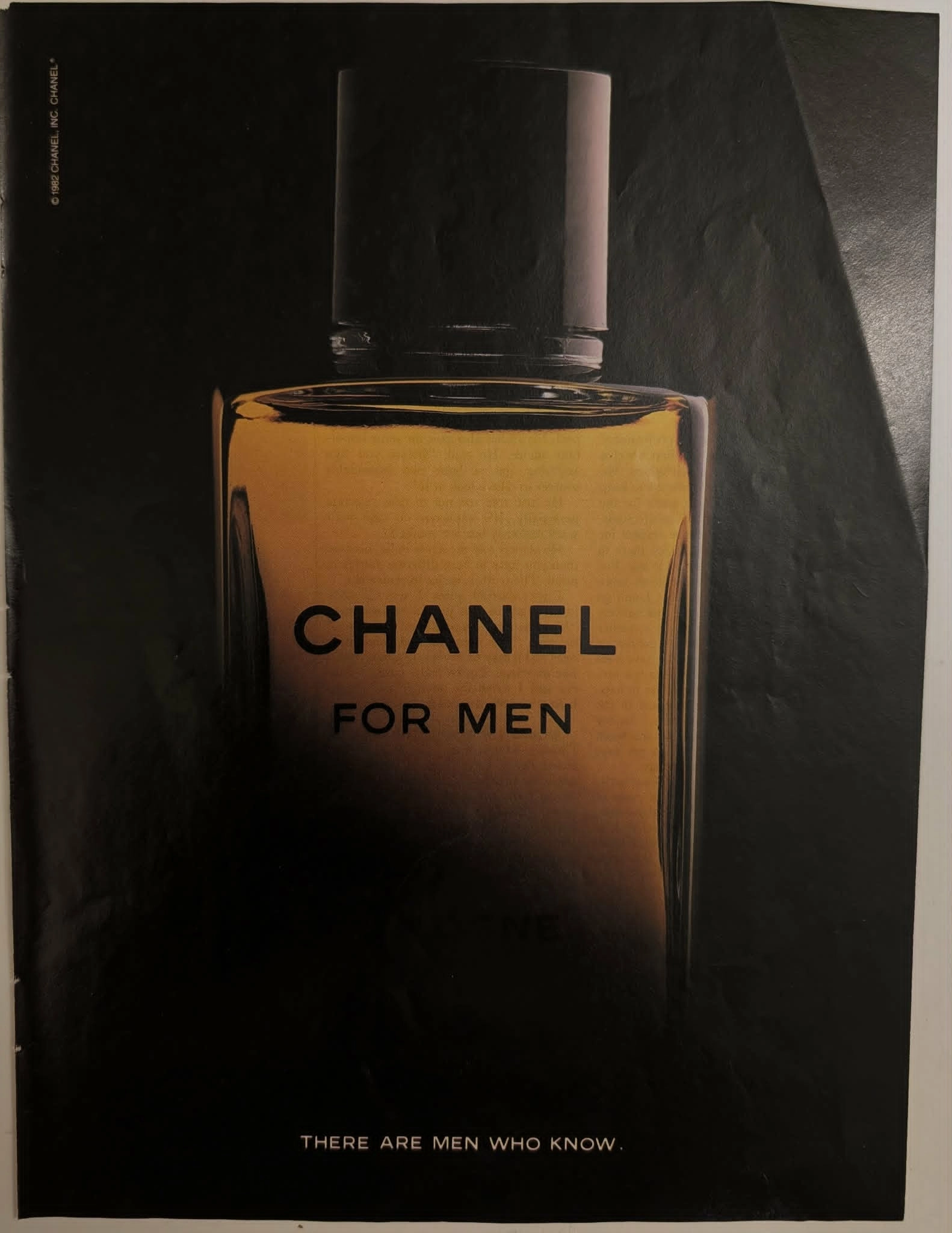
Masculinity was once broadcasted. Then, it was weaponized. Finally, it was internalized. This archival document from 1982 represents a profound ideological pivot in the commercialization of the male identity. Before this artifact, men’s fragrance was marketed through the lens of overt action, sexual conquest, or rugged outdoor survival. The imagery was loud; the message was literal. After this artifact, luxury became a silent consensus. The advertisement features no man. It features no lifestyle. It presents only a minimalist monolith of amber liquid suspended in an infinite black void, anchored by a six-word manifesto: "THERE ARE MEN WHO KNOW." It is a deliberate weaponization of exclusivity. It is the exact historical moment when luxury marketing for men stopped explaining itself and began demanding that the consumer rise to its unspoken standard.
Category: Fashion
Brand: CHANEL
The History
The Epoch of Olfactory Aggression To fully comprehend the gravity of this artifact, we must meticulously reconstruct the socio-cultural and commercial landscape of 1982. The early 1980s was an era defined by volume. The Western world was emerging from the economic malaise of the 1970s and stepping into a decade of unbridled financial deregulation, conspicuous consumption, and corporate warfare. The "Yuppie" was being born. Success was no longer something to be quietly accumulated; it was something to be aggressively displayed. In the realm of men's grooming, this cultural shift manifested as olfactory aggression. The market was entirely dominated by "powerhouse" fragrances. Competitors were releasing dense, heavy, room-clearing concoctions built on massive doses of patchouli, leather, and synthetic musks. Advertising campaigns of the era reflected this brute force. They featured muscular men on horseback, bare-chested sailors, or executives surrounded by adoring women. The prevailing marketing theory was that a fragrance was a tool for hunting—whether hunting for wealth or hunting for a mate. Chanel surveyed this landscape of deafening noise and chose to whisper. In doing so, they created a sound far more penetrating than any shout. The Genesis of the Formula: A Masterclass in Restraint While the advertisement is dated 1982, the liquid inside the bottle carries a much older, more aristocratic DNA. The fragrance marketed in the United States as "Chanel for Men" was originally formulated in 1955 by Chanel’s legendary master perfumer, Henri Robert, under the name "Pour Monsieur." It was the first men's fragrance ever launched by the house of Chanel. The composition of the juice itself is the antithesis of the 1980s powerhouse trend. It is a traditional chypre—a highly disciplined, intellectual structure of perfumery. It opens with an austere, razor-sharp blast of Sicilian lemon and neroli, transitions into a restrained heart of cardamom and subtle spices, and settles into a dry, impeccably tailored base of oakmoss and cedarwood. There is no sweetness. There is no heavy musk. There is no desperate attempt to seduce. By pushing this specific formulation in 1982, Chanel was executing a contrarian strategy. They were offering olfactory discipline in an age of excess. The fragrance does not enter the room before the man does; it is only discovered when one is invited into his personal space. This chemical reality perfectly mirrors the psychological strategy of the advertisement. The Psychology of Exclusion We must ruthlessly dissect the copywriting of this artifact. "THERE ARE MEN WHO KNOW." In the entire history of modern advertising, few taglines have operated with such cold, calculated psychological efficiency. It is a masterpiece of the "Information Gap" theory. It deliberately creates a void of context. It does not tell the viewer what these men know. It does not explain the benefits of the product. It does not offer a promise of romance or financial success. Instead, it establishes an immediate, invisible hierarchy. It draws a line in the sand. On one side are the men who "know." On the other side are the uninitiated, the loud, the vulgar, and the try-hards. This is the commercialization of "Old Money" aesthetics tailored for a "New Money" era. In 1982, thousands of newly wealthy men were desperate for signifiers of true class. Chanel weaponized their insecurity. By purchasing the bottle, the consumer is essentially purchasing an entry ticket into this vague, elite brotherhood of the enlightened. The genius lies in the fact that the consumer must project his own aspirations onto the word "KNOW." Does it mean knowing about fine art? Knowing about tailoring? Knowing how to command a room without speaking? The advertisement refuses to answer. It merely observes. The Semiotics of the Monolith The decision to completely remove the human figure from a men’s grooming advertisement in 1982 was radically subversive. The bottle is presented not as a consumer good, but as an architectural monolith. It evokes the imagery of the monolith from Stanley Kubrick’s 2001: A Space Odyssey—an object of advanced, silent intelligence that fundamentally alters the environment around it. By stripping away the lifestyle imagery, Chanel future-proofed the artifact. A man in a 1982 suit driving a 1982 automobile would immediately date the image, rendering it obsolete within five years. The minimalist bottle, floating in a timeless void, exists outside of the constraints of temporal fashion. It elevates the product from a temporary trend to an eternal truth. The Historical Shift: The Birth of Stealth Wealth This document marks the absolute pivot point where "stealth wealth" and "quiet luxury" became codifiable, marketable concepts in the men's sector. Chanel foresaw the inevitable fatigue that would follow the loud, aggressive consumption of the early 80s. They realized that true power does not need to announce itself. While their competitors were fighting for attention in crowded discotheques, Chanel positioned its product for the boardroom, the private club, and the quiet study. This advertisement educated a generation of men on the power of understatement. It taught the market that restraint is a far more intimidating display of status than excess. Every modern luxury brand that currently relies on minimalist branding, cryptic messaging, and the allure of "if you know, you know" (IYKYK) owes its foundational DNA to this specific piece of archival history.
The Paper
The physical medium of this 1982 artifact is a critical component of its impact. Printed on high-gloss, clay-coated magazine stock typical of premium periodicals of the era (such as GQ or Esquire), the paper has a relatively high Grams per Square Meter (GSM) rating, likely around 90 to 110 GSM. The printing methodology is standard four-color (CMYK) industrial halftone lithography. Upon close inspection of the magnified archives (specifically the amber fluid), the precise rosette patterns of the halftone dots are clearly visible, revealing the mechanical truth behind the golden illusion. However, the defining physical characteristic of this artifact is the massive application of "Key" (black) ink. To achieve the deep, infinite void surrounding the bottle, the printers had to lay down a heavy, saturated layer of black. Over four decades, this dense ink layer has begun to interact with the clay coating, creating a subtle, localized silvering effect under direct light. The edges show microscopic chipping where the ink has separated from the degrading paper fibers. The physical document is fragile, yet the heavy black ink acts as a preservative seal, locking the golden amber image in a state of suspended animation.
The Rarity
Classification: Class A (Socio-Cultural Marker) While Chanel advertisements from the 1980s were widely circulated in international publications, finding this specific, text-minimal 1982 variation in pristine condition commands a Class A rating. Its rarity is derived not from low initial print runs, but from the physical vulnerability of its design. The heavy, edge-to-edge black ink is notoriously unforgiving; even the slightest handling, folding, or humidity causes permanent, visible scuffing and cracking. Finding a surviving copy with a flawless black void and sharp, unbled typography is exceedingly difficult. It is highly sought after by brand archivists and semioticians studying the evolution of minimalist luxury marketing.
Cite this article
- MLA
- Naodhinsuk, Ronin. “The Time Traveller's Dossier : Chanel for Men 1982 - The Architecture of Quiet Masculinity.” The Record Institute, 23 May 2026, https://therecord.institute/journal/the-time-travellers-dossier-chanel-for-men-1982-the-architecture-of-quiet-masculinity.
- APA
- Naodhinsuk, R. (2026, May 23). The Time Traveller's Dossier : Chanel for Men 1982 - The Architecture of Quiet Masculinity. The Record Institute. https://therecord.institute/journal/the-time-travellers-dossier-chanel-for-men-1982-the-architecture-of-quiet-masculinity
- CHICAGO
- Naodhinsuk, Ronin. 2026. “The Time Traveller's Dossier : Chanel for Men 1982 - The Architecture of Quiet Masculinity.” The Record Institute, May 23, 2026. https://therecord.institute/journal/the-time-travellers-dossier-chanel-for-men-1982-the-architecture-of-quiet-masculinity.