The Time Traveller's Dossier : Chaps Ralph Lauren - The Western Shift in Masculinity
The era of maritime discipline fades. The era of the internal frontier begins. Before this artifact, male fragrance was a matter of hygiene or boardroom conquest. It was external armor. Here, we observe a radical shift. The cologne becomes an internal state. The problem: A generation of men unmoored by the socio-political turbulence of the late 1970s, seeking an anchor in an increasingly complex world. The solution: The commodification of the American West. Not as a geographical location, but as a psychological refuge. A worn leather jacket. A pair of jeans. A scent. The concept of rugged independence, distilled, bottled, and sold.
The History
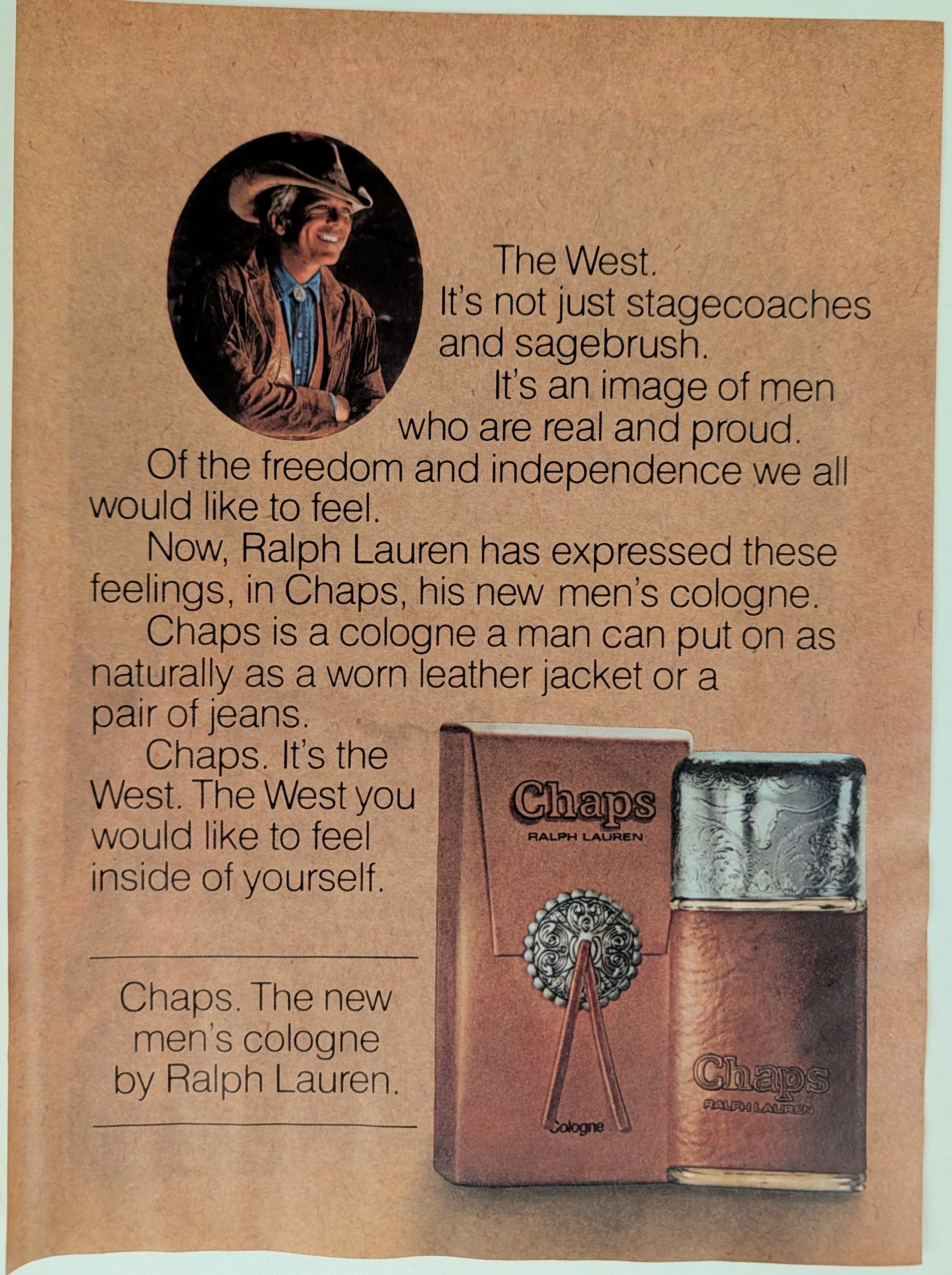
The Socio-Economic Landscape of an Unmoored Generation To understand the precise mechanical function of this advertisement, we must first dissect the temporal environment of its creation. The year is 1979. The United States is navigating a profound transitional phase. The post-Vietnam era has left a lingering skepticism toward traditional institutions and overt nationalism. The economic reality is defined by stagflation, energy crises, and a palpable sense of national malaise. Simultaneously, the cultural landscape of the late 1970s is dominated by disco culture. The aesthetic of the era heavily emphasizes a manicured, urban, and highly stylized presentation of masculinity. Men are wearing polyester suits, unbuttoned silk shirts, and engaging in grooming rituals that border on the peacockesque. This creates a vacuum. Whenever a culture swings heavily toward the artificial and the hyper-urban, a counter-movement inevitably forms, yearning for the authentic, the terrestrial, and the stoic. The American male psyche, fractured by a decade of rapid social change and economic uncertainty, requires a stable archetype to anchor itself. The Mythos of the West as Psychological Refuge Ralph Lauren identifies this vacuum. He does not invent the American cowboy. The archetype has existed in the cultural consciousness since the dime novels of the 19th century and the golden age of Hollywood Westerns. However, Ralph Lauren re-engineers the cowboy. He strips away the historical grit, the brutal reality of frontier life, and the physical hardship. He isolates the philosophy. "The West. It's not just stagecoaches and sagebrush," the copy reads. This is a deliberate rejection of the literal. The advertisement explicitly instructs the consumer to stop viewing the West as a historical era or a physical place. "It's an image of men who are real and proud. Of the freedom and independence we all would like to feel." This is the psychological pivot. The West is repositioned as an internal state of being. It is an emotional destination. By stating "we all would like to feel," the copywriter acknowledges a collective deficit. The modern man, trapped in gridlock traffic, navigating corporate hierarchies, or struggling with inflation, does not feel free. He does not feel independent. He feels constrained. Chaps is engineered as the antidote to modern constraint. It is the democratization of the frontier spirit, available for purchase at the local department store. The Fragrance Architecture of the Era: A Comparative Analysis To measure the impact of Chaps, we must evaluate the contemporary competitors occupying the shelves in 1979. The market is rigidly segmented. On one end, there is Old Spice. A relic of the mid-century, heavily associated with the World War II generation. It relies on nautical imagery, duty, and straightforward masculine hygiene. It is the scent of the father. On the opposite end, there is Brut by Fabergé. Launched in the 1960s, Brut is characterized by aggressive, synthetic musk and loud marketing. It is a dominance play, the scent of the locker room and overt sexual conquest. In the prestige sector, there is Aramis. Elite, sophisticated, firmly entrenched in the European tradition of perfumery. It is the scent of the executive boardroom and the country club. Where does Chaps fit? It deliberately avoids all three established paradigms. It is not about duty (Old Spice). It is not about aggressive conquest (Brut). It is not about elite exclusivity (Aramis). Chaps pioneers a new category: Accessible, rugged aspiration. It aligns fragrance with casual, foundational garments. "Chaps is a cologne a man can put on as naturally as a worn leather jacket or a pair of jeans." This sentence is a masterclass in consumer psychology. In 1979, the concept of wearing a fragrance every day, especially outside of a formal or romantic context, is still gaining traction among average men. By equating the cologne with jeans and a leather jacket—items fundamentally coded as comfortable, durable, and effortlessly masculine—the advertisement demystifies the product. It removes the pretension of perfumery and reframes it as a necessary layer of daily masculine armor. The Physical Engineering of the Artifact The product design itself is a crucial component of this historical shift. Look closely at the visual representation of the bottle and the packaging in the artifact. Ralph Lauren does not present a sleek glass vial. He presents an object that mimics western tack. The cap is cast in a metallic finish, intricately embossed with floral scrollwork and a prominent longhorn steer skull. This is a direct visual quote from western belt buckles and saddle silver. It communicates weight, permanence, and tradition. The lower body of the bottle is encased in a material mimicking worn, brown leather, stamped with the Chaps logo in a western serif font. The outer carton continues this tactile illusion, featuring a simulated leather texture and a focal point: a printed silver concho with two leather ties hanging downward. This is not merely a container for liquid. It is a physical talisman. When the consumer holds the bottle, they are meant to feel the texture of the saddle, the cold silver of the spur. The physical engineering of the packaging reinforces the psychological promise of the text. It anchors the ephemeral nature of scent to a heavy, tangible representation of the western myth. The Historical Shift: Scent as Identity Construction The true historical significance of this advertisement lies in its facilitation of a transition in male consumer behavior. Prior to this era, men bought products for what they did. After this era, men increasingly bought products for who they wanted to be. Chaps marks the moment when mass-market men's fragrance transitioned from a functional hygiene product into a complex tool for identity construction. Ralph Lauren successfully convinced the American male that applying a specific combination of aromatic chemicals could mentally transport him out of his suburban reality and into the idealized, solitary freedom of the high plains. The advertisement concludes with a profound psychological instruction: "Chaps. It's the West. The West you would like to feel inside of yourself." The frontier is no longer a territory to be conquered. It is a feeling to be consumed. This is the ultimate privatization of a cultural myth. The shift is complete. The external world has been deemed too complex, so the vastness of the West has been collapsed, bottled, and placed on the bathroom counter.
The Paper
The artifact exists as a standard magazine page, likely sourced from a widely circulated lifestyle or men's publication of the late 1970s or early 1980s. The substrate is a lightweight, lightly coated stock. The GSM (Grams per Square Meter) rests reasonably between 60 and 70. Under close observation, the halftones of the CMYK printing process become evident. The rosette patterns of the ink dots form the texture of the cowboy's leather jacket and the shadows across his face. Time has acted upon the physical material. The paper exhibits noticeable oxidation, leading to a yellowing of the substrate. The magenta and yellow inks have held their ground, pushing the entire composition into a warm, sepia-toned spectrum. This aging process is philosophically resonant. The physical degradation of the paper enhances the visual message. The artifact itself is taking on the characteristics of the "worn leather jacket" it describes. The passage of time validates the vintage authenticity the advertisement originally sought to simulate.
The Rarity
Classification: Class A This artifact is not classified by extreme scarcity. Millions of these pages were printed, distributed, and subsequently discarded in the cyclical churn of periodical publishing. Its value is deeply contextual. It achieves a Class A rating because it is a pristine record of a specific pivot point in marketing history and male psychology. Finding an intact, legible copy that perfectly demonstrates Ralph Lauren’s initial architectural framing of the "Chaps" identity provides immense value to sociologists, brand historians, and semioticians. It is common in volume, but rare in its unfiltered representation of a cultural paradigm shift.
Cite this article
- MLA
- Naodhinsuk, Ronin. “The Time Traveller's Dossier : Chaps Ralph Lauren - The Western Shift in Masculinity.” The Record Institute, 8 April 2026, https://therecord.institute/journal/the-time-travellers-dossier-chaps-ralph-lauren-the-western-shift-in-masculinity.
- APA
- Naodhinsuk, R. (2026, April 8). The Time Traveller's Dossier : Chaps Ralph Lauren - The Western Shift in Masculinity. The Record Institute. https://therecord.institute/journal/the-time-travellers-dossier-chaps-ralph-lauren-the-western-shift-in-masculinity
- CHICAGO
- Naodhinsuk, Ronin. 2026. “The Time Traveller's Dossier : Chaps Ralph Lauren - The Western Shift in Masculinity.” The Record Institute, April 8, 2026. https://therecord.institute/journal/the-time-travellers-dossier-chaps-ralph-lauren-the-western-shift-in-masculinity.