The Time Traveller's Dossier: Coca-Cola 1944 - The Weaponization of Morale
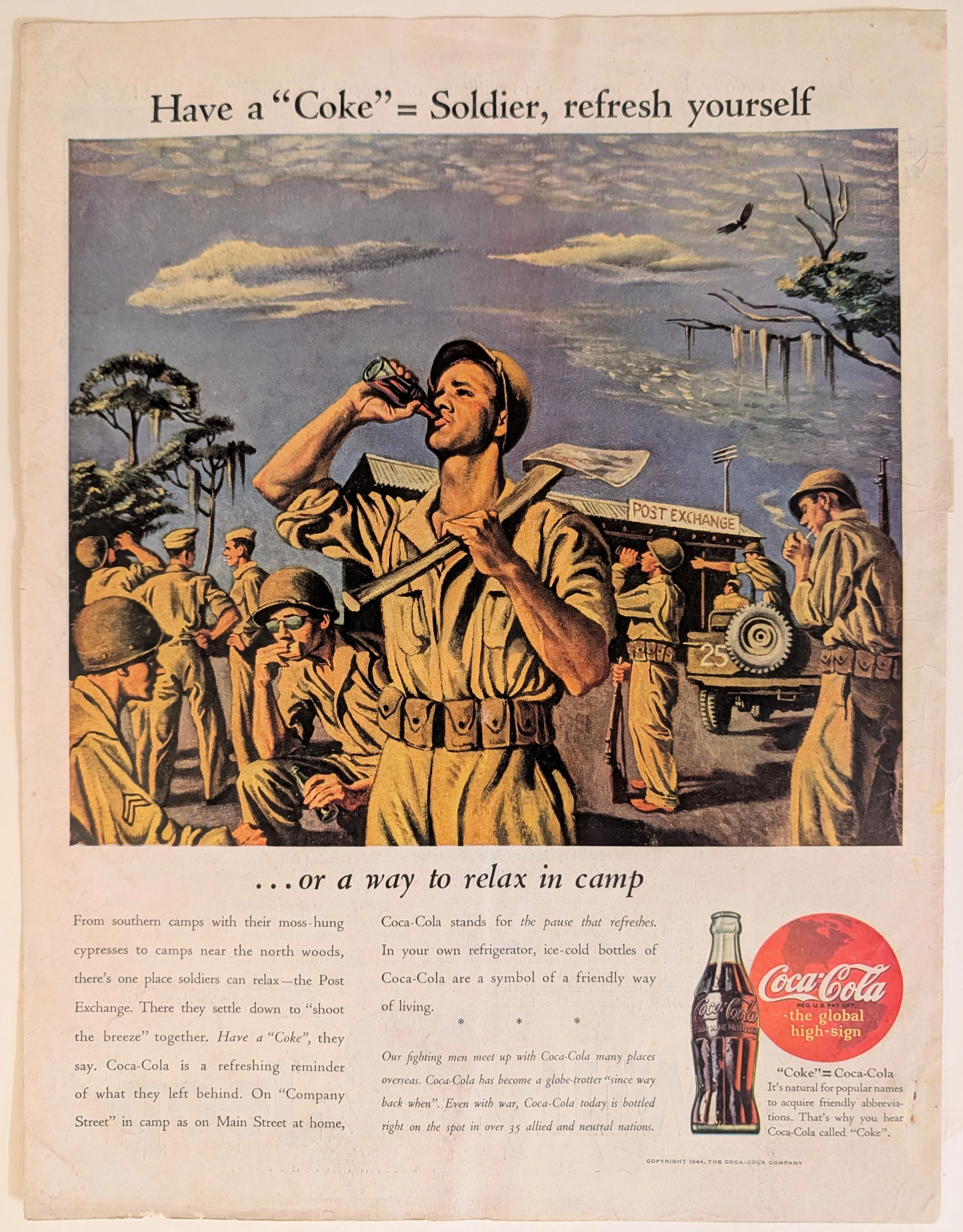
Then, sugar and carbonated water were not merely ingredients for a domestic treat; they were classified as essential psychological logistics for a global war. Now, a soda is just a soda. The problem for the United States military in 1944 was not just arming its young men with rifles and artillery; it was the monumental task of maintaining the human spirit under the soul-crushing weight of total war. The boys being trained in the muggy, moss-draped camps of the American South were destined for the meat grinders of Europe and the Pacific. They needed a tether to the homes they were leaving behind. The solution, brilliantly engineered and ruthlessly promoted by The Coca-Cola Company, was the weaponization of nostalgia. This artifact is a portal. It transports us to a sweltering training camp in 1944. It documents the exact historical moment when a private beverage corporation successfully intertwined its product with the very fabric of American patriotism, military logistics, and the linguistic evolution of its own brand identity.
Category: Beverage
Brand: Coca-Cola
The History
The Military-Industrial Refreshment Complex To understand the gravity of this 1944 advertisement, one must understand Coca-Cola’s wartime strategy. At the outbreak of WWII, Coca-Cola President Robert Woodruff famously pledged that "every man in uniform gets a bottle of Coca-Cola for five cents, wherever he is and whatever it costs the Company." This was not merely an act of corporate patriotism; it was a masterstroke of global logistics. By classifying Coca-Cola as an essential morale-boosting item, the company was exempted from severe wartime sugar rationing. They built bottling plants directly behind the front lines. The scene depicted in this artifact—soldiers clustered around a mobile "Post Exchange" (PX) in a southern U.S. training camp—is the domestic prequel to this global operation. The ad sells the idea that the simple, localized act of "shooting the breeze" over a soda on "Company Street" is the exact same freedom these men are preparing to die for overseas. Coca-Cola was no longer just selling refreshment; it was bottling the American Way of Life. Surrendering to the Vernacular: The Baptism of "Coke" From a corporate archiving perspective, the bottom right quadrant of this page is historically monumental. For decades, the Coca-Cola Company fought a bitter, litigious war against the public's tendency to abbreviate their product as "Coke." They feared trademark dilution and genericization. By 1944, they realized the battle was lost and smartly pivoted to weaponize the slang instead. The educational text is an outright corporate surrender framed as a friendly embrace: "Coke = Coca-Cola. It's natural for popular names to acquire friendly abbreviations. That's why you hear Coca-Cola called 'Coke'." This advertisement represents the precise era when the corporation officially adopted the vernacular of the streets and the trenches, formally trademarking "Coke" in 1945, just a year after this ad was printed. The "Global High-Sign" and Imperial Expansion The inclusion of the red globe graphic with the phrase "the global high-sign" is a bold declaration of intent. While the illustration shows boys in a domestic training camp, the text explicitly reminds the reader that "Our fighting men meet up with Coca-Cola many places overseas." WWII was the ultimate vector for Coca-Cola's global expansion. The American military apparatus essentially acted as a heavily armed distribution network for the brand. As Allied forces liberated Europe and island-hopped across the Pacific, they brought Coca-Cola with them, introducing the beverage to millions of foreigners. The "global high-sign" was a prophecy being fulfilled in real-time through the logistics of warfare.
The Paper
This artifact is a tactile survivor of a resource-starved era. Printed during the height of wartime rationing in 1944, the paper stock is remarkably thin and highly porous, exhibiting the classic traits of high-lignin, acidic wood pulp. Over the last eight decades, this chemical composition has resulted in a warm, toasted degradation, particularly visible near the margins. The printing methodology is a mid-century, high-volume rotary offset lithography. Upon close macro-inspection of the soldier's face and the hand gripping the bottle, the image shatters into the beautiful, chaotic geometry of overlapping CMYK halftone dots—the rosette pattern. The registration is impressively tight for wartime printing, allowing the rich, earthy tones of the military khaki and the deep, syrupy brown of the cola to retain their visual weight after 80 years.
The Rarity
Classification: Class B (High Historical and Contextual Value) While Coca-Cola printed millions of advertisements during WWII, pristine full-page survivals from 1944 that specifically feature the explicit explanation of the "Coke" abbreviation are highly prized by brand historians. This artifact ascends to Class B status because it is a multi-layered primary source document: it captures wartime morale propaganda, the evolution of corporate trademark law, and the visual aesthetics of mid-century military life in a single, structurally sound page.
Cite this article
- MLA
- Naodhinsuk, Ronin. “The Time Traveller's Dossier: Coca-Cola 1944 - The Weaponization of Morale.” The Record Institute, 21 April 2026, https://therecord.institute/journal/the-time-travellers-dossier-coca-cola-1944-the-weaponization-of-morale.
- APA
- Naodhinsuk, R. (2026, April 21). The Time Traveller's Dossier: Coca-Cola 1944 - The Weaponization of Morale. The Record Institute. https://therecord.institute/journal/the-time-travellers-dossier-coca-cola-1944-the-weaponization-of-morale
- CHICAGO
- Naodhinsuk, Ronin. 2026. “The Time Traveller's Dossier: Coca-Cola 1944 - The Weaponization of Morale.” The Record Institute, April 21, 2026. https://therecord.institute/journal/the-time-travellers-dossier-coca-cola-1944-the-weaponization-of-morale.