The Time Traveller's Dossier: Coca-Cola (1952) – The Wholesome Prescription
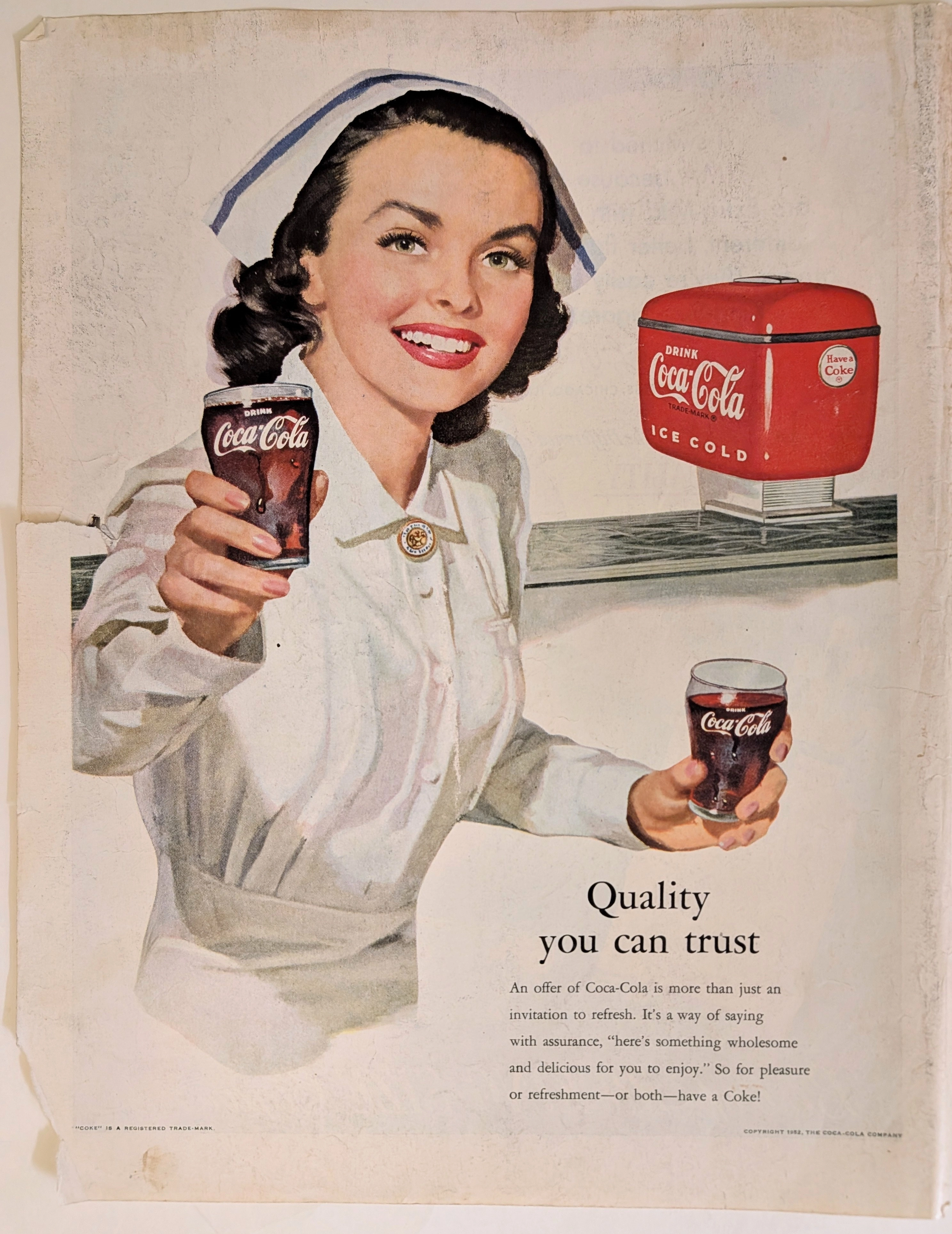
Before the era of aggressive nutritional labeling and the demonization of refined sugars, carbonated beverages sought to position themselves not merely as treats, but as vital, life-affirming staples of the American diet. The artifact before us—a 1952 magazine advertisement for The Coca-Cola Company—is a masterclass in psychological association. By placing their product in the pristine, capable hands of a registered nurse, Coca-Cola is explicitly borrowing her cultural authority. She is the ultimate symbol of care, cleanliness, and health. The advertisement doesn't just offer you a drink; it offers you a "wholesome" prescription for daily fatigue. It is a fascinating glimpse into an era where a sugary, caffeinated beverage could be advertised with the solemn promise: "Quality you can trust."
Category: Beverage
Brand: Coca-Cola
The History
The Halo of the Caregiver To understand the power of this imagery, we must look at the cultural landscape of 1952. America was in the midst of a post-WWII boom, yet locked in the anxieties of the Cold War and the active Korean War. The nurse was a revered figure—a hero of the home front and the battlefield alike. She represented safety, competence, and maternal care. By having a nurse serve the Coca-Cola, the D'Arcy Advertising Company (Coke's primary agency at the time) effectively bypassed any lingering health skepticisms about carbonated sodas. The copy reinforces this visual trick: "It's a way of saying with assurance, 'here's something wholesome and delicious for you to enjoy.'" If a medical professional deems it "wholesome," the consumer is given absolute permission to indulge. The Dispenser as a Modern Marvel Behind the nurse sits a bright red, countertop Coca-Cola dispenser. In the early 1950s, Coca-Cola was aggressively expanding its fountain and dispenser presence, moving beyond just the classic glass bottle. This specific dispenser model, with its rounded, atomic-age styling and "ICE COLD" lettering, represents the modernization of the American soda fountain. It signals to the consumer that Coca-Cola is ubiquitous, hygienic, and perfectly chilled, whether you are at a diner, a pharmacy, or a hospital cafeteria. The Standardization of "Coke" Notice the small text artifact: "COKE" IS A REGISTERED TRADE-MARK. For decades, The Coca-Cola Company fought against the public's tendency to abbreviate their product to "Coke," fearing it would become a generic term for any cola. However, by the 1940s, they realized it was a losing battle and strategically pivoted, trademarking the abbreviation themselves. By 1952, "Coke" was proudly displayed on the dispenser badge ("Have a Coke"), completely integrated into their official lexicon.
The Paper
The macro photographs provided offer a spectacular look at the mechanics of mid-century CMYK (Cyan, Magenta, Yellow, and Key/Black) halftone printing. In the extreme close-up of the nurse's lapel pin, we can clearly see the rosette patterns formed by the overlapping dots of ink. To the naked eye, the nurse has a smooth, peaches-and-cream complexion; under magnification, her skin is a highly organized, regimented grid of red, yellow, and blue dots. The paper is a standard, lightweight, uncoated magazine stock of the era. Over seventy years of oxidation have turned the edges a brittle, warm beige, though the heavily inked areas—particularly that proprietary "Coca-Cola Red"—remain remarkably vibrant, a testament to the heavy pigmentation of 1950s commercial printing inks.
The Rarity
Classification: Class S (High Cultural Significance, Moderate Scarcity) As a single page likely carefully excised from a mass-circulation magazine (such as LIFE, The Saturday Evening Post, or Look), this item is not exceptionally rare in sheer numbers. Coca-Cola was one of the most prolific advertisers in human history. However, its archival value is elevated by its specific iconography. Advertisements featuring specific professions (nurses, soldiers, policemen) are highly sought after by niche collectors. Furthermore, it serves as a flawless primary source document demonstrating the mid-century corporate strategy of equating processed consumer goods with health and vitality.
Cite this article
- MLA
- Naodhinsuk, Ronin. “The Time Traveller's Dossier: Coca-Cola (1952) – The Wholesome Prescription.” The Record Institute, 22 April 2026, https://therecord.institute/journal/the-time-travellers-dossier-coca-cola-1952-the-wholesome-prescription.
- APA
- Naodhinsuk, R. (2026, April 22). The Time Traveller's Dossier: Coca-Cola (1952) – The Wholesome Prescription. The Record Institute. https://therecord.institute/journal/the-time-travellers-dossier-coca-cola-1952-the-wholesome-prescription
- CHICAGO
- Naodhinsuk, Ronin. 2026. “The Time Traveller's Dossier: Coca-Cola (1952) – The Wholesome Prescription.” The Record Institute, April 22, 2026. https://therecord.institute/journal/the-time-travellers-dossier-coca-cola-1952-the-wholesome-prescription.