The Time Traveller's Dossier : Conoco Nth Motor Oil - The Post-War Shield
Time does not merely pass; it leaves residue. In the grand archive of human endeavor, advertising serves as a highly calibrated mirror, reflecting not just what we bought, but what we feared, what we desired, and how we sought to protect ourselves. Then, the automobile was a nascent beast of steel and fire, demanding constant mechanical appeasement. The world had just emerged from the ultimate global conflagration of the Second World War. Society was hyper-fixated on the concepts of survival, shielding, and engineered safety. Now, we take the internal combustion engine for granted. We view lubrication as a passive, invisible necessity. This artifact from November 12, 1949, published in The Saturday Evening Post, represents a monumental shift. It marks the exact moment when mechanical maintenance transcended mere utility and became a psychological battle for armor. It did not just sell oil; it sold an impenetrable shield against the friction of modern existence.
Category: Automotive
The History
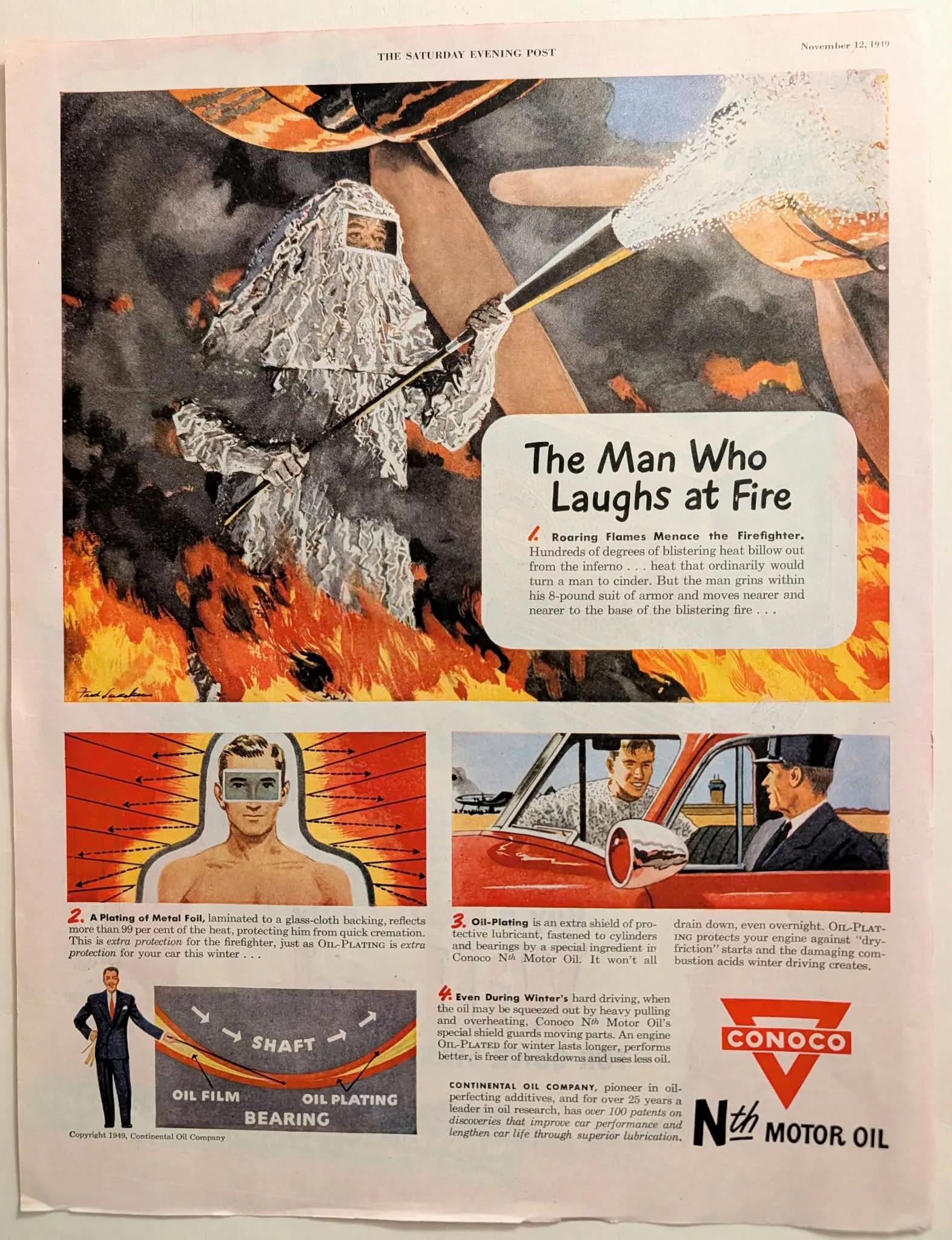
The Epoch of Post-War Rebirth and Paranoia To understand the artifact, one must first inhabit the psychological landscape of 1949. The global theatre had ceased its overt military bombardment, but the psychological residue of total war remained deeply embedded in the American consciousness. This was the dawn of the Atomic Age. It was a year defined by geopolitical tension, the beginning of the Cold War, and a pervasive, underlying anxiety regarding sudden, catastrophic destruction. The American public was fundamentally obsessed with the concept of the "shield." Civil defense protocols were being drafted; the idea of an impenetrable barrier against unseen forces was a dominant cultural narrative. Simultaneously, the American automotive industry was undergoing an explosive renaissance. Factories that had spent half a decade churning out bombers and tanks had retooled to produce massive, heavy-steel automobiles. The car was no longer a luxury; it was the ultimate symbol of American post-war freedom, prosperity, and individual agency. However, these magnificent machines were plagued by the physical realities of early mechanical engineering: heat, friction, and rapid degradation. The internal combustion engine was, fundamentally, a contained explosion. Controlling that explosion, mitigating the brutal wear and tear of metal grinding against metal, was the primary technological hurdle of the everyday consumer. The Shift from Lubricant to Armor Before this era, motor oil was marketed primarily as a simple fluid necessity—a viscous substance poured into an engine to prevent it from seizing. The marketing was largely rudimentary, focusing on viscosity, source origin (such as Pennsylvania crude), or basic longevity. The Conoco Nth Motor Oil advertisement represents a seismic philosophical shift in consumer communication. It elevated motor oil from a fluid to a structural component of the engine. Notice the intense, deliberate terminology used by the Continental Oil Company. They introduced the concept of "OIL-PLATING". This is not a liquid; a "plating" implies metallurgy. It implies the fusion of a protective layer onto the vulnerable internal organs of the machine. The artifact explicitly states that this lubricant is "fastened to cylinders and bearings by a special ingredient". This was revolutionary. It told the consumer that the oil did not merely sit in the engine; it actively bonded with it, creating an armored exoskeleton for the internal components. The Visual Metaphor: The Firefighter as the Ultimate Sentinel The genius of this artifact lies in its aggressive visual metaphor. The primary image does not feature a car. Instead, it dominates the page with a firefighter battling an aviation blaze, clad in a highly experimental, heat-reflective suit. The headline boldly declares, "The Man Who Laughs at Fire". This is a masterclass in psychological transference. The copy elaborates that "Roaring Flames Menace the Firefighter" and describes "Hundreds of degrees of blistering heat... heat that ordinarily would turn a man to cinder". It details the "8-pound suit of armor" that allows him to move toward the inferno. By establishing this extreme life-or-death scenario, the advertisement instantly calibrates the reader's understanding of "protection." It then aggressively pivots this life-saving technology to the consumer's automobile. Panel two meticulously explains the "Plating of Metal Foil, laminated to a glass-cloth backing" that protects the firefighter from "quick cremation". It draws a direct, unyielding parallel: "This is extra protection for the firefighter, just as OIL-PLATING is extra protection for your car this winter...". The engine's heat and the winter's cold are equated to an aviation fire. The oil is the suit of armor. The consumer is no longer a driver; they are a commander deploying a shield. The Engineering of Trust and Fear The lower section of the artifact transitions from emotional storytelling to pseudo-scientific validation. The diagram featuring the sharply dressed engineer explicitly maps the architecture of this protection. It visualizes the "SHAFT" and the "BEARING" separated not just by a vulnerable "OIL FILM", but by a hardened, distinct layer of "OIL PLATING". This diagram addresses a highly specific mechanical anxiety of the era: the cold start. In 1949, engines left overnight in winter would drain their oil into the pan, leaving the cylinders critically dry upon the next ignition. This "dry-friction" caused catastrophic wear. Conoco addressed this directly, stating that their OIL-PLATING "won't all drain down, even overnight" and protects against "the damaging combustion acids winter driving creates". The language of "combustion acids" sounds corrosive, violent, and insidious. The solution is presented as absolute. Furthermore, the Continental Oil Company reinforces its authority by citing its institutional legacy. The text proudly notes they are a "pioneer in oil-perfecting additives," boasting "over 25 years a leader in oil research" and possessing "over 100 patents on discoveries that improve car performance". This is not mere boasting; it is the establishment of technical supremacy in a market flooded with competitors like Standard Oil and Mobilgas, who were still relying heavily on mascot-driven or purely geographical marketing. Conoco chose the path of the laboratory and the proving ground. The Historical Pivot This artifact documents the exact moment advertising realized that science, when translated through the lens of survival, is the ultimate sales tool. It shifted the societal expectation of what a consumer product should do. Consumers were no longer buying maintenance; they were purchasing peace of mind in an increasingly complex, mechanized, and threatening world. The legacy of this specific campaign reverberates through decades of subsequent automotive marketing, laying the groundwork for how synthetic oils and modern additives are sold today—not as fluids, but as highly engineered, molecular bodyguards.
The Paper
The physical medium itself is a testament to the era's manufacturing realities. Printed on standard, mass-market magazine stock typical of late-1940s publications like The Saturday Evening Post, the paper likely possesses a basis weight hovering around 60-70 GSM. The printing method is a classic web offset lithography, evidenced by the distinct, slightly imperfect CMYK halftone rosette patterns visible upon microscopic inspection of the fiery gradients. The aging process has introduced a subtle oxidation to the paper fibers, resulting in a faint, warm yellowing around the margins. The texture is matte with a very slight tooth, lacking the high-gloss coatings of modern periodicals. This physical degradation is beautiful; it acts as an artifact recording time, a physical manifestation of the very entropy and "wear" the advertised oil sought to prevent. The ink, however, remains remarkably vibrant, a testament to the heavy, lead-based pigment formulations of the mid-20th century.
The Rarity
While vintage magazine advertisements are relatively common in physical numbers, this specific artifact achieves a Class A rating due to its profound historical significance and contextual weight. It is not an Omega-class rarity forged of unique materials, nor is it a singular lost painting. Its immense value lies entirely in its narrative power. It represents a flawless encapsulation of post-war American psychology, mid-century graphic design, and the evolution of technical copywriting. To a historian of technology or a scholar of consumer psychology, this single page is a Rosetta Stone for understanding the commercial mindset of 1949.
Cite this article
- MLA
- Naodhinsuk, Ronin. “The Time Traveller's Dossier : Conoco Nth Motor Oil - The Post-War Shield.” The Record Institute, 23 July 2026, https://therecord.institute/journal/the-time-travellers-dossier-conoco-nth-motor-oil-the-post-war-shield.
- APA
- Naodhinsuk, R. (2026, July 23). The Time Traveller's Dossier : Conoco Nth Motor Oil - The Post-War Shield. The Record Institute. https://therecord.institute/journal/the-time-travellers-dossier-conoco-nth-motor-oil-the-post-war-shield
- CHICAGO
- Naodhinsuk, Ronin. 2026. “The Time Traveller's Dossier : Conoco Nth Motor Oil - The Post-War Shield.” The Record Institute, July 23, 2026. https://therecord.institute/journal/the-time-travellers-dossier-conoco-nth-motor-oil-the-post-war-shield.