The Time Traveller's Dossier : Crane's Paper - The Anatomy of Trust
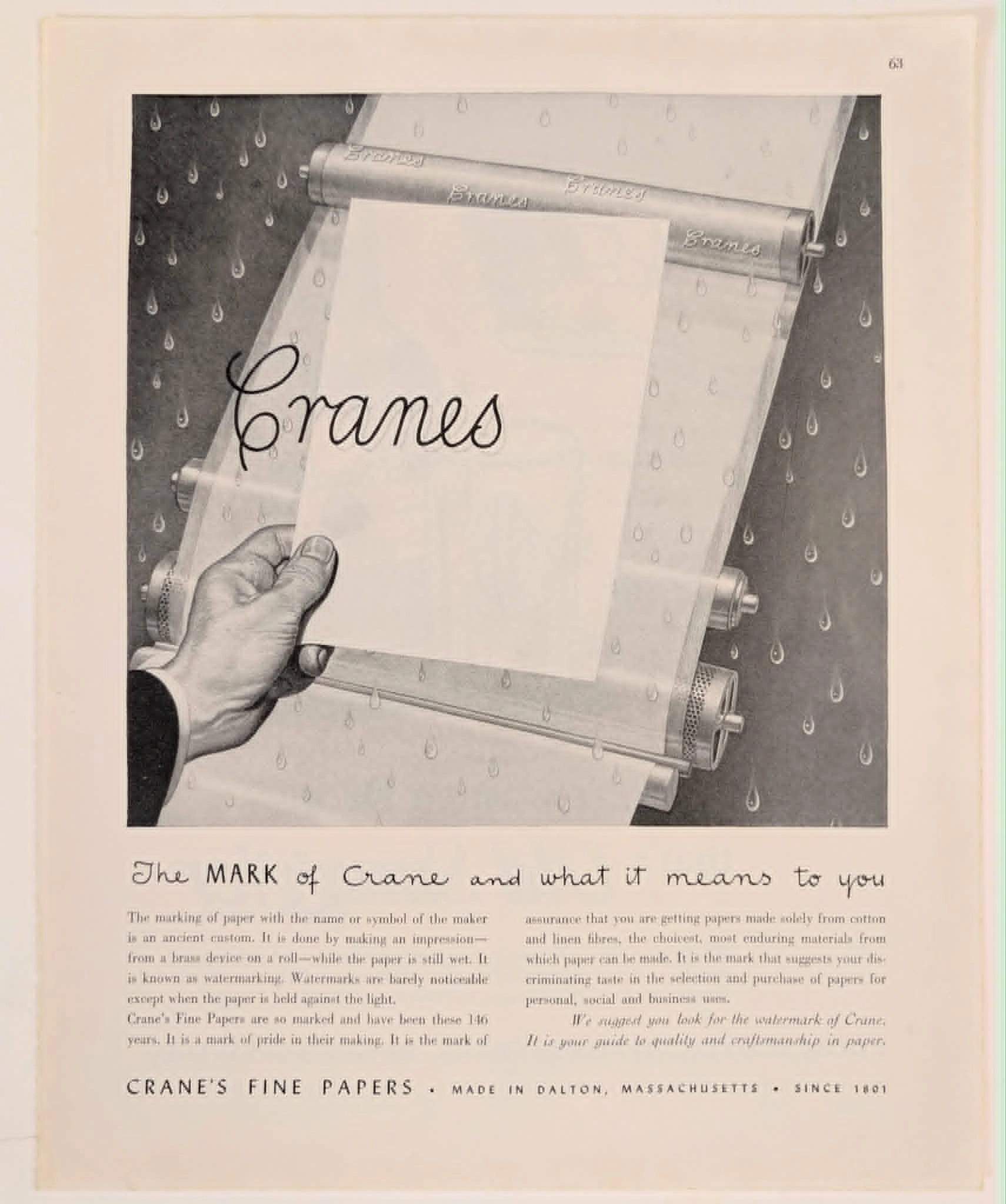
We view paper as a passive commodity. A disposable plane. A temporary surface designed to carry ink and be discarded. This artifact demands a correction of that perspective. It is a document from an era when the medium was indistinguishable from the message. Before the advent of digital encryption, biometric verification, or cryptographic hashing, trust had to be manufactured physically. Trust had to be woven into the very molecular structure of a document. This advertisement for Crane’s Fine Papers is not selling a writing surface. It is explaining the architecture of institutional authority. It highlights the mechanism of the watermark—an invisible seal of authenticity that only reveals itself when actively interrogated by light. It represents a critical historical shift: the moment paper stopped being merely a canvas and became an active participant in the security, identity, and permanence of global commerce.
Category: Other
Brand: Crane
The History
The Ontology of the Invisible Mark To understand this artifact, we must analyze the philosophical weight of the watermark. The concept is ancient, dating back to thirteenth-century Italy, but Crane’s Fine Papers modernized and industrialized the practice for the American century. The advertisement explicitly outlines the process. It is done by making an impression from a brass device on a roll while the paper is still wet. Consider the implication. The mark is not applied to the paper after the fact. It is not ink. It is not a stamp. It is a localized alteration of the paper’s physical density. It is created during the chaotic, foundational moment when suspended fibers are settling into a solid form. The watermark is, literally, an engineered absence of material. By making the paper slightly thinner in the shape of the cursive "Crane" script, light is allowed to pass through more freely. Identity is established through a calculated void. This was the ultimate security feature of the physical age. A printed letterhead could be forged by any skilled lithographer. A signature could be traced. But a watermark required a paper mill. It required industrial infrastructure, specialized brass wire weaving, and precise control over the fluid dynamics of paper pulp. It raised the barrier to forgery so high that the watermark became the unquestioned proxy for truth. The Mechanical Ballet of the Dandy Roll The engineering behind this process is a triumph of industrial precision. The visual anchor of the advertisement is the "dandy roll." In the Fourdrinier papermaking process, a continuous slurry of water and fiber is deposited onto a moving wire mesh. At the specific point where the dandy roll sits, the mixture is approximately ninety-five percent water. It is a fragile, moving web of liquid chaos. The dandy roll is a hollow, wire-mesh cylinder. Soldered onto its surface is the brass electrotype forming the Crane logo. As the cylinder rotates at the exact speed of the moving wet web, the raised brass gently displaces the fibers. It pushes them aside. It does not cut them. It does not break them. It merely rearranges their microscopic architecture. If the roll is too heavy, the paper crushes. If the roll is too light, the mark is illegible. If the speed is mismatched by even a fraction of a percent, the logo smears into an unrecognizable blur. This artifact captures that precise, violent, and delicate intersection of water, brass, and fiber. It visualizes the exact millisecond where raw material is granted a corporate identity. The War Between Cotton and Cellulose The artifact contains a crucial declarative sentence: "assurance that you are getting papers made solely from cotton and linen fibres, the choicest, most enduring materials from which paper can be made." This is not mere marketing copy. It is a technical line drawn in the sand against the industrialization of cheap resources. Following the mid-nineteenth century, the paper industry experienced a massive shift. To meet the insatiable demand of mass media and modern bureaucracy, manufacturers turned to wood pulp. Wood was abundant and cheap. However, wood pulp contains lignin. Lignin is a complex organic polymer that oxidizes when exposed to air and light. It produces acid. It turns yellow. It causes the paper to literally digest itself over time. Crane rejected this modern compromise. They maintained their adherence to cotton and linen rags. Cotton is almost pure cellulose. It contains no lignin. It does not yellow. It does not turn brittle. A document printed on one hundred percent cotton paper will remain chemically stable for centuries. Crane supplied the paper for United States currency. They were in the business of permanence. When a corporation chose Crane paper for their letterhead, they were making a subconscious declaration of solvency. They were signaling that their contracts, their treaties, and their words were intended to outlast the humans who drafted them. The Competitive Landscape of the Analog Era During the era this advertisement circulated, the American paper industry was highly stratified. Mass-market competitors like Hammermill focused their strategic messaging on efficiency. They sold to the typing pool. They advertised how well their paper fed into modern typewriters, how easily it could be erased, and how economical it was for high-volume corporate communication. Crane operated on an entirely different psychological plane. They did not compete on price. They did not compete on office efficiency. They competed on prestige and institutional gravity. While other mills advertised the bright white color of their sheets, Crane advertised the invisible mark hidden within it. They sold the ritual of verification. The physical act of a business executive lifting a contract to the window light to confirm the watermark was a ritual of due diligence. Crane owned that ritual. The Historical Shift: Substrate to Security This artifact marks the apex of the physical document era. Before the shift to digital data storage, the physical weight, texture, and internal composition of a document were legal realities. Society was scaling up. Corporations were becoming multinational. Transactions were occurring between parties who would never meet face-to-face. Trust could no longer be established by a handshake. It had to be transmitted through the mail. The watermarked, cotton-fiber sheet became the avatar of the enterprise. It was a technological shift disguised as a traditional craft. The watermark was the analog precursor to the cryptographic key. It proved origin. It proved integrity. It proved that the entity issuing the document possessed the capital and the heritage required to commission customized, internally branded, lignin-free substrates. This advertisement is a monument to the time when truth was something you could hold in your hands, trace with your fingertips, and verify against the sun.
The Paper
The physical artifact preserving this message is heavily layered in irony. While the advertisement praises the eternal, non-yellowing, pristine nature of one hundred percent cotton fiber paper, the advertisement itself is printed on standard, mid-century publication stock. This is likely a sixty to seventy GSM coated wood-pulp paper, designed for mass circulation in business magazines. The printing employs a high-volume offset lithography process. The image is rendered entirely in grayscale, utilizing a complex halftone dot pattern to achieve the gradient shading of the water droplets and the metallic sheen of the brass dandy roll. Time has executed its slow chemistry upon this page. The lignin within this mass-market paper has oxidized. The edges are displaying a distinct archival yellowing, a warm, toasted tone that creeps inward from the margins. The tactile quality is flat and smooth, completely devoid of the crisp, heavy snap that characterizes the premium Crane paper it so meticulously describes. The decay of the ad serves as a perfect, unintended proof of the ad’s own argument regarding material purity.
The Rarity
Classification: Class A (Contextual Ephemera) This artifact is not classified by extreme physical scarcity. Mid-century business publications were printed in the tens of thousands. Its rarity—and its Class A designation—stems entirely from its exceptional pedagogical and contextual value. It is exceedingly rare to find commercial advertising that so clearly and unapologetically details the mechanical and chemical engineering of its own product. Most advertising of this era focused on lifestyle, convenience, or abstract status. This document acts as an open schematic. It is a historical bridge connecting the ancient art of papermaking with the modern necessity of data security. For archivists, historians of technology, and forensic document examiners, it is a flawless primary source illustrating how analog society engineered trust.
Cite this article
- MLA
- Naodhinsuk, Ronin. “The Time Traveller's Dossier : Crane's Paper - The Anatomy of Trust.” The Record Institute, 27 May 2026, https://therecord.institute/journal/the-time-travellers-dossier-cranes-paper-the-anatomy-of-trust.
- APA
- Naodhinsuk, R. (2026, May 27). The Time Traveller's Dossier : Crane's Paper - The Anatomy of Trust. The Record Institute. https://therecord.institute/journal/the-time-travellers-dossier-cranes-paper-the-anatomy-of-trust
- CHICAGO
- Naodhinsuk, Ronin. 2026. “The Time Traveller's Dossier : Crane's Paper - The Anatomy of Trust.” The Record Institute, May 27, 2026. https://therecord.institute/journal/the-time-travellers-dossier-cranes-paper-the-anatomy-of-trust.