The Time Traveller's Dossier : Darien 1910 - Suburban Shift
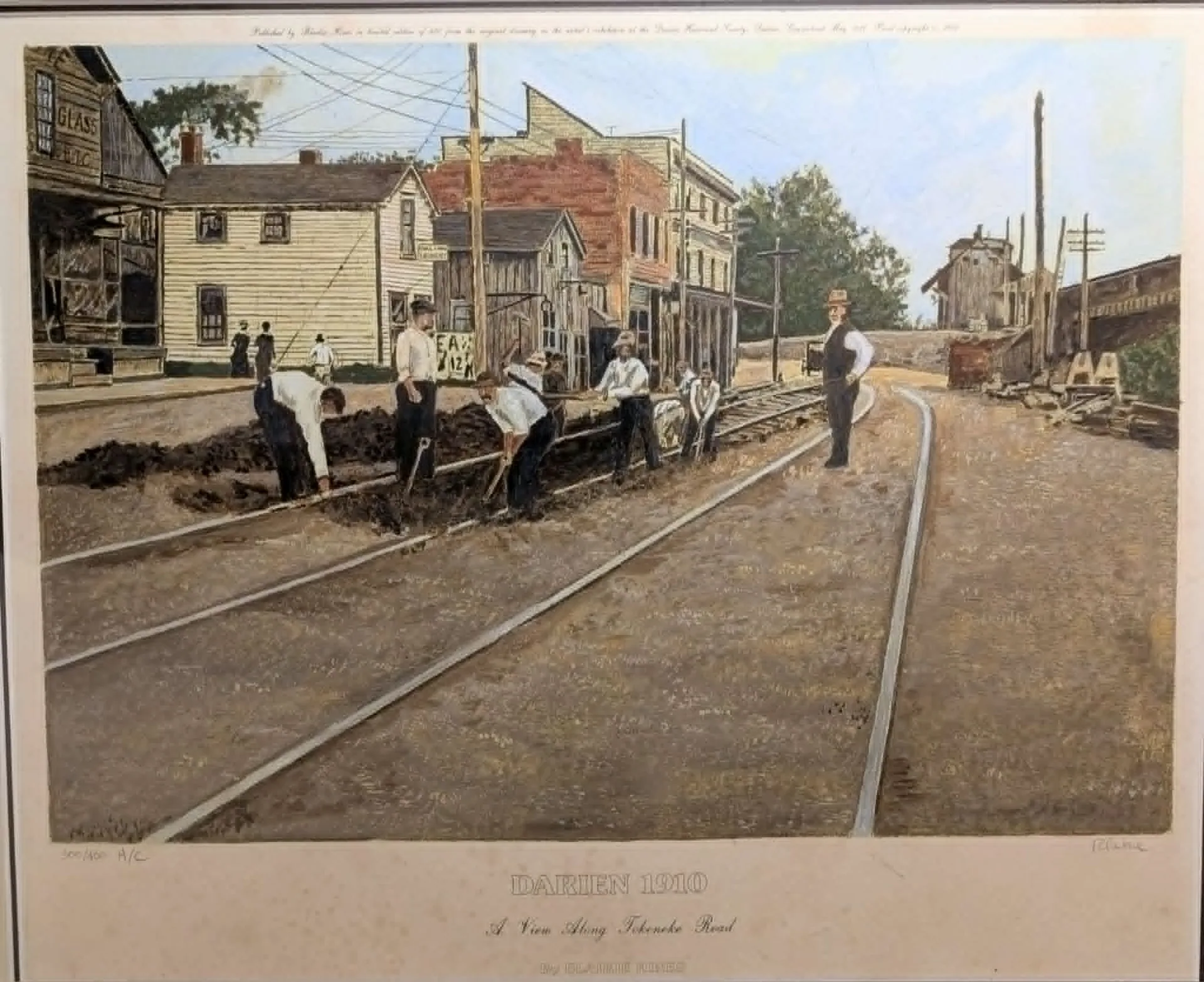
The dirt is being reorganized. Before this moment, a road was merely a suggestion of travel. A path worn by hooves, weather, and the slow march of local time. But steel is definitive. The image captures the precise moment a community surrenders its rural isolation to the inevitable grid of modernity. Then, Darien was a quiet stop on the post road. Now, it is a suburban artery. The shift is absolute. It is the transition from organic dirt to engineered iron. From wandering paths to fixed schedules. We are looking at the death of distance, measured out in wooden ties and metal rails.
Category: Other
The History
The Epoch of 1910: The American Transition The year 1910 sits perfectly on the fulcrum of two distinct eras. The 19th century has ended, but its ghosts still linger in the architecture, the clothing, and the dirt roads. The 20th century has arrived, asserting its dominance through industry, electricity, and steel. America was in a state of rapid, violent infrastructural expansion. The frontier had been declared closed twenty years prior. The objective was no longer to conquer new land, but to optimize the land already claimed. This optimization took the form of connectivity. Before the widespread democratization of the personal automobile, the trolley and the streetcar were the absolute kings of transit. They represented the democratization of movement. They allowed the working class to commute. They allowed towns to bleed into one another, creating the first true concepts of the modern suburb. This artifact does not show the triumph of the finished railway. It shows the gritty, labor-intensive reality of its birth. It shows the transition state. The exact moment the timeline fractured. The Geography of Change: Darien and Tokeneke Road Darien, Connecticut, serves as the stage for this mechanical play. Nestled in Fairfield County, Darien was historically an agricultural community. It was a place defined by its geography, bound by the slow speed of horses and the localized economy of its residents. Tokeneke Road was a quiet vein in a sleepy body. But the introduction of the rail changes the fundamental nature of the town. A railway is a vector. It implies a destination beyond the immediate horizon. By laying these tracks, the laborers are physically binding Darien to Stamford, to Norwalk, and eventually, to the immense gravitational pull of New York City. The dirt road is yielding to mathematical geometry. Parallel lines that stretch out of frame. The town is no longer an isolated settlement. It is becoming a node on a regional network. The Mechanics of Progress: Steel, Sweat, and Steam Look at the mechanics of the scene. There are no massive diesel engines here. No automated track-laying machines. The grand infrastructure of the early 20th century was built on the brute force of human muscle. Men with picks. Men with shovels. The earth is being excavated by hand. The dirt is piled haphazardly along the edges, disrupting the daily life of the street, to make way for the permanent scar of the rail bed. This is the hidden cost of progress. It is loud. It is dirty. It is chaotic. The men are bent in unified labor. Their postures are studies in kinetic energy and mechanical leverage. They are reshaping the earth, shovel by shovel, strike by strike, forcing the natural topography to accept the rigid logic of the industrial age. The Social Fabric: Laborers and Onlookers The societal structure of the era is laid bare in the composition. In the foreground, the laborers toil in the dirt. Their sleeves are rolled. Their posture is curved toward the earth. They are the engine of change, anonymous and exhausted. To the right, a man stands in a dark vest and hat. His posture is upright, his hands resting on his hips or behind his back. He is not digging. He is observing. He is directing. He represents management. Capital. The organizing intelligence behind the brute force. In the background, women in long, conservative skirts walk along the wooden sidewalks. Men stand idly by the storefronts. They are the existing society, watching their reality be fundamentally altered. They are spectators to their own modernization. The tracks are a physical barrier separating the old way of life on the sidewalks from the new reality being forged in the street. The Dual Networks: Wire and Rail Above the physical labor, another network is already in place. Look at the sky. It is fractured by a chaotic webbing of lines. Telegraph poles line the street, leaning slightly under the tension of dozens of wires. This is the second great shift. If the rails below represent the physical movement of bodies and goods, the wires above represent the instantaneous movement of information. Power. Telegraphy. Perhaps early telephony. The physical and the ethereal networks are converging on this single dirt road. The signs on the buildings—"GLASS", "LAUNDRY", "TEA 12c"—represent the local, physical economy. But the wires above and the tracks below signal the arrival of a larger, interconnected national economy that will eventually render these small local systems obsolete. The town is being wired into the mainframe of the 20th century. The 1980 Retrospective: Archiving the Impermanent This image is a temporal paradox. It depicts 1910, but it was published in 1980 by Blaikie Hines. Why 1980? By 1980, the streetcar era was long dead, replaced entirely by asphalt, highways, and the private automobile. The world was standing on the precipice of the digital revolution. Personal computers were entering homes. In 1980, society began to realize that the physical, mechanical world was disappearing into microchips and invisible data streams. Hines’s work is an act of deliberate historical preservation. It is an excavation of memory. He is looking back seventy years to a time when progress was visible. When you could see the sweat that built the future. When infrastructure was a physical object you could touch, not an invisible signal in the air. The print from 1980 is a secondary artifact. It is a record of a record. It captures a modernizing society looking backward to understand how it got there. The Philosophical Shift: From Dirt to Grid Ultimately, the shift documented here is philosophical. A dirt road is democratic. It allows movement in any direction. It shifts with the rain and the seasons. It is organic. A railroad track is authoritarian. It dictates the exact path of travel. It demands adherence to a schedule. It ignores the weather. The town of Darien is trading its organic freedom for mechanical efficiency. It is a necessary trade. It is the trade every modern civilization makes. But this print captures the precise moment of the transaction. The moment the dirt was broken, but before the first car rolled over the steel. It is the tension of the impending future.
The Paper
This is a lithographic reproduction on heavyweight, archival-grade stock. The GSM (Grams per Square Meter) is substantial, likely sitting between 250 and 300, giving the paper a stiff, enduring presence. The texture holds a slight tooth, designed to mimic the tactile reality of the original drawing. The aging process is visible. The subtle yellowing at the extreme margins speaks to forty years of atmospheric exposure since its printing in 1980. The graphite signature and the handwritten "300/400 H/C" are embedded into the fibers, providing a forensic link to the human hand that verified this specific iteration. The paper acts not just as a medium, but as a vault. It holds the 1980 interpretation of a 1910 reality, freezing two distinct timelines onto a single physical plane.
The Rarity
Classification: Class A (Significant Archival Witness) The rarity of this piece is defined by its highly specific localized context and its restricted print run. It is part of an edition of 400, but is designated "H/C" (Hors Commerce), indicating it was a proof or presentation copy outside the commercial run. While the market price for localized historical prints remains accessible, its "contextual value" is profound. It is a definitive visual record of a hyper-specific moment in New England's infrastructural evolution. As physical towns continue to homogenize, documents that capture the precise mechanics of their original modernization elevate in historical importance.
Cite this article
- MLA
- Naodhinsuk, Ronin. “The Time Traveller's Dossier : Darien 1910 - Suburban Shift.” The Record Institute, 6 July 2026, https://therecord.institute/journal/the-time-travellers-dossier-darien-1910-suburban-shift.
- APA
- Naodhinsuk, R. (2026, July 6). The Time Traveller's Dossier : Darien 1910 - Suburban Shift. The Record Institute. https://therecord.institute/journal/the-time-travellers-dossier-darien-1910-suburban-shift
- CHICAGO
- Naodhinsuk, Ronin. 2026. “The Time Traveller's Dossier : Darien 1910 - Suburban Shift.” The Record Institute, July 6, 2026. https://therecord.institute/journal/the-time-travellers-dossier-darien-1910-suburban-shift.