The Time Traveller's Dossier : Datsun 280-ZX - The GT Shift
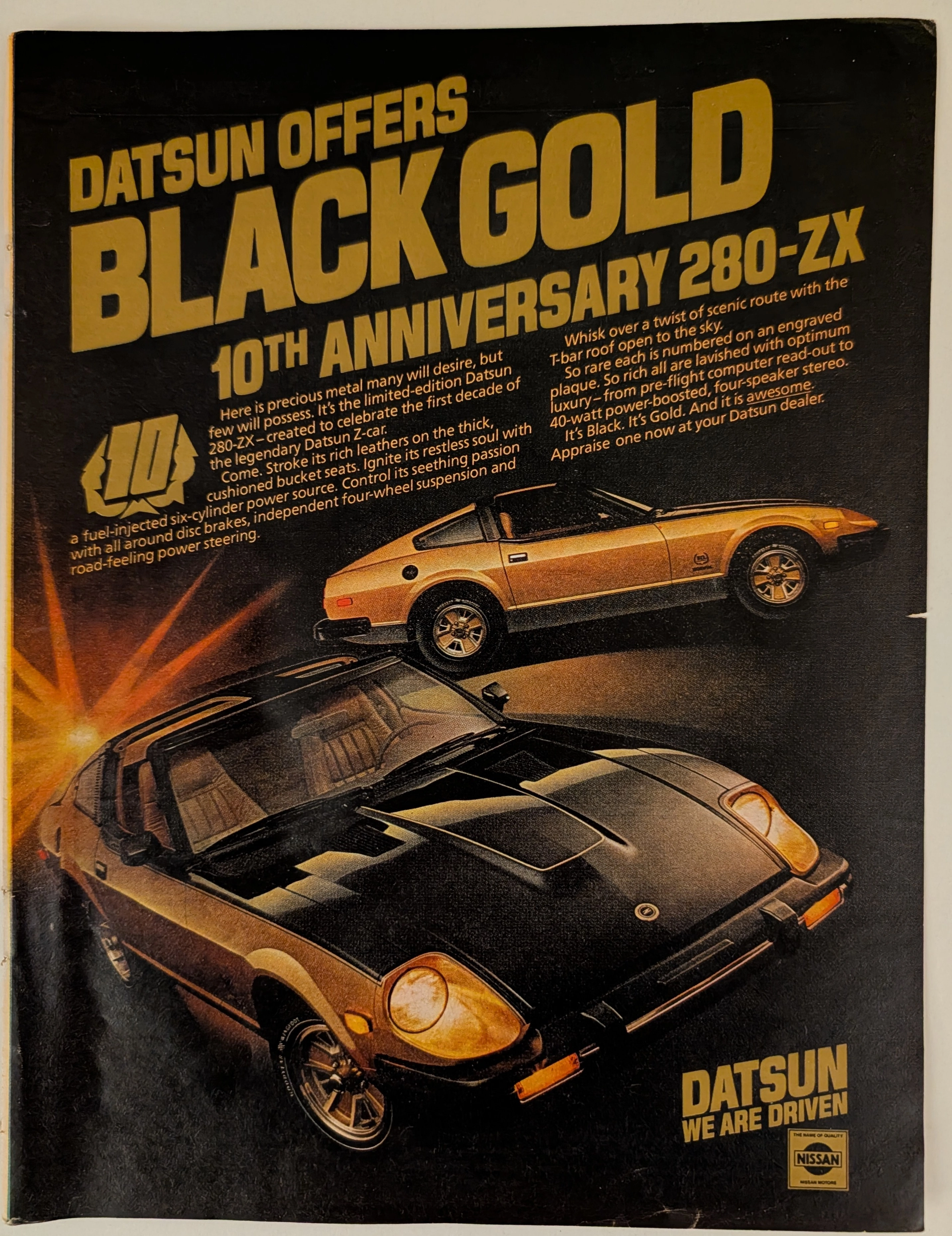
Then. The sports car was a visceral punishment. A machine of raw mechanical feedback. Loud. Uncomfortable. Temperamental. It demanded physical sacrifice in exchange for kinetic velocity. It was a weekend indulgence, entirely divorced from daily comfort. Now. The sports car is an isolated, luxurious capsule. It is a computational network rolling on synthetic rubber. It prioritizes atmospheric control, acoustic perfection, and passenger comfort alongside acceleration. It is a sanctuary of speed. The artifact before us documents the precise architectural bridge between these two eras. The year is 1980. The vehicle is the Datsun 280-ZX 10th Anniversary "Black Gold" edition. This is not merely a piece of automotive marketing collateral. It is the obituary of the raw, analog sports car. It is the birth certificate of the modern Personal Luxury Grand Tourer. It is the definitive moment Japanese manufacturing stopped apologizing and claimed absolute supremacy over the American highway.
The History
The Architecture of the Grand Touring Ascension The Malaise Era and the Vacuum of Power To understand the gravity of this printed document, one must first dissect the geopolitical and economic landscape of 1980. The American automotive industry was suffocating. The entire decade of the 1970s had been a relentless assault on the concept of performance. Two severe oil crises, orchestrated by OPEC embargoes, had permanently altered the economics of gasoline. Simultaneously, the newly formed Environmental Protection Agency mandated strict emissions regulations. Detroit’s response was catastrophic. The legendary American V8 engines were mechanically choked. Compression ratios plummeted. Catalytic converters strangled exhaust flow. Cars became heavy, slow, and asthmatic. This period is historically classified as the "Malaise Era." The Chevrolet Corvette, once a pinnacle of performance, had devolved into a sluggish, heavy cruiser. The raw European roadsters—from MG and Triumph—were plagued by electrical unreliability and archaic engineering. There was a massive, unexploited vacuum in the market. The consumer still desired the aesthetic silhouette of a sports car, but they no longer wanted the mechanical suffering associated with it. They wanted reliability. They wanted efficiency. Above all, they demanded luxury. Datsun recognized this shifting psychological paradigm. The Evolution of the Z: From Purity to Plush The artifact explicitly celebrates "the first decade of the legendary Datsun Z-car." In 1970, the original Datsun 240Z revolutionized the industry. It was lightweight, affordable, beautifully styled, and purely focused on the driving experience. It was an analog scalpel. By 1979, Datsun introduced the 280-ZX chassis. Automotive purists and automotive journalists wept. The car had grown larger. It had gained significant weight. The suspension was softened to absorb highway imperfections rather than to carve canyon corners. The steering was assisted. However, the market reacted with extreme enthusiasm. Sales skyrocketed. Datsun had accurately calculated that the aging demographics of the original sports car buyers no longer wanted to feel every pebble on the road. The 280-ZX was a masterclass in demographic pivoting. It transformed from a pure sports car into a "Grand Tourer" (GT). It was designed for long-distance, high-speed travel in absolute comfort. This 10th Anniversary "Black Gold" edition, limited to merely 3,000 units (2,500 in black and gold, 500 in red and black), was the ultimate manifestation of this new philosophy. It was an unapologetic celebration of excess and comfort. The Semiotics of Black and Gold The visual language of the late 1970s and early 1980s was heavily reliant on the psychological impact of specific color combinations. Black and gold was the ultimate chromatic signifier of premium status. It was the colorway of the dominant John Player Special Lotus Formula One cars. It was the colorway of high-end audio equipment. It represented a specific type of disco-era opulence transitioning into the Wall Street excess of the upcoming decade. The copy reads: "It's Black. It's Gold. And it is awesome." This is a stark departure from previous Japanese advertising, which often focused on humility, fuel economy, and sensible pricing. This phrasing is confident. It is arrogant. It dictates the value of the object to the reader rather than pleading for their approval. The use of the word "awesome" in 1980 advertising copy marks a shift toward colloquial, emotionally driven marketing over sterile, specification-based selling. Aerospace Envy and Silicon Dreams The textual analysis of the engineering features reveals a society infatuated with the dawn of the microprocessor age. "So rich all are lavished with optimum luxury—from pre-flight computer read-out to 40-watt power-boosted, four-speaker stereo." The term "pre-flight computer read-out" is the critical phrase. In 1980, the NASA Space Shuttle program was preparing for its inaugural launch. The cultural consciousness was saturated with aerospace terminology. Datsun deliberately hijacked this vernacular. The car featured a rudimentary diagnostic display—a series of warning lights for fluid levels and bulb failures. By labeling it a "pre-flight computer," they elevated the driver from a mere motorist to a pilot. They transformed a daily commute into an aerospace operation. It capitalized on the human desire for mastery over complex, silicon-based machinery. Furthermore, the emphasis on a "40-watt power-boosted, four-speaker stereo" highlights the shift in interior expectations. The cabin was no longer just a place to sit; it was a mobile acoustic chamber. The roar of the engine was actively being replaced by the fidelity of the sound system as the primary auditory metric of automotive value. The T-Bar Compromise The artifact highlights the "T-bar roof open to the sky." During the 1970s, the convertible automobile was effectively legislated out of existence in the United States due to impending, draconian rollover safety standards. Manufacturers scrambled for a solution that provided open-air driving without compromising structural rigidity. The T-bar roof (or T-tops) was the engineering compromise. It left a solid steel beam running down the center of the cabin, providing safety, while allowing glass panels to be removed. It became a defining cultural hallmark of the 1980s sports car. It was the physical manifestation of safety colliding with the human desire for freedom. The Nomenclature of Transition Finally, one must observe the typography in the lower right quadrant. "DATSUN WE ARE DRIVEN" sits boldly above a smaller, secondary box: "THE NAME OF QUALITY NISSAN." This artifact captures a massive corporate identity crisis frozen in ink. At this exact historical moment, Nissan Motor Company was beginning the arduous, incredibly expensive process of phasing out the globally recognized "Datsun" brand name to unify its products under the corporate "Nissan" banner. The juxtaposition of the two logos illustrates the transition. Datsun is the bold, emotional hook. Nissan is the quiet, corporate guarantor of quality. Within a few years, the Datsun name would be entirely erased from the physical vehicles and the marketing materials, making this specific era of dual-branding a unique sociological record of corporate restructuring.
The Paper
The physical artifact is extracted from a premium, high-circulation periodical of the early 1980s. Estimated at 80 GSM. High-gloss calendared magazine stock. The surface is designed to hold heavy ink loads without bleeding, a necessity for the vast expanses of dark imagery. Under microscopic analysis, the CMYK halftone separation is aggressively weighted toward the "Key" (black) plate. The black background is not a flat tone; it is a "rich black," built by layering cyan, magenta, and yellow beneath the black ink to create a bottomless, light-absorbing depth. The gold elements are achieved through precise ratios of yellow and magenta, avoiding actual metallic inks which were cost-prohibitive for mass-market magazine runs. Time has degraded the artifact. Micro-abrasions map the surface gloss. The edges display a faint, acidic yellowing where the lignin in the paper pulp has oxidized. It was engineered for a transient existence. To be flipped through, observed, and discarded. Its survival transforms it from a temporary commercial message into a permanent historical record of metallurgical and sociological desire.
The Rarity
Classification: Class B Archival Justification: The artifact is not unique in its original production. Hundreds of thousands of these pages were printed and distributed across North America in magazines like Motor Trend, Car and Driver, and Time. However, its archival value is derived from its contextual weight and the escalating scarcity of flawless survival. Finding a perfectly preserved copy—free from moisture damage, staple tears, or UV fading—is increasingly difficult. Its primary value is not financial, but anthropological. It is a Class B artifact because it perfectly encapsulates a triad of historical shifts: the death of the analog sports car, the rise of Japanese automotive dominance, and the corporate death of the Datsun brand. It is a foundational text for automotive historians.
Cite this article
- MLA
- Naodhinsuk, Ronin. “The Time Traveller's Dossier : Datsun 280-ZX - The GT Shift.” The Record Institute, 8 April 2026, https://therecord.institute/journal/the-time-travellers-dossier-datsun-280-zx-the-gt-shift.
- APA
- Naodhinsuk, R. (2026, April 8). The Time Traveller's Dossier : Datsun 280-ZX - The GT Shift. The Record Institute. https://therecord.institute/journal/the-time-travellers-dossier-datsun-280-zx-the-gt-shift
- CHICAGO
- Naodhinsuk, Ronin. 2026. “The Time Traveller's Dossier : Datsun 280-ZX - The GT Shift.” The Record Institute, April 8, 2026. https://therecord.institute/journal/the-time-travellers-dossier-datsun-280-zx-the-gt-shift.