The Time Traveller's Dossier : Ethyl Magic Circle - Driving as Leisure
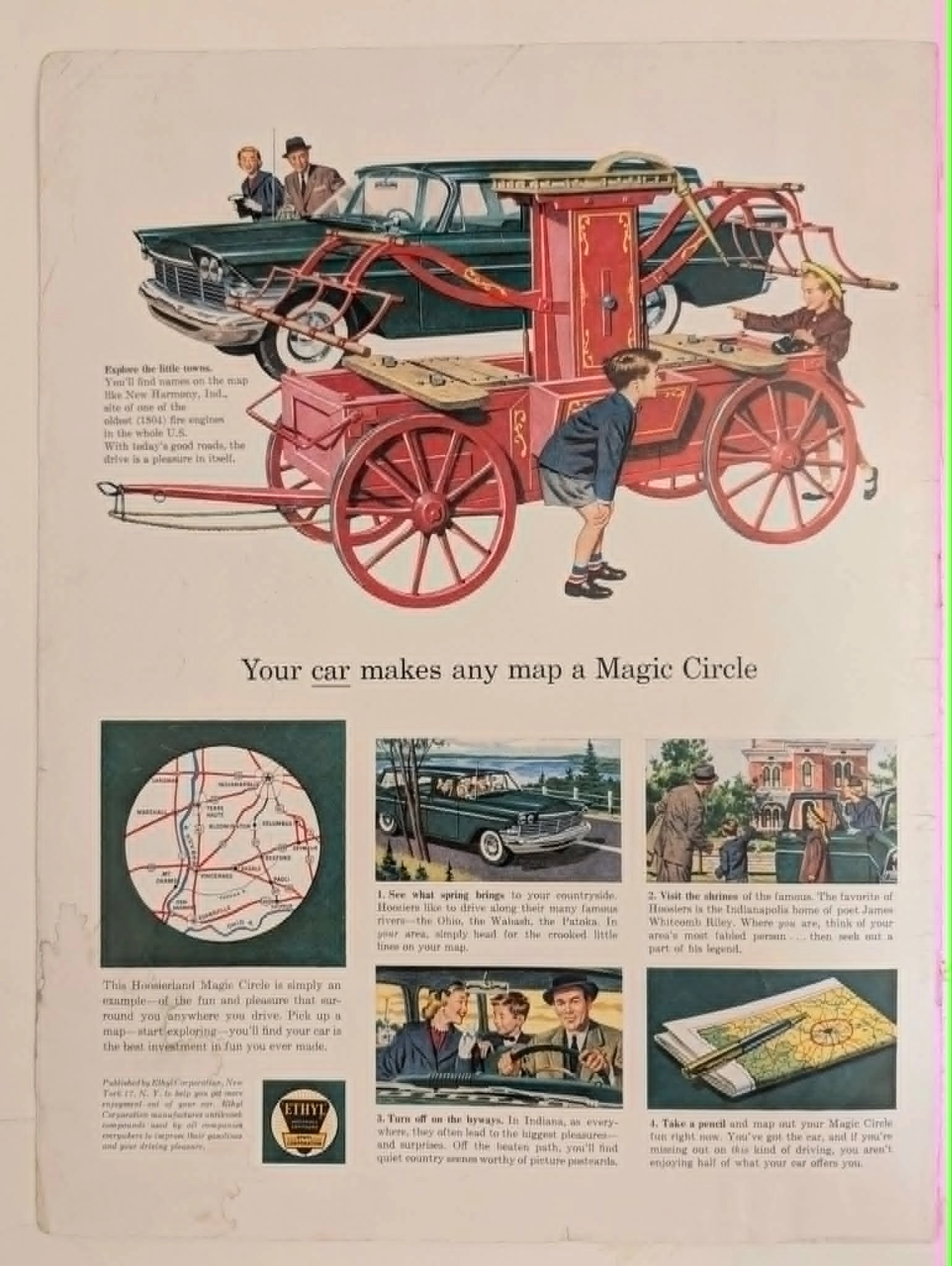
Before. The automobile was a mechanism of pure utility. A vector linking point A to point B. Travel was a logistical equation. A calculation of time, cost, and endurance. You drove because you had to arrive. After. The road became the destination. The map was no longer a set of instructions. It was a menu of experiences. The automobile transformed from a tool of transport into a capsule of collective family leisure. This artifact, a mid-century advertisement from the Ethyl Corporation, documents a profound psychological pivot in human history. It is not merely selling a product. It is selling an entirely new behavioral paradigm. It engineered the concept of driving for the sheer sake of driving. It instructed a post-war society how to consume its newfound free time, transforming the burning of fossil fuels from a necessity into a recreational weekend ritual.
Category: Travel
The History
The Architecture of Engineered Leisure To understand this document, we must examine the landscape of the mid-twentieth century. The post-World War II economic boom fundamentally rewired the American paradigm. For the first time in modern history, a massive middle class possessed two novel currencies: disposable income and structured free time. The weekend was no longer merely a pause from labor; it became an empty canvas demanding to be filled. Simultaneously, the physical landscape was being rewritten. The Federal-Aid Highway Act of 1956 had begun carving a permanent, concrete circulatory system across the continent. Roads were no longer rutted tracks; they were smooth, engineered ribbons of asphalt designed for speed and comfort. Yet, a problem emerged for the petroleum industry. When a population only drives to work and the grocery store, gasoline consumption remains static. It is a fixed variable. To increase revenue, the industry needed to alter human behavior. They needed to manufacture a reason to move. Enter the Ethyl Corporation and the concept of the "Magic Circle." This campaign is a masterpiece of behavioral engineering. It told the consumer: You do not need to drive across the country to find adventure. Adventure is immediate. It is local. Draw a circle around your home. That radius is your playground. By reframing the mundane local map as a treasure chart, the campaign successfully transformed aimless wandering into a structured, desirable family activity. It created the "joyride" as a socio-cultural institution. The Alchemy of Combustion The irony of this artifact lies in its author. The Ethyl Corporation did not sell cars. It did not sell tires. It did not even sell gasoline directly to the public. The Ethyl Corporation was a joint venture between General Motors and Standard Oil. They manufactured a chemical compound: Tetraethyllead (TEL). In the 1920s, automotive engineers faced a severe technical limitation. As they attempted to build larger, more powerful engines with higher compression ratios, the fuel of the era would detonate prematurely in the cylinders. This caused a destructive, metallic pinging known as "engine knock." It threatened to stall the evolution of the internal combustion engine. The solution, discovered by engineer Thomas Midgley Jr., was the addition of lead to the gasoline. This "antiknock compound" slowed the burn rate of the fuel. It was an engineering triumph that allowed for the massive, heavy, chrome-laden V8 automobiles of the 1950s—like the sprawling station wagon depicted in the artifact. Therefore, this advertisement is a sophisticated piece of indirect marketing. Ethyl Corporation is spending vast amounts of capital to encourage people to drive. The logic is coldly mathematical: More driving equals more gasoline consumed. More gasoline consumed equals more premium fuel refined. More premium fuel refined equals an increased demand for Ethyl's chemical additive from the major oil companies. They are not selling you a road trip. They are ensuring the systemic, continuous consumption of their chemical catalyst. Cartography as a Persuasion Tool Observe the cartographic element embedded in the design. The "Hoosierland Magic Circle." The map ceases to be a mere geographic record. It is weaponized as a psychological trigger. The red lines of the highways are bolded, highlighted against the subdued background. The text instructs the reader to "simply head for the crooked little lines on your map." This is an instruction to intentionally get lost. It is a radical departure from the utilitarian origins of cartography. Maps were historically designed to prevent wandering. Here, the map is utilized to encourage it. The artifact teaches the viewer to look at the space around their home not as familiar territory, but as an untapped reservoir of "surprises" and "fabled persons." The choice of Indiana—Hoosierland—is highly deliberate. It is the geographic center of Middle America. It represents the ultimate everyman location. If a Magic Circle can be drawn in the quiet, agricultural expanse of Indiana, it can be drawn anywhere. The Juxtaposition of Eras The visual narrative relies heavily on temporal juxtaposition. The focal point is a late-1950s station wagon, sleek, modern, and painted a rich, confident green. It represents the pinnacle of mid-century consumer technology. Yet, what is this modern marvel visiting? An antique. The oldest fire engine in the U.S. (1804), located in New Harmony, Indiana. This is a recurring theme in mid-century automotive advertising. The message is clear: Our advanced technology allows us to effortlessly access and appreciate the past. The automobile is framed as a time machine. The family, safely enclosed in their steel and glass capsule, glides through history. They visit the shrines of poets like James Whitcomb Riley. They consume history as a roadside attraction. The station wagon itself is crucial to this narrative. It is not a sports car for the individual. It is a mobile living room for the nuclear family. The father drives, the mother navigates, the children observe. The car reinforces the societal structure of the era. The Unseen Repercussions As an archivist, looking at this document requires viewing it through the lens of subsequent history. The artifact is beautifully rendered, projecting an aura of innocence, freedom, and idyllic family bonding. Yet, we now know the invisible cost of the "Magic Circle." The very compound this advertisement was designed to push—Tetraethyllead—would eventually be recognized as one of the most devastating environmental and public health disasters of the 20th century. The idyllic country drives promoted here were actively distributing micro-particles of neurotoxic lead across the American landscape, settling into the soil, the water, and the bloodstreams of the population. The shift from driving for utility to driving for leisure fundamentally altered the global climate trajectory. It normalized the frivolous burning of fossil fuels. It shaped urban sprawl, ensuring that future generations would be completely dependent on the automobile for basic survival. This single sheet of paper, therefore, is not just a charming vintage illustration. It is a foundational blueprint for the modern, carbon-dependent, hyper-mobile society. It is a document of engineered desire, blinding technical optimism, and catastrophic unforeseen consequences.
The Paper
The physical medium of this artifact is highly characteristic of mid-century mass-market periodical publishing. It is printed on standard magazine stock, likely weighing between 65 and 80 GSM (Grams per Square Meter). The paper is manufactured from mechanical wood pulp, a process that retains high levels of lignin. This lignin content is the primary agent of the artifact's current physical state. Over the decades, exposure to ultraviolet light and atmospheric oxygen has caused the lignin to oxidize. This chemical reaction results in the distinct yellowing and browning around the margins, a degradation process known archivally as 'foxing'. The printing process utilized is early offset lithography, combined with rotary letterpress techniques for the sharpest typography. Under magnification, the imagery resolves into distinct, overlapping CMYK (Cyan, Magenta, Yellow, Key/Black) halftone dots. This mechanical reproduction of color was designed for speed and volume, allowing the Ethyl Corporation to place this image in the hands of millions simultaneously. The slight imperfections in the registration—where the color plates misalign by a fraction of a millimeter—anchor the artifact firmly in the industrial realities of the 1950s.
The Rarity
Classification: Class A - Contextually Significant Archive In terms of pure market scarcity, this artifact is not rare. Advertisements of this nature were printed in massive print runs, inserted into publications like Life, The Saturday Evening Post, and Look magazine. Millions of copies existed at the moment of its creation. However, The Record Institute assigns rarity based on historical weight and contextual preservation. As a pristine, legible record of a massive behavioral engineering campaign, it holds significant value. It is a primary source document capturing the exact moment when the petroleum industry successfully convinced the public to treat gasoline not as a utility, but as a gateway to leisure. Its value lies in its ideological transparency. It is an artifact of the Anthropocene, documenting the systematic promotion of mass fossil fuel consumption.
Cite this article
- MLA
- Naodhinsuk, Ronin. “The Time Traveller's Dossier : Ethyl Magic Circle - Driving as Leisure.” The Record Institute, 15 May 2026, https://therecord.institute/journal/the-time-travellers-dossier-ethyl-magic-circle-driving-as-leisure.
- APA
- Naodhinsuk, R. (2026, May 15). The Time Traveller's Dossier : Ethyl Magic Circle - Driving as Leisure. The Record Institute. https://therecord.institute/journal/the-time-travellers-dossier-ethyl-magic-circle-driving-as-leisure
- CHICAGO
- Naodhinsuk, Ronin. 2026. “The Time Traveller's Dossier : Ethyl Magic Circle - Driving as Leisure.” The Record Institute, May 15, 2026. https://therecord.institute/journal/the-time-travellers-dossier-ethyl-magic-circle-driving-as-leisure.