The Time Traveller's Dossier : Fatima 1918 - The Sensible Shift
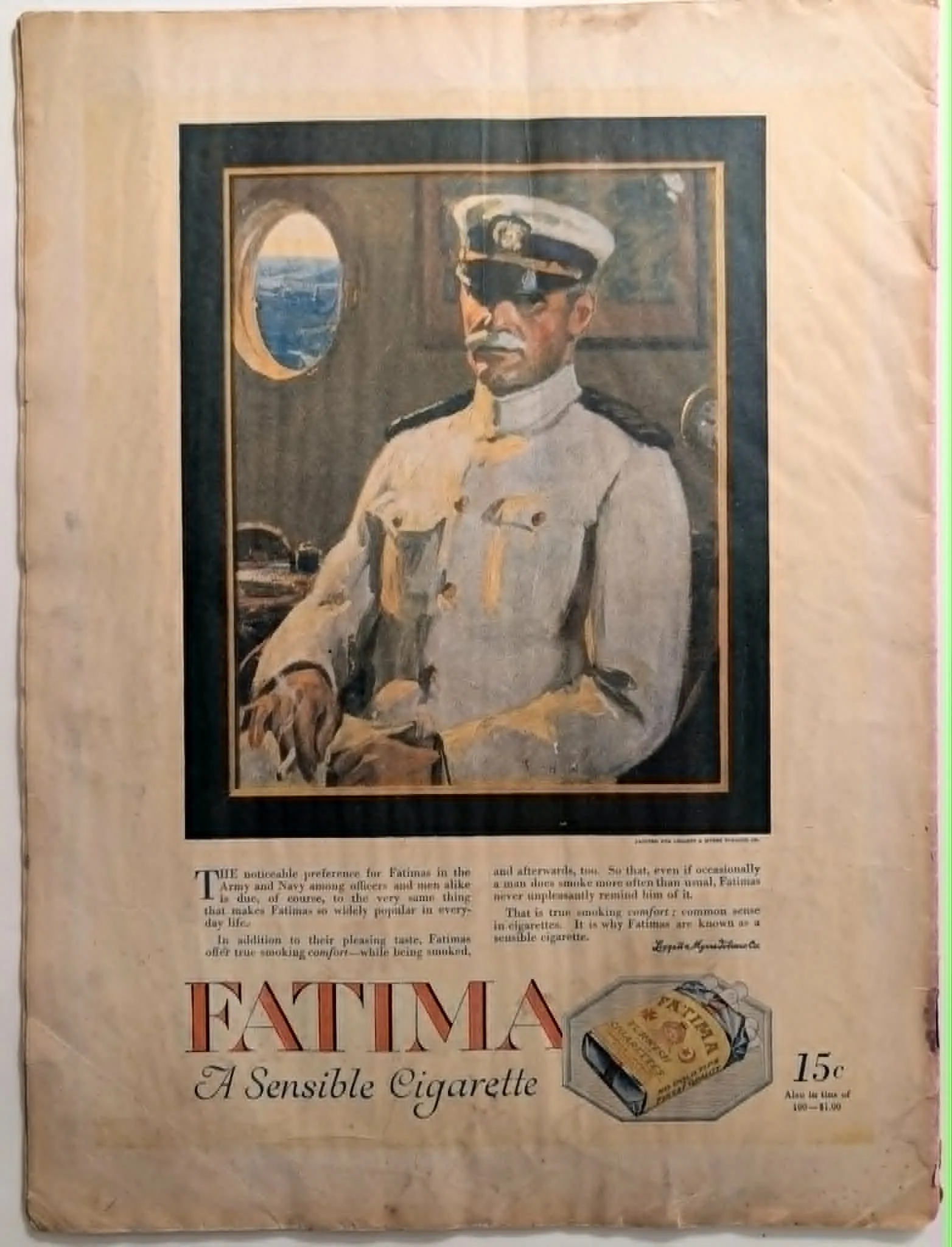
Habit was once an indulgence. Then, it became a strategic necessity. Before the mechanized acceleration of the twentieth century, tobacco consumption was largely a slow, stationary act. It belonged to the parlor, the cigar lounge, and the pipe-smoke-filled study. This artifact—a Fatima Cigarettes advertisement published by Liggett & Myers—documents the precise moment that paradigm collapsed. The problem was no longer how to pass an idle evening. The problem was how to anchor the human mind amidst the relentless, industrial anxiety of global naval warfare. This document does not sell a luxury. It sells a physiological coping mechanism. By branding their product as "sensible" and placing it in the steady hands of a high-ranking naval officer, the creators engineered a fundamental shift. They transformed the cigarette from an effeminate novelty or a cheap vice into an essential, rational tool for operational readiness. This is the architecture of wartime pragmatism. A record of when the brief, controlled burn of a cigarette became the universal unit of time for a world in conflict.
Category: Tobacco
The History
The Acceleration of Time and the Death of the Cigar To understand this artifact, one must first understand the fundamental shift in how humanity experienced time at the dawn of the twentieth century. The world before this era was governed by natural rhythms and the slow progression of the Victorian age. In that world, the cigar and the pipe were the undisputed monarchs of tobacco. Both required an investment of time. A cigar demands an hour of contemplation; a pipe requires careful packing, tamping, and a sheltered environment to remain lit. They were instruments of peace. The modern world did not grant peace. It granted frantic intervals. The industrialization of society, culminating in the outbreak of global conflict, fractured time into minute, stressful increments. Men were no longer sitting in drawing rooms; they were standing watch on the freezing, wind-swept decks of steel dreadnoughts. They were waiting in the damp, claustrophobic bellies of submarines. They needed a cognitive anchor that could be accessed instantly, consumed in exactly seven minutes, and discarded just as quickly when the alarm sounded. The cigarette, previously dismissed by the elite as a cheap habit for urban laborers or a fleeting novelty, was suddenly elevated. It was precision-engineered for the pace of modernity. Fatima recognized this shift not merely as a change in consumer preference, but as a change in the human condition. The Geopolitics of the Turkish Blend Examine the typography and the iconography of the Fatima package nestled in the bottom right corner of the artifact. "FATIMA TURKISH BLEND CIGARETTES." The package bears the image of a veiled woman, a crescent moon, and a star. This imagery represents a profound historical dissonance and a brilliant marketing pivot. Prior to global conflict, "Turkish" or "Oriental" tobacco—imported from the Ottoman Empire and the Balkans—was the absolute gold standard for premium cigarettes. It was exotic, aromatic, and deeply associated with European aristocracy and romanticized Eastern mystique. However, the geopolitical realities of the 1910s made this association highly problematic. The Ottoman Empire was a Central Power, an enemy to the Allied forces. Liggett & Myers faced a monumental strategic challenge: how to sell an "Oriental" blend to intensely patriotic American military personnel. The solution was the complete domestication of the exotic. They did not change the packaging—the cost and brand confusion would have been disastrous. Instead, they changed the context. By placing the Turkish blend directly into the hands of an American military archetype, they stripped the product of its foreign allegiance. The blend remained a symbol of premium quality, but the act of smoking it was rebranded as a distinctly American, patriotic duty. It was a masterclass in separating the supply chain's origin from the consumer's identity. The Naval Officer as an Archetype of Control The visual anchor of this document is not the product, but the practitioner. The painted portrait of the naval officer is a calculated psychological projection. He is not a terrified, mud-soaked infantryman in a trench. He is a high-ranking officer. His uniform is pristine, blindingly white against the dark interior of the cabin. His jaw is set, his mustache impeccably groomed, his posture rigid yet relaxed. Through the porthole behind him, we see the vast, turbulent expanse of the open ocean—a realm of chaos, unpredictable weather, and unseen enemy submarines. Inside the cabin, however, there is absolute order. The officer controls the chaos. This is the psychological core of the advertisement. In an era where human beings were being dwarfed by massive machines of war—battleships, artillery, dreadnoughts—the individual felt profoundly powerless. The officer holding the Fatima cigarette represents the reclamation of control. He is the steady hand at the helm. Liggett & Myers was not selling tobacco; they were selling the emotional equilibrium required to command a warship. The cigarette is positioned as the silent partner in his leadership, a tool that aids his concentration rather than an indulgence that distracts him. The Lexicon of the "Sensible" Narrative The copywriting in this artifact is a triumph of understated, rational persuasion. It deliberately avoids the flamboyant, hyperbolic language of the Gilded Age. "The noticeable preference for Fatimas in the Army and Navy among officers and men alike is due, of course, to the very same thing that makes Fatimas so widely popular in every-day life." The text is clinical. It builds a bridge between the extreme environment of the military and the normalcy of civilian life. But the true shift lies in the slogan: "A Sensible Cigarette." And the supporting argument: "Fatimas offer true smoking comfort—while being smoked, and afterwards, too. So that, even if occasionally a man does smoke more often than usual, Fatimas never unpleasantly remind him of it." This is a direct appeal to physiological efficiency. The advertisement acknowledges the reality of war: men under stress will smoke heavily ("more often than usual"). In a time before the widespread medical understanding of tobacco's lethality, the concern was not long-term health, but short-term operational impairment—the "hangover" of heavy smoking, the raw throat, the clouded head. By promising that Fatima will "never unpleasantly remind him of it," the brand aligns itself with operational readiness. It is the cigarette of the intelligent, rational man who cannot afford to have his faculties impaired. It is anti-excess. It is, purely and simply, sensible. The Logistics of Morale: Pricing and Delivery Finally, we must analyze the stark economic data printed in the lower right corner. "15c. Also in tins of 100 —
The Paper
This document is a survivor of mass-market industrial printing, born from early twentieth-century acidic wood pulp. It was inherently designed to die. The paper possesses a high lignin content, a natural polymer in wood that reacts aggressively with oxygen and light. Over a century, this chemical betrayal has resulted in the deep, brittle yellowing visible at the margins. The printing utilizes an early form of commercial color lithography. The inks, particularly the stark black framing the officer and the vibrant blue of the ocean, are pressed directly into the paper's porous fiber, creating a matte, non-reflective surface. The text shows microscopic bleed, a hallmark of high-speed press plates striking imperfect paper. It is tactile history. When you trace the edge of this page, you are feeling the exact texture of mass communication as it existed during the mechanization of global society.
The Rarity
This artifact is classified as Class B. It is not a unique, one-of-a-kind painting, nor is it an impossibly rare misprint. Millions of these magazines were printed and distributed across America. However, its archival value is immense, derived entirely from its contextual significance rather than its scarcity. Most of these pages were used as fire starter, insulation, or simply thrown away. An intact page, preserving the precise color balance of the officer's uniform and the sharp typography of the pricing structure, is a rare window into the psychological manipulation of a society at war. Its value is not monetary; it is anthropological. It captures the exact moment the exotic cigarette was weaponized as a tool of domestic patriotism.
Cite this article
- MLA
- Naodhinsuk, Ronin. “The Time Traveller's Dossier : Fatima 1918 - The Sensible Shift.” The Record Institute, 24 June 2026, https://therecord.institute/journal/the-time-travellers-dossier-fatima-1918-the-sensible-shift.
- APA
- Naodhinsuk, R. (2026, June 24). The Time Traveller's Dossier : Fatima 1918 - The Sensible Shift. The Record Institute. https://therecord.institute/journal/the-time-travellers-dossier-fatima-1918-the-sensible-shift
- CHICAGO
- Naodhinsuk, Ronin. 2026. “The Time Traveller's Dossier : Fatima 1918 - The Sensible Shift.” The Record Institute, June 24, 2026. https://therecord.institute/journal/the-time-travellers-dossier-fatima-1918-the-sensible-shift.