The Time Traveller's Dossier : Ferrari 312 F1 - The Aerodynamic Subjugation Summary
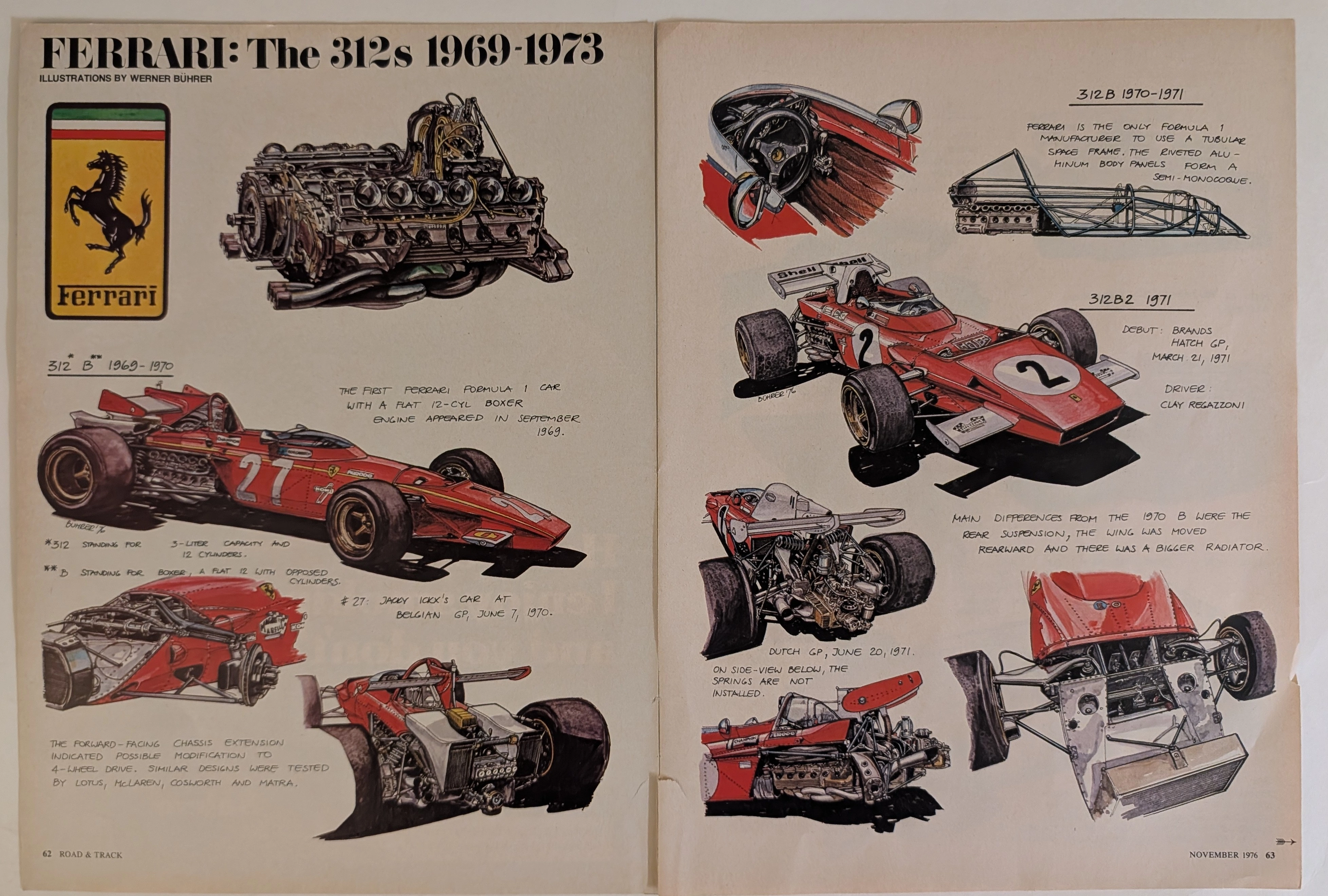
Then, speed was a brute-force equation of pushing a cigar-shaped fuselage blindly through the resisting atmosphere. Now, speed is the absolute subjugation of the invisible air, weaponizing the wind to crush the machine into the asphalt. The problem in the late 1960s and early 1970s Formula 1 was not merely generating more horsepower; the internal combustion engine had already reached terrifying heights of output. The existential crisis for manufacturers was keeping the tires connected to the earth. The cars were literally taking flight. The pursuit of pure, unadulterated mechanical grip had reached its physical, terrifying limit. The solution, as meticulously documented in this 1976 Road & Track retrospective by Werner Bührer, was a violent paradigm shift. It was the painful, reluctant birth of modern aerodynamics. This artifact is a portal. It transports us to the exact historical, psychological, and engineering pivot where Enzo Ferrari—a man who famously proclaimed that aerodynamics were for people who could not build engines—was forced to surrender to the wind. It is an automotive magazine spread, yes. But deeper than that, it is a beautifully illustrated autopsy of a legacy manufacturer desperately evolving its DNA. It captures the frantic mutation of the Ferrari 312 from a traditional tube-framed missile into a winged, deformed, downforce-generating weapon. It is the visual documentation of motorsport losing its romantic innocence and embracing the cold, hard laws of fluid dynamics.
Category: Automotive
Brand: Ferrari
The History
The Crucible of 1969: The Death of the Cigar and the Cosworth Threat To understand the profound historical significance of this artifact, one must first understand the battlefield of Formula 1 at the dawn of the 1970s. For decades, Grand Prix racing had been an elegant, albeit deadly, pursuit dominated by sleek, cigar-shaped cars. Grip was derived mechanically, through suspension geometry and tire compounds. However, by 1968, the British "Garagistes"—nimble, pragmatic teams like Lotus, McLaren, and Tyrrell—had introduced a terrifying new variable to the grid: the Ford Cosworth DFV V8 engine paired with rudimentary aerodynamic wings. Enzo Ferrari, operating from the hallowed grounds of Maranello, viewed these British teams with aristocratic disdain. They were, in his eyes, mere chassis builders who bought off-the-shelf engines. Ferrari built the entire car, heart and skeleton alike. Yet, the brutal reality of the stopwatch could not be ignored. The Cosworth-powered cars, utilizing their lightweight aluminum monocoque chassis and towering, fragile aerodynamic wings, were dominating. Ferrari was facing an existential crisis. The artifact before us, detailing the evolution of the 312 series from 1969 to 1973, is the physical blueprint of Maranello’s frantic counter-attack. It represents a proud, traditional empire forced to rapidly mutate its engineering philosophy or face absolute extinction on the global stage. The Heart of the Beast: Forghieri’s Flat-12 Boxer Rebellion The foundational element of this mechanical shift is displayed with stunning clarity on the right-hand page: the legendary 3-liter, 12-cylinder Flat-12 "Boxer" engine. Introduced in September 1969 under the brilliant direction of engineer Mauro Forghieri, this engine was a masterpiece of lateral thinking. Traditional V12 engines, while powerful, were tall. They raised the car's center of gravity and disrupted airflow over the rear of the chassis. Forghieri flattened the V. By utilizing a 180-degree opposed cylinder configuration, he created a remarkably wide but incredibly low power plant. This lowered the Ferrari 312B’s center of gravity to the very asphalt, drastically improving mechanical grip and handling. Furthermore, the flat architecture provided a clean, unobstructed path for the air to flow over the rear wing. This engine, rendering a glorious, screaming 500 horsepower, was the technological anchor that kept Ferrari relevant. It was an Italian declaration of war, a statement that while the British might understand the wind, Maranello still ruled the combustion chamber. The intricate illustration of this engine captures the sheer, terrifying complexity of pre-computer mechanical engineering—a dense, beautiful jungle of exhaust headers, fuel lines, and magnesium castings. The Architectural Schism: Tubes Versus the Monocoque Beneath the aerodynamic narrative lies an even deeper, more stubborn technological conflict, explicitly noted in Bührer’s annotations: "Ferrari is the only Formula 1 manufacturer to use a tubular space frame. The riveted aluminum body panels form a semi-monocoque." This single sentence encapsulates a massive historical shift in automotive architecture. While Colin Chapman of Lotus had revolutionized the sport in 1962 with the introduction of the fully stressed aluminum monocoque—a rigid, bathtub-like structure that was immensely stronger and lighter—Ferrari stubbornly clung to the past. They continued to weld hundreds of small steel tubes together to form a space frame, covering it with riveted aluminum skins. It was an archaic, aircraft-inspired method dating back to the 1950s. This artifact documents the dying days of the tubular space frame in top-tier motorsport. Ferrari’s reluctance to abandon their traditional fabrication methods in the face of obvious British superiority was a symptom of institutional pride. The 312s documented here are fascinating transitional fossils; they possess the cutting-edge Flat-12 engine and evolving aerodynamic wings, yet their skeletons are fundamentally rooted in the past. The Aerodynamic Desperation: From Wings to the "Snowplow" The visual hierarchy of the artifact perfectly traces the desperate, trial-and-error evolution of downforce. We see the 1970 312B, driven by Jacky Ickx, sporting a relatively modest, high-mounted rear wing and small front dive planes. By 1971, with Clay Regazzoni’s 312B2, the wing has moved rearward, the radiators have grown, and the front aerodynamics have become more pronounced. The engineers were no longer just trying to pierce the air; they were actively trying to bend it to their will. Then, the artifact reveals the climax of this aerodynamic desperation: the August 1972 312 B3, radically designed by Mauro Forghieri. Earning the unflattering nickname "Spazzaneve" (The Snowplow), this machine was an aesthetic nightmare but an aerodynamic revelation. The incredibly wide, flat, shovel-like nose was designed to aggressively channel air to the radiators and generate massive front downforce, complying with new 1973 regulations regarding deformable structures and fuel bags. Bührer notes, "This car was never raced." It was deemed too radical, too heavy, and Forghieri was temporarily sidelined by Fiat engineers. Yet, the "Snowplow" was the ultimate proof of the historical shift. The pursuit of speed had forever abandoned the pursuit of beauty. The car was no longer a sculpted work of art; it was a deformed, functional tool built entirely to manipulate invisible atmospheric pressure. The Paradigm Shift and the Legacy of the 312 Ultimately, this brilliant two-page spread chronicles the exact window of time when motorsport transitioned from an art form into an aerospace science. The years 1969 to 1973 were a violent, experimental crucible. The regulations were fluid, the speeds were climbing exponentially, and the death toll was tragically high. Designers like Forghieri were operating in the dark, without wind tunnels or computational fluid dynamics (CFD), relying entirely on intuition, track testing, and raw courage. The Ferrari 312 series, in all its iterations shown here, is the physical manifestation of a proud manufacturer fighting for its life in a changing world. They threw everything at the problem: flat-12 engines, twin radius arms, moving radiators, and revolutionary shovel-noses. This document does not just show cars; it shows a massive corporate intellect grinding against the laws of physics. It proves that innovation is rarely a smooth, linear trajectory; it is chaotic, ugly, and fraught with failure. The "Snowplow" never raced, but the aerodynamic lessons learned from its bizarre geometry directly birthed the legendary Ferrari 312T series, which would utterly dominate the mid-1970s and win multiple World Championships. This artifact captures the painful, necessary adolescence of modern racing.
The Paper
This artifact is a profound physical manifestation of mid-1970s enthusiast publishing. Carefully excised from the November 1976 issue of Road & Track, the paper stock is a classic, lightweight uncoated offset sheet, hovering around 60 to 70 GSM. Unlike the glossy, hyper-reflective stock of modern magazines, this porous paper actively absorbs the ink, giving Werner Bührer’s exquisite watercolor and marker illustrations a soft, almost tactile depth. The chemical reality of this specific paper blend has resulted in a very slight, warm yellowing—a delicate oxidization process that archivists recognize as the slow burning of cellulose. The tactile nature of the page is slightly toothy, carrying the faint, unmistakable scent of vintage petroleum-based inks and archived history. The printing method is a high-volume offset lithography. Under a jeweler's loupe, the intricate, microscopic CMYK halftone rosette patterns that compose the vibrant Ferrari red (Rosso Corsa) and the metallic sheen of the engine parts are clearly visible. The slight bleeding of the black ink in the hand-lettered text is a direct, sensory recording of analog, pre-digital publishing constraints, transforming this page from a mere informational graphic into a fragile, temporal artifact.
The Rarity
Classification: Class A (Archival Significance - High Contextual Value) While Road & Track magazines from 1976 were printed in vast quantities, the survival rate of intact, vibrant, two-page technical spreads specifically featuring Werner Bührer’s highly sought-after illustrations is steadily declining. The rarity of this piece does not stem from an exorbitant auction price, but rather from its immense, irreplaceable contextual and artistic value. It is an unsanitized, highly strategic primary source document bridging the gap between cold engineering blueprints and automotive romanticism. Finding a specimen where the complex reds of the Ferraris and the intricate line work of the Flat-12 engine remain this vibrant, free from severe fading or tearing, elevates it strictly to Class A archival status within any serious motorsport or graphic design collection.
Cite this article
- MLA
- Naodhinsuk, Ronin. “The Time Traveller's Dossier : Ferrari 312 F1 - The Aerodynamic Subjugation Summary.” The Record Institute, 20 April 2026, https://therecord.institute/journal/the-time-travellers-dossier-ferrari-312-f1-the-aerodynamic-subjugation-summary.
- APA
- Naodhinsuk, R. (2026, April 20). The Time Traveller's Dossier : Ferrari 312 F1 - The Aerodynamic Subjugation Summary. The Record Institute. https://therecord.institute/journal/the-time-travellers-dossier-ferrari-312-f1-the-aerodynamic-subjugation-summary
- CHICAGO
- Naodhinsuk, Ronin. 2026. “The Time Traveller's Dossier : Ferrari 312 F1 - The Aerodynamic Subjugation Summary.” The Record Institute, April 20, 2026. https://therecord.institute/journal/the-time-travellers-dossier-ferrari-312-f1-the-aerodynamic-subjugation-summary.