The Time Traveller's Dossier : Firestone "500" - The Motorsport Translation of Highway Safety
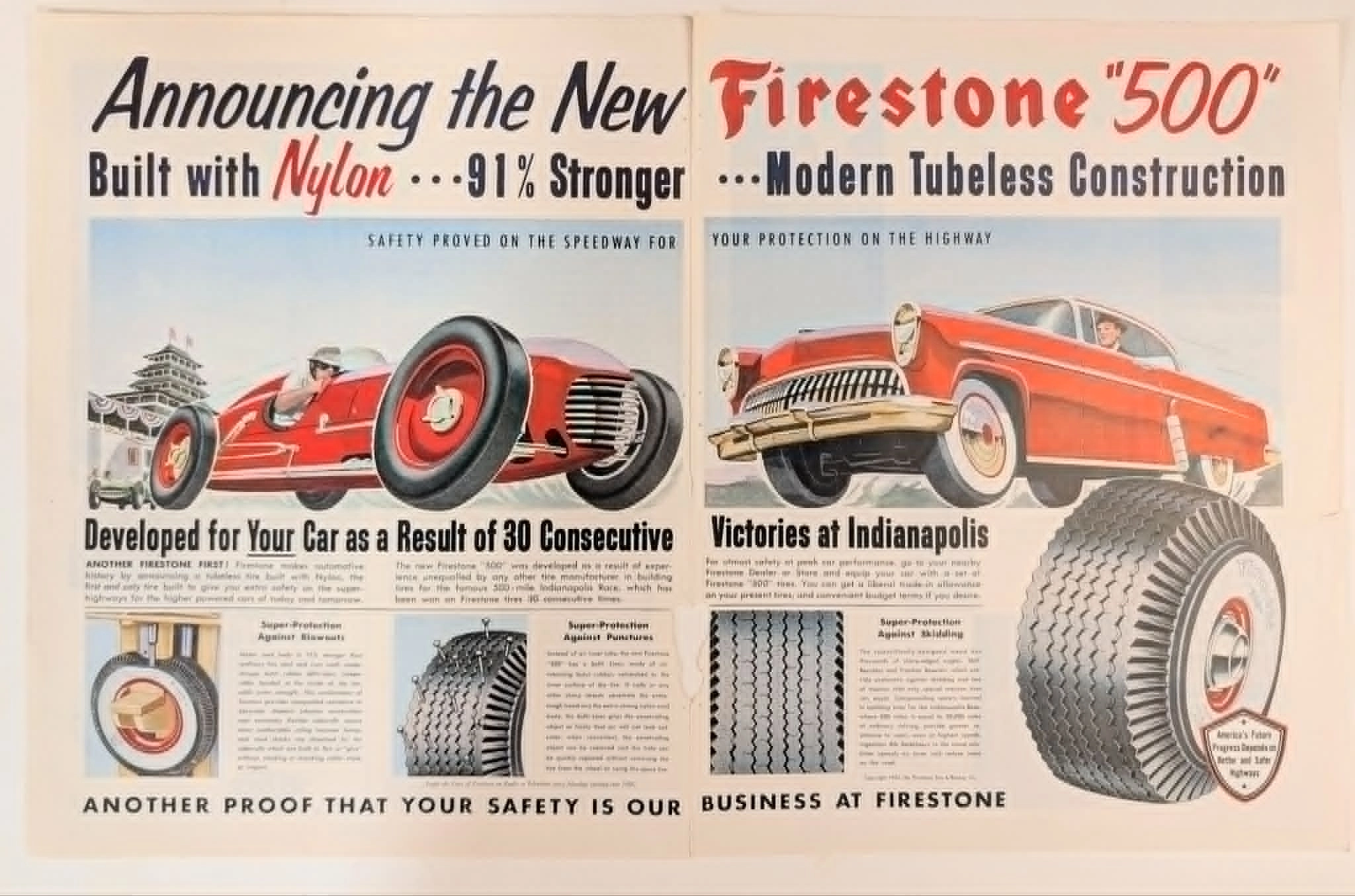
This is not merely an advertisement for rubber. It is a documentary record of a critical threshold in automotive survival. Before this era, the pneumatic tire was a fragile balloon. It was prone to thermal fatigue, explosive sudden-death blowouts, and instantaneous deflation. The highway was a dangerous frontier. This double-page spread from the mid-1950s captures the exact moment the tire evolved from a delicate consumable into a structural component of human safety. It documents two massive technological shifts simultaneously: the eradication of the inner tube, and the integration of weapons-grade nylon into consumer transport. It is a bridge of applied physics. It connects the brutal, high-speed crucible of the Indianapolis Motor Speedway directly to the newly paved concrete of the American Interstate system. It sells peace of mind. It sells the future. It translates the violence of the racetrack into the security of the family driveway.
Category: Technology
Brand: Firestone
The History
The Post-War Highway Equation To understand this artifact, one must understand the velocity of the era. The mid-1950s marked a radical shift in the American landscape. The Federal-Aid Highway Act was birthing the Interstate system. Ribbons of unbroken, high-speed concrete were replacing meandering dirt and gravel roads. Simultaneously, the automobile itself was mutating. Post-war prosperity fueled the rise of the heavy, powerful V8 engine. Cars were gaining mass. They were gaining horsepower. But there was a fatal flaw in this equation of mass and velocity. The tires. Before this shift, standard tires were built with cotton or rayon cords, and they relied on a separate, internal rubber bladder—the inner tube—to hold air. This architecture was fundamentally flawed for sustained high speeds. The friction between the tire casing and the inner tube generated immense heat. Heat is the silent, invisible destroyer of vulcanized rubber. At sustained speeds of sixty or seventy miles per hour, rayon cords stretched. The rubber softened. The inner tube pinched. The result was the blowout. A catastrophic, explosive loss of air pressure that would instantaneously rip the steering wheel from a driver’s hands, sending the two-ton steel vehicle spiraling into the ditch. The blowout was a daily, deadly reality of mid-century motoring. It was the great anxiety of the American road trip. The Eradication of the Tube This Firestone "500" advertisement documents the cure. The headline proudly announces "Modern Tubeless Construction." This was not a minor update. It was a paradigm shift in pneumatic physics. By coating the inside of the tire casing with a specialized, impermeable butyl rubber layer, engineers eliminated the need for the tube entirely. The consequences were immediate and profound. First, the friction between tube and tire was gone. The tire ran drastically cooler at highway speeds. The thermal degradation plummeted. Second, the mechanics of a puncture were altered. When a nail pierced an old tube-type tire, the inner tube would tear and rupture like a popped balloon, causing an explosive deflation. But when a nail pierces a tubeless tire, the impermeable inner liner clings to the penetrating object. The rubber forms a tight seal around the shank of the nail. The explosive blowout is downgraded to a slow, manageable leak. The driver retains control. The artifact highlights this exact mechanism in the center inset graphic: a tire tread brutally studded with nails, yet holding its structural integrity. It is a visual guarantee of survival. The Nylon Revolution The second technological pillar documented here is the material science of the casing. "Built with Nylon ... 91% Stronger." Rayon and cotton were organic or semi-organic materials. They absorbed moisture. They degraded. They broke under sheer kinetic stress. Nylon was a synthetic miracle. Forged in the crucible of World War II, it was the material of parachutes, tow ropes, and flak jackets. It was engineered for extreme tensile stress. By weaving nylon cords into the plies of the tire casing, Firestone altered the structural limits of the tire. Nylon possessed a unique thermal property: as it heated up, it actually shrank slightly, tightening the internal structure of the tire rather than relaxing it. It fought against the centrifugal forces trying to tear the tire apart at high speeds. The left inset graphic demonstrates this brutal durability. A tire is shown being compressed violently against a steel block, the sidewall bulging under immense, crushing pressure. "Super-Protection Against Blowouts." It is a testament to the skeletal strength of the nylon plies. The tire absorbs the kinetic shock of a pothole or debris without the internal cords snapping. The Indianapolis Laboratory The brilliance of this artifact lies in how it justifies these technological leaps. It does not rely solely on laboratory claims. It relies on the absolute, undeniable violence of the racetrack. "Developed for Your Car as a Result of 30 Consecutive Victories at Indianapolis." The Indianapolis 500 was not merely a sporting event in the 1950s. It was the supreme proving ground for automotive metallurgy and rubber compounding. It was a 500-mile, high-speed telemetry session. Race cars were essentially mobile laboratories pushing materials beyond the threshold of failure. The open-wheel racer depicted in the advertisement is not just a symbol of speed; it is a symbol of accelerated testing. If a tire casing could survive the blistering heat, the lateral G-forces, and the abrasive asphalt of the Brickyard for five hundred miles, it could survive a summer road trip to Florida. Firestone understood this translation perfectly. The visual hierarchy of the advertisement places the red Indianapolis racer and the red passenger sedan on parallel vectors. They are moving in the same direction. The DNA of the race car is actively flowing into the family vehicle. The Geometry of Friction Look closely at the right inset graphic. "Super-Protection Against Skidding." The macro-photography of the tread pattern is not accidental. The intricate, zig-zag sipes cut into the rubber blocks are engineered for a specific fluid dynamic. As the heavy car travels over wet pavement, these microscopic channels act as a squeegee, forcing the water out from under the contact patch and allowing the rubber to bite into the aggregate of the road. Before advanced tread geometry, heavy cars on bias-ply tires were notoriously prone to hydroplaning. They were essentially water-skis. This tread design is an attempt to mathematically dictate the friction coefficient regardless of weather. The Shield of Progress Finally, the artifact contextualizes itself within a broader national narrative. The small shield in the corner reads: "America's Future Progress Depends on Better and Safer Highways." This aligns the product with the civic duty of the era. The Eisenhower Interstate System was a matter of national defense and economic expansion. But the system was useless if the vehicles traveling it were prone to catastrophic failure. Firestone positions the "500" tire not just as a consumer good, but as a vital component of American infrastructure. The tire is the interface between the citizen and the newly built republic. This advertisement is a masterclass in translating abstract engineering—polymer chemistry, vulcanization, tensile strength—into deep, emotional security. It tells the post-war father that he can harness the power of his new V8 engine, he can travel the new interstate highways at unprecedented speeds, and the ghosts of the racetrack will keep his family tethered safely to the earth.
The Paper
This is a double-page spread extracted from a high-circulation mid-century American publication. The substrate is a standard, lightweight, machine-made magazine stock, calibrated strictly for mass-market rotary presses. The printing relies on the classic CMYK halftone process. Under magnification, the illusion of the solid red race car shatters into a precise, interlocking constellation of magenta and yellow rosettes. The aging is evident. The paper displays the classic oxidation of mid-century wood-pulp—a subtle, warm yellowing migrating inward from the edges. The fibers are brittle. The tactile sensation is dry, bearing the distinct, slightly dusty scent of decomposing lignin. It is a mass-produced artifact, yet the organic decay of the paper grants it the solemnity of a historical document.
The Rarity
Rarity: C — Very Common This artifact falls squarely into the foundational tier of the Institute’s grading system. Record Score: High. The artifact documents a truly pivotal shift in automotive history—the commercialization of tubeless technology and nylon reinforcement, directly bridging motorsport engineering to mass-market safety. Rarity Score: Low. This advertisement was embedded in publications like Life, The Saturday Evening Post, and Look. It was printed by the millions. Because these magazines were often hoarded in attics and basements by mid-century consumers, the surviving population of this specific advertisement is enormous. Composite Logic: Following the Institute’s strict rules, the grade is capped. Historical significance can lift a common object only as far as S. However, because this specific artifact was produced in the tens of millions and survives in deep abundance, the Rarity axis exerts gravity on the composite. It cannot transcend its mass-produced origins. It is a ubiquitous record of an important shift. Condition: Good — The spread exhibits mild center-fold wear where it was extracted from the binding, light edge toning, and minor handling ripples, but remains structurally complete with vibrant ink retention.
Cite this article
- MLA
- Naodhinsuk, Ronin. “The Time Traveller's Dossier : Firestone "500" - The Motorsport Translation of Highway Safety.” The Record Institute, 3 June 2026, https://therecord.institute/journal/the-time-travellers-dossier-firestone-500-the-motorsport-translation-of-highway-safety.
- APA
- Naodhinsuk, R. (2026, June 3). The Time Traveller's Dossier : Firestone "500" - The Motorsport Translation of Highway Safety. The Record Institute. https://therecord.institute/journal/the-time-travellers-dossier-firestone-500-the-motorsport-translation-of-highway-safety
- CHICAGO
- Naodhinsuk, Ronin. 2026. “The Time Traveller's Dossier : Firestone "500" - The Motorsport Translation of Highway Safety.” The Record Institute, June 3, 2026. https://therecord.institute/journal/the-time-travellers-dossier-firestone-500-the-motorsport-translation-of-highway-safety.