The Time Traveller's Dossier : Firestone - The Low-Pressure Shift
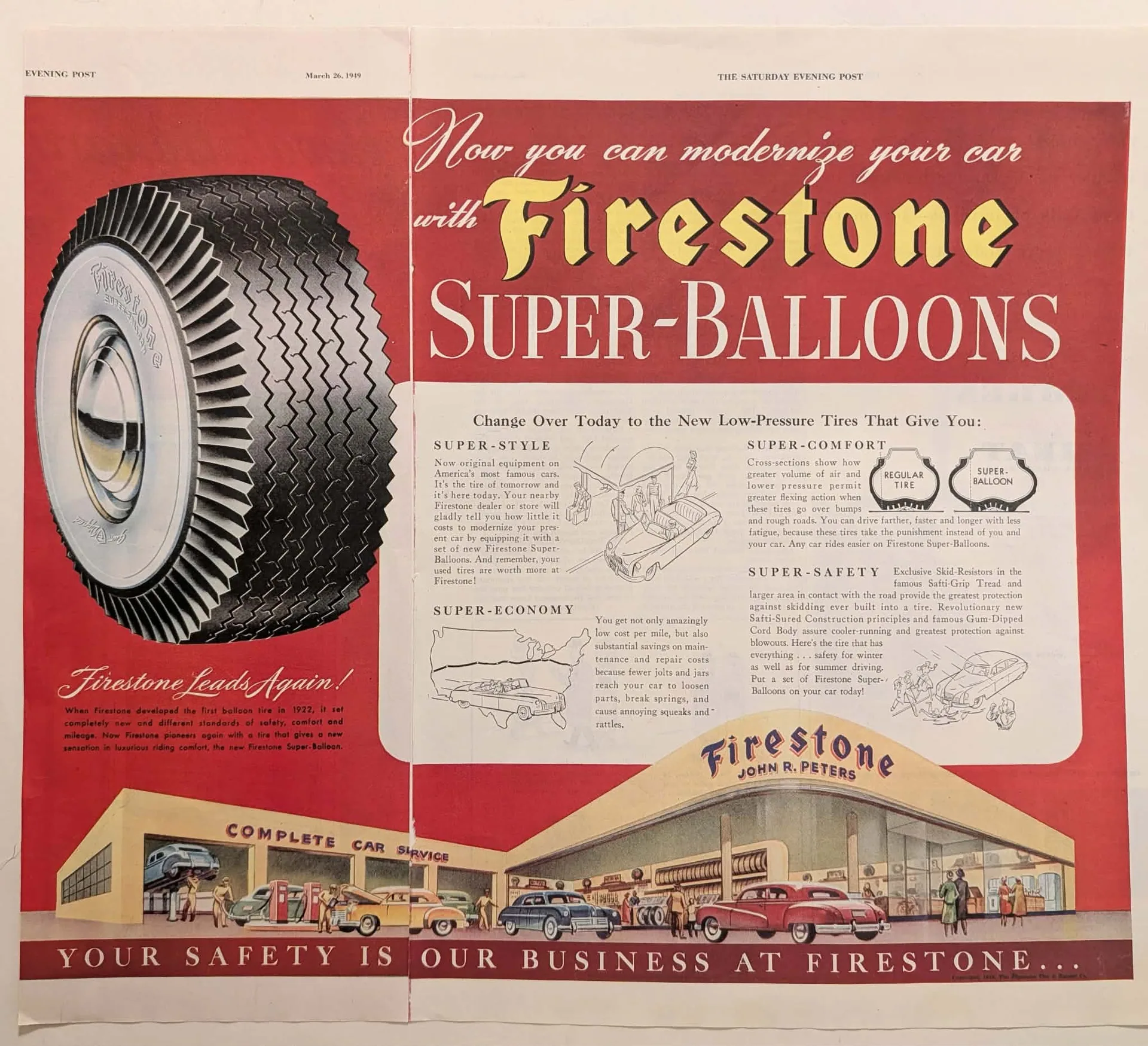
Then. Rubber was a weapon of war. It was rationed, restricted, and poured into the treads of tanks and the bellies of bombers. The civilian automobile was left to rattle on aging, solidifying synthetics. Now (1949). The war is won. The economy is accelerating. But the infrastructure remains scarred. The roads are rough. The pre-war suspension systems are punishing. The solution was not to pave the entire continent overnight. The solution was pneumatic. This 1949 Firestone Super-Balloon double-page spread from The Saturday Evening Post represents a fundamental pivot in automotive philosophy. It is the exact moment the tire transitioned from a simple, utilitarian wear-and-tear component into an active instrument of luxury. It promised the modernization of an aging machine without the cost of a new chassis. It sold the illusion of a newly paved world, entirely contained within a few extra pounds of air.
Category: Technology
Brand: Firestone
The History
The Post-War Rubber Renaissance To understand the gravity of this document, we must first understand the material scarcity of the era that preceded it. During the early 1940s, rubber was a critical, heavily guarded resource. The global supply chains were severed. Civilians drove on bald tires, nursing them through rationing boards and vulcanized patches. By March 1949, the paradigm had violently shifted. The American industrial complex, hypertrophied by wartime production, pivoted its immense weight back to the consumer market. Rubber was no longer a symbol of sacrifice; it was the canvas of the new American leisure class. Firestone was not just selling a tire. They were selling the dividends of peacetime. The messaging here is aggressive, triumphant, and deeply psychological. "Now you can modernize your car." In 1949, Detroit was still struggling to meet the explosive demand for new automobiles. Millions of Americans were still driving pre-war models—heavy, rigid machines with archaic suspensions. Firestone identified a massive economic loophole. They offered a technological retrofit. By simply changing the rolling rubber, a driver could simulate the smooth glide of the elusive, futuristic 1950s models that were still trapped on the assembly lines. The Engineering of the Super-Balloon The shift from high-pressure tires to low-pressure "balloons" was an engineering marvel disguised as a simple consumer choice. Pre-war tires required high air pressure to maintain structural integrity under the weight of steel car bodies. This high pressure meant the tire was rigid. Every fissure, every rock, every imperfection in the mid-century asphalt was telegraphed directly up the steering column and into the driver’s spine. The "Super-Balloon" altered the physics of the drive. The artifact explicitly illustrates this in its "Super-Comfort" cross-section diagram. By increasing the physical volume of the air chamber and decreasing the internal pressure, the tire itself became a primary suspension component. It allowed for "greater flexing action." The tire could now absorb the kinetic energy of an impact before that energy ever reached the metal chassis. Firestone engineers had to redesign the structural carcass of the tire to prevent sidewall blowouts under this new flexing paradigm. The advertisement references their proprietary "Gum-Dipped Cord Body" and "Safti-Sured Construction." This was highly technical jargon localized for the suburban consumer. It meant the cotton or rayon cords inside the rubber were saturated in liquid rubber before vulcanization, reducing internal friction and heat buildup—the primary killers of low-pressure tires. The Competitor Landscape Firestone was not alone in this arms race. Goodyear, BFGoodrich, and Michelin were simultaneously fighting for the corners of the American automobile. Goodyear had their "Super-Cushion." Goodrich was experimenting with tubeless technology. To win, Firestone had to assert historical dominance. The red banner in the lower-left corner screams: Firestone Leads Again! The copy intentionally reaches back in time, reminding the consumer that Firestone pioneered the original balloon tire in 1922. This is strategic anchoring. By claiming the genesis of the technology, they positioned the 1949 Super-Balloon not as a novelty, but as the ultimate, perfected iteration of a thirty-year bloodline. The Architecture of Consumer Trust Look at the panoramic illustration anchoring the bottom of the spread. The "John R. Peters" Firestone dealership. This is a masterclass in mid-century commercial architecture and sociological signaling. The dealership is vast, brightly lit, and constructed with enormous panes of plate glass. It borrows heavily from the Streamline Moderne movement. There are no dark corners. There is no grease on the floor. It is presented not as a mechanic's garage, but as a clean, clinical laboratory for automotive health. The men are in uniform. The customers are well-dressed. A family safely navigates the showroom floor. The text below reads: "YOUR SAFETY IS OUR BUSINESS AT FIRESTONE." The shift here is profound. The maintenance of an automobile was being brought out of the industrial shadows and elevated to a sanitized, family-friendly retail experience. They were institutionalizing car care. A Canvas Anticipating Motion Beyond its historical data, the artifact itself possesses a unique physical architecture. The composition is highly layered. The hyper-detailed rendering of the tire sits heavily in the foreground, completely detached from the background plane. The typography swoops and curves like a physical object cutting through space. The diagrammatic cars and the panoramic dealership exist on entirely separate visual strata. Because of this meticulous separation of elements, the document feels restless. The static print practically begs to be disassembled. It requires no great leap of imagination to see how seamlessly this archival piece could be extracted from the page and reassembled as a living 2D artwork. The heavy rubber tread rolling on a fixed axis, the mechanics animating in the service bays, the script typography drawing itself across the red void. The illustrator built a kinetic world and simply paused it on paper. The artifact is a storyboard waiting for the timeline to play. The Shift in Human Expectation Ultimately, the Super-Balloon represented the democratization of comfort. Prior to this era, a smooth ride was the exclusive domain of extreme luxury vehicles like Packard or Cadillac, which utilized heavy, expensive, and complex suspension setups. Firestone allowed the working-class driver in a ten-year-old Ford to purchase a fraction of that luxury for the cost of four tires. It changed what the human body expected from a machine. Once a population experiences isolation from the harshness of the road, they will never willingly return to feeling the bumps. The Super-Balloon permanently altered the baseline of automotive comfort.
The Paper
This artifact was extracted from the March 26, 1949, edition of The Saturday Evening Post. Weight & Grain: Estimated at 60-65 GSM. The paper is lightweight but densely woven, typical of mass-market, high-circulation periodicals of the late 1940s. Printing Method: Offset lithography. The Ink: Under macro inspection, the halftone rosettes are clearly visible, particularly in the blue-grey shading of the tire’s inner hub and the subtle gradients of the red background. The Aging Process: The organic nature of the paper is actively recording time. The edges exhibit moderate oxidation (foxing) where the acid content of the wood pulp has reacted with 75 years of atmospheric moisture and light. The paper has shifted from a cool white to a warm, archival cream. Texture: Matte and highly porous. The ink has sunk deeply into the fibers over the decades, softening the razor-sharp edges of the original printing plates. The artifact feels dry, fragile, and inherently impermanent.
The Rarity
Classification: Class A (High Contextual Significance) While physical copies of The Saturday Evening Post from 1949 are not exceptionally rare in the antique market, the pristine nature of this centerfold spread elevates its status. Its true value is not monetary. Its value is purely archival. It serves as an uncorrupted, primary source document proving the exact moment pneumatic engineering was leveraged as an economic modernization tool for the American middle class. It is a perfectly preserved fossil of mid-century industrial optimism.
Cite this article
- MLA
- Naodhinsuk, Ronin. “The Time Traveller's Dossier : Firestone - The Low-Pressure Shift.” The Record Institute, 25 July 2026, https://therecord.institute/journal/the-time-travellers-dossier-firestone-the-low-pressure-shift.
- APA
- Naodhinsuk, R. (2026, July 25). The Time Traveller's Dossier : Firestone - The Low-Pressure Shift. The Record Institute. https://therecord.institute/journal/the-time-travellers-dossier-firestone-the-low-pressure-shift
- CHICAGO
- Naodhinsuk, Ronin. 2026. “The Time Traveller's Dossier : Firestone - The Low-Pressure Shift.” The Record Institute, July 25, 2026. https://therecord.institute/journal/the-time-travellers-dossier-firestone-the-low-pressure-shift.