The Time Traveller's Dossier : Fortune Magazine July 1938 - The Industrial Monolith
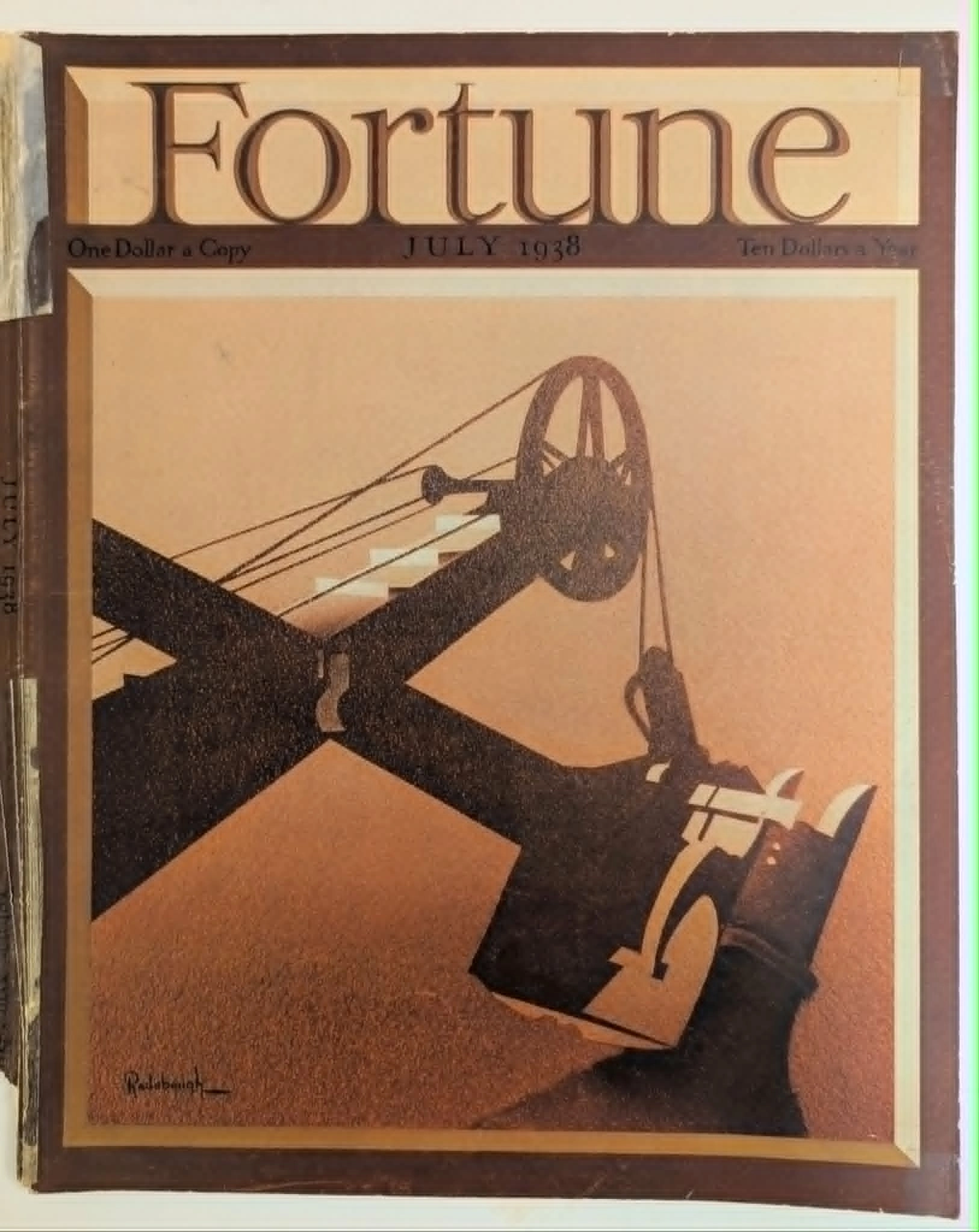
Then, it was a bold declaration of dominance. Now, it is a fossil of an empire’s foundation. In July 1938, a single dollar was not a casual expenditure. It was a day’s survival for a family struggling in the lingering dust of the Great Depression. Yet, for that exact sum, one could purchase a magazine. Not a magazine for the masses, but a manifesto for the elite. The problem of the era was profound economic stagnation; the solution, proposed silently on this cover, was mechanized, unrelenting industrial force. We see no human faces here. We see only the brutal, beautiful geometry of an earthmover. It is a visual thesis arguing that salvation would not come from politics, but from steel, cables, and the raw power to rip the earth apart and build it anew. This artifact does not merely record a month in history; it records the psychological pivot of a nation transitioning from agricultural despair to industrial supremacy.
Category: Other
The History
The Architecture of a Capitalist Cathedral The year is 1938. The month is July. The United States exists in a state of suspended animation. The Great Depression, initiated by the catastrophic market collapse of 1929, has not yet relinquished its grip on the throat of the American economy. Specifically, 1938 is defined by the "Roosevelt Recession," a severe, secondary economic downturn nested within the broader depression. Unemployment, which had been slowly dropping, violently spiked back up to nearly nineteen percent. Industrial production had plummeted. Fear was a tangible currency. Yet, amid this widespread financial paralysis, a publication arrives on the newsstands demanding a king's ransom. "One Dollar a Copy. Ten Dollars a Year." To comprehend the sheer audacity of this price tag, one must calculate the temporal cost of existence in 1938. The average hourly wage for a manufacturing worker was roughly twenty-two cents. A loaf of bread cost nine cents. Rent for an apartment might run twenty dollars a month. To purchase this single, unbound issue of Fortune, an average laborer would need to trade nearly five hours of backbreaking physical exertion. This was deliberately exclusionary. Henry Luce, the publishing magnate who had already successfully launched Time, founded Fortune in 1930, mere months after the stock market crashed. It was an act of supreme editorial arrogance paired with unparalleled visionary foresight. Luce believed that business was the defining narrative of the American century. He saw commerce not as a series of dry ledger entries, but as a grand, sprawling epic of risk, steel, sweat, and monumental engineering. The Utilitarian vs. The Monumental When comparing Fortune to its contemporaries, the shift in narrative ambition becomes clear. Competitors like Forbes (founded in 1917) and BusinessWeek (founded in 1929) offered practical, immediate advice for investors and middle-managers. They were printed on standard paper. They were utilitarian tools for surviving the market. Fortune was not a tool. Fortune was a cathedral. It measured a massive 11 by 14 inches. It weighed heavier than a standard textbook. It utilized the finest, heaviest paper stock available, employing cutting-edge color gravure printing that rendered images with a depth and saturation previously unseen in commercial publishing. It was designed to sit on the mahogany desks of CEOs, bank presidents, and industrialists. It was a status symbol that whispered to the executive: You are the architect of reality. The Geometry of Progress The July 1938 cover encapsulates this ethos with chilling perfection. It does not feature a portrait of a wealthy industrialist in a tailored suit. It does not display a complex graph of rising profit margins. It displays a machine. Specifically, the artwork highlights the boom, cables, and heavy bucket of a cable-operated excavator—a mechanical shovel. This is the precise point where the historical shift in the human narrative is visibly captured. The narrative of power was definitively transferring from human hands to mechanized hydraulics, diesel engines, and steel cables. Prior to this era, large-scale infrastructure—from the digging of the Erie Canal to the laying of the early transcontinental railways—was largely built on the broken backs of men and the strained, exhausted muscles of draft animals. It was an organic, biological effort, limited by the constraints of flesh and bone. By the late 1930s, however, the New Deal had initiated unprecedented, colossal public works projects. The Hoover Dam. The Tennessee Valley Authority. The Grand Coulee Dam. These were not projects built by mere men with shovels. They were forged by iron giants. The machine dominating this cover is a symbol of this terrifying and magnificent terraforming capability. This machinery represented the absolute apex of contemporary mechanical engineering. It represented humanity's mastery over thermodynamics, mechanical advantage, and earth-moving logistics. A single operator, seated in a small steel cab, could now move literal tons of earth with the simple pull of a calibrated lever. This was the mechanization of progress. The economic landscape was precarious, yet the technological landscape was accelerating at a breakneck pace. This magazine cover served as high-level propaganda for the capitalist soul. It whispered a specific, reassuring message to the executives paying their ten dollars a year: The economy may currently falter, the markets may crash, but the machine marches on. It promised that through heavy industry, America would forcefully dig itself out of the trench of the Depression. The Impending Storm There is also a profound, unsettling philosophical neutrality to the machine depicted here. It does not feel pity. It does not ask for higher wages. It does not go on strike. It simply acts upon the earth, rearranging the planet's surface to suit the dictates of commerce and infrastructure. The transition depicted here is not merely physical; it is deeply psychological. America was aggressively shifting its identity. It was permanently abandoning the agrarian, pastoral republic envisioned by its founders. It was becoming an unquestionable industrial titan. What the readers in July 1938 could not yet fully realize was how vital this specific mechanical supremacy would soon become. Within three short years of this publication, these exact factories, these exact structural engineers, and these exact machines would fundamentally pivot. The tools of earthmoving, civil construction, and commerce would be rapidly retooled for global destruction and subsequent liberation. The vast industrial capacity celebrated as an economic savior on this cover would rapidly transform into the "Arsenal of Democracy" that would eventually win the Second World War. The heavy tractors would become tanks; the structural steel would become battleships; the aviation companies profiled within these pages would build bombers. The July 1938 issue of Fortune is, therefore, a transitional fossil. It sits on the historical timeline precisely in the twilight between the domestic despair of the Great Depression and the mechanized, global violence of the impending World War. It documents the exact, fleeting moment when the machine became the undeniable, revered god of the American landscape.
The Paper
The artifact itself is a testament to longevity. Fortune did not use cheap newsprint. The cover utilizes a high-GSM (Grams per Square Meter) heavy stock, likely featuring a high cotton-rag content to ensure durability, which explains its survival after eight decades. Printing Method: The typography heavily relies on crisp, debossed letterpress techniques, giving the words "One Dollar a Copy" a tactile, physical presence on the page. The artwork itself was likely reproduced using high-quality offset lithography or photogravure, allowing for the smooth, rich gradients in the sky. CMYK and Oxidation: The muted sepia, rust, and burnt-orange tones are not entirely an accident of design; they are the result of eighty-eight years of slow chemical oxidation. The underlying yellow and magenta inks have subtly shifted, reacting to decades of ambient light and oxygen. The Tactile Philosophy: When holding this paper, you are feeling the trapped atmosphere of 1938. The lignin within the fibers slowly degrades, producing the characteristic scent of old vanilla and decaying wood. The paper is not just a carrier of the image; it is an active participant in the recording of time.
The Rarity
Class S (Contextual Benchmark) While individual issues of Fortune from the 1930s can still be located in institutional archives, finding one in private hands with an uncompromised cover, sharp edges, and minimal spine roll elevates this artifact to Class S rarity. Its true value is not defined by auction house market prices, but by its contextual weight. It is a perfectly preserved cultural barometer. It is rare because it represents a pristine cross-section of elite American thought during a period of intense national vulnerability and industrial hubris. It is an artifact of pure, uncut capitalist ideology.
Cite this article
- MLA
- Naodhinsuk, Ronin. “The Time Traveller's Dossier : Fortune Magazine July 1938 - The Industrial Monolith.” The Record Institute, 22 May 2026, https://therecord.institute/journal/the-time-travellers-dossier-fortune-magazine-july-1938-the-industrial-monolith.
- APA
- Naodhinsuk, R. (2026, May 22). The Time Traveller's Dossier : Fortune Magazine July 1938 - The Industrial Monolith. The Record Institute. https://therecord.institute/journal/the-time-travellers-dossier-fortune-magazine-july-1938-the-industrial-monolith
- CHICAGO
- Naodhinsuk, Ronin. 2026. “The Time Traveller's Dossier : Fortune Magazine July 1938 - The Industrial Monolith.” The Record Institute, May 22, 2026. https://therecord.institute/journal/the-time-travellers-dossier-fortune-magazine-july-1938-the-industrial-monolith.