The Time Traveller's Dossier : Fotomat - The Geometry of Memory
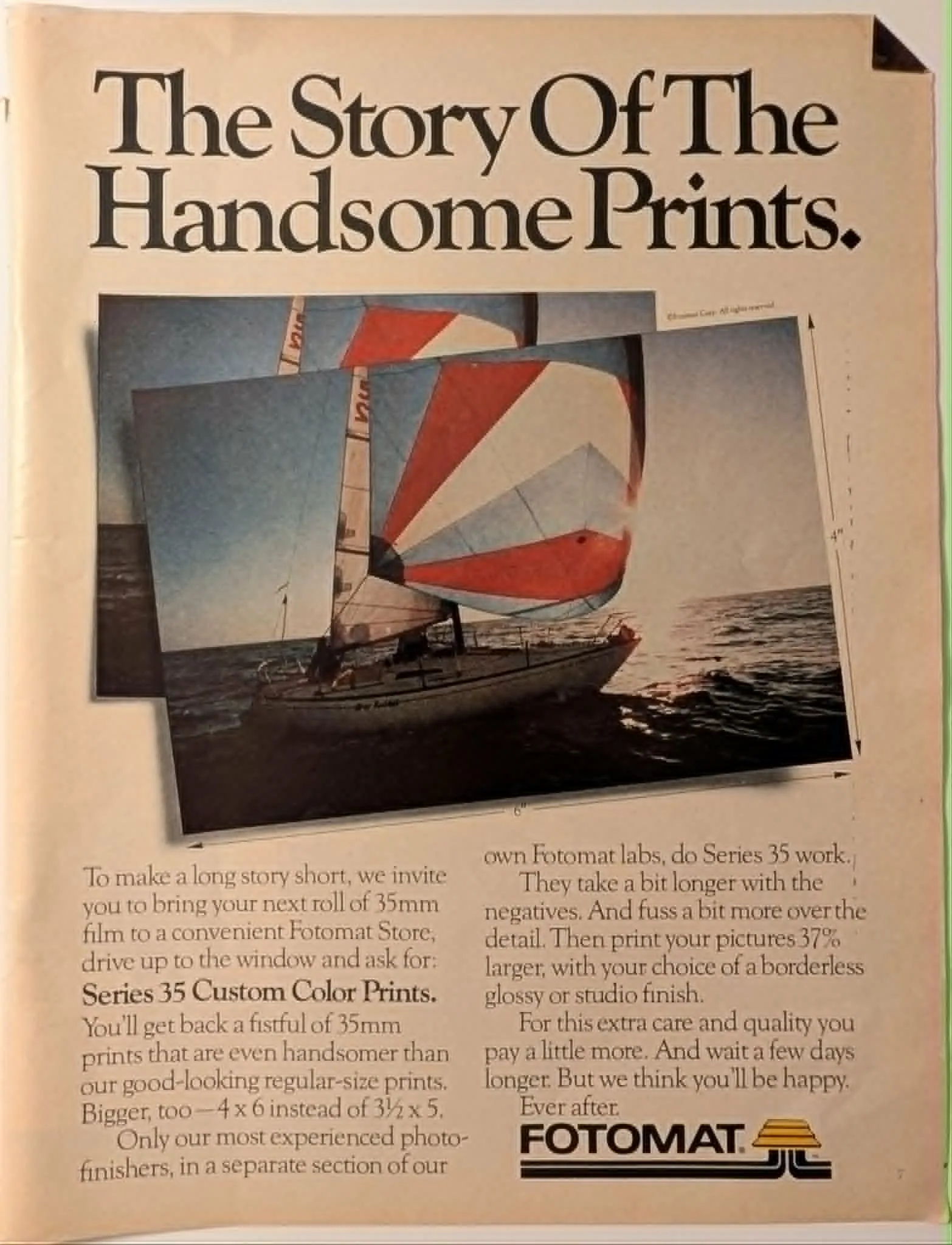
Memory was once a physical object. It was not instantaneous. It was not digital. It was chemical. Before the era of immediate validation, capturing a moment required faith. You clicked the shutter. You wound the spool. You waited. This artifact is a relic of that waiting period. It is an advertisement for Fotomat, arguably the most iconic photographic middleman of the twentieth century. It details a specific product offering: the "Series 35 Custom Color Prints." The core narrative is not merely about a larger photograph. It is about a structural shift in consumer expectations. Then, standard meant 3.5 x 5 inches. It was fast. It was adequate. Now, the artifact proposes 4 x 6 inches. It is "handsomer." It demands patience. This document chronicles the moment a mass-market brand attempted to pivot from pure convenience to curated quality, attempting to survive an industry that was rapidly accelerating toward instant gratification.
Category: Technology
The History
The Architecture of Convenience To understand this artifact, one must first understand the landscape of American consumerism in the late 1960s and 1970s. The automobile was the undisputed center of suburban life. Convenience was geographically defined by the steering wheel. Fotomat capitalized on this infrastructure. Founded in 1968, the company did not build destination stores. They built outposts. They placed small, brightly colored kiosks in the middle of vast supermarket parking lots. They featured a distinctive gold-colored, multi-tiered pyramidal roof. The model was frictionless. Drive up. Hand over the exposed film cartridge. Drive away. Return the next day for the processed prints. Fotomat did not process the film in these tiny boxes. They were purely logistical nodes. A fleet of couriers would arrive daily, collect the film, transport it to regional processing laboratories, and return the finished envelopes. For a decade, this hub-and-spoke model was an undisputed triumph. It removed the friction of entering a pharmacy or a camera store. Fotomat commoditized photographic processing. But commoditization breeds vulnerability. The Threat of the Minilab By the late 1970s and early 1980s, the technological landscape shifted underneath Fotomat’s foundation. The threat did not come from digital sensors. Those were decades away from consumer viability. The threat came from the Noritsu QSS (Quick Service System), introduced in 1976, and its subsequent competitors. These were "minilabs." A minilab combined film developing and paper printing into a single, relatively compact machine that could fit behind the counter of a pharmacy or a standalone strip-mall shop. The centralized, hub-and-spoke model was suddenly obsolete. Minilabs offered one-hour photo processing. Fotomat’s central labs, requiring physical transport across counties, could not compete with one-hour turnaround. They were structurally locked into a system that required at least an overnight wait. This advertisement is a strategic counter-offensive. It is a masterclass in repositioning a weakness as a virtue. If you cannot be faster, you must claim to be better. The Geometry of the 35mm Negative The text of the artifact invites the consumer to ask for "Series 35 Custom Color Prints." It highlights that these prints are "Bigger, too—4 x 6 instead of 3 1/2 x 5." This is not a random increase in surface area. It is a correction of a long-standing geometric compromise. The standard 35mm photographic negative measures exactly 24mm by 36mm. This yields an aspect ratio of 1:1.5, or 2:3. For decades, the industry standard for cheap, mass-market consumer prints was 3.5 x 5 inches. Mathematically, 3.5 by 5 yields an aspect ratio of 1:1.42. Because the paper did not match the negative, something had to be sacrificed. When a 35mm negative was printed onto 3.5 x 5 paper, the image had to be cropped. Bits of the frame—the edges of the memory—were violently sliced away by automated printing masks to force the image onto the cheaper, standardized paper size. A 4 x 6 inch print, however, possesses an aspect ratio of exactly 1:1.5. It is a mathematically perfect match for the 35mm negative. It requires zero cropping. What the photographer saw in the viewfinder is exactly what is printed on the paper. It is, as the ad claims, a "handsome" print. It respects the original composition. Reframing the Narrative of Time The copywriter of this artifact performed a delicate psychological maneuver. Observe the text: "To make a long story short... They take a bit longer with the negatives. And fuss a bit more over the detail. Then print your pictures 37% larger... For this extra care and quality you pay a little more. And wait a few days longer. But we think you'll be happy." This is the sound of a company losing the speed war. They are explicitly acknowledging their logistical reality. You will "wait a few days longer." But they reframe the waiting period. It is no longer a symptom of an inefficient hub-and-spoke courier system. It is now framed as a symptom of craftsmanship. They are "fussing" over the details. Only the "most experienced photo-finishers, in a separate section of our own Fotomat labs" are handling these negatives. They transformed a structural delay into a premium service. They segregated their own labor force in the copy, implying an elite tier of technicians devoted solely to the 4x6 print. The Socio-Economic Shift During this era, 35mm cameras were trickling down from professional use to the mass consumer market. The single-lens reflex (SLR) camera, like the Canon AE-1 or the Pentax K1000, became middle-class staples. Consumers were spending more money on their hardware. They were learning about aperture, shutter speed, and focal lengths. The "point-and-shoot" user was evolving into the amateur hobbyist. Fotomat recognized this shift in consumer identity. An amateur hobbyist who just spent a week's wages on a Japanese SLR did not want their carefully composed landscapes cropped to fit a drugstore 3.5 x 5 paper. They wanted the full frame. They wanted borderless gloss. They wanted to feel like artists. The "Series 35" was an appeal to the ego of the amateur photographer. It offered them a gallery-like experience from a parking lot drive-through. Ultimately, this strategy delayed the inevitable. The minilab technology became cheaper, faster, and eventually capable of printing 4x6 at a one-hour speed. Fotomat’s centralized model collapsed under the weight of localized efficiency. The golden roofs disappeared. But this document remains. It records the exact moment when the 4x6 print became the new societal standard, a dimension that held firm until the entire concept of the physical print evaporated into the digital cloud.
The Paper
This artifact is suspended on standard mid-to-late 20th-century magazine stock. Estimated at 60 to 70 GSM. It is a lightweight, coated paper designed for high-volume rotary offset lithography. The printing relies on a CMYK halftone process. If observed under magnification, the smooth blue of the sky and the crisp red of the sailboat sail dissolve into a rigid, microscopic constellation of cyan, magenta, yellow, and black dots. The paper acts as a silent witness to the passage of time. The edges exhibit slight oxidation. The lignin within the wood pulp is reacting with ambient light and oxygen, slowly turning the margins a faint, buttery yellow. The texture is smooth but not entirely devoid of friction. It holds the scent of old binding glue and dormant archives. It is fragile. It requires preservation. It is not just an image; it is a physical layer of the 1980s.
The Rarity
Classification: Class B (Archival Standard) Financially, this artifact holds marginal market value. Millions of these magazines were printed, distributed, and subsequently discarded. It is a common piece of ephemera. Contextually, however, its value is immense. It is a perfect, self-contained thesis on the evolution of photographic processing. It documents a specific corporate strategy deployed against technological disruption. Finding an intact, well-preserved copy without moisture damage or severe color fading elevates its status for institutional archivists. It is a functional piece of commercial history.
Cite this article
- MLA
- Naodhinsuk, Ronin. “The Time Traveller's Dossier : Fotomat - The Geometry of Memory.” The Record Institute, 17 June 2026, https://therecord.institute/journal/the-time-travellers-dossier-fotomat-the-geometry-of-memory.
- APA
- Naodhinsuk, R. (2026, June 17). The Time Traveller's Dossier : Fotomat - The Geometry of Memory. The Record Institute. https://therecord.institute/journal/the-time-travellers-dossier-fotomat-the-geometry-of-memory
- CHICAGO
- Naodhinsuk, Ronin. 2026. “The Time Traveller's Dossier : Fotomat - The Geometry of Memory.” The Record Institute, June 17, 2026. https://therecord.institute/journal/the-time-travellers-dossier-fotomat-the-geometry-of-memory.