The Time Traveller's Dossier : Galion Iron Works - Engineering Defense
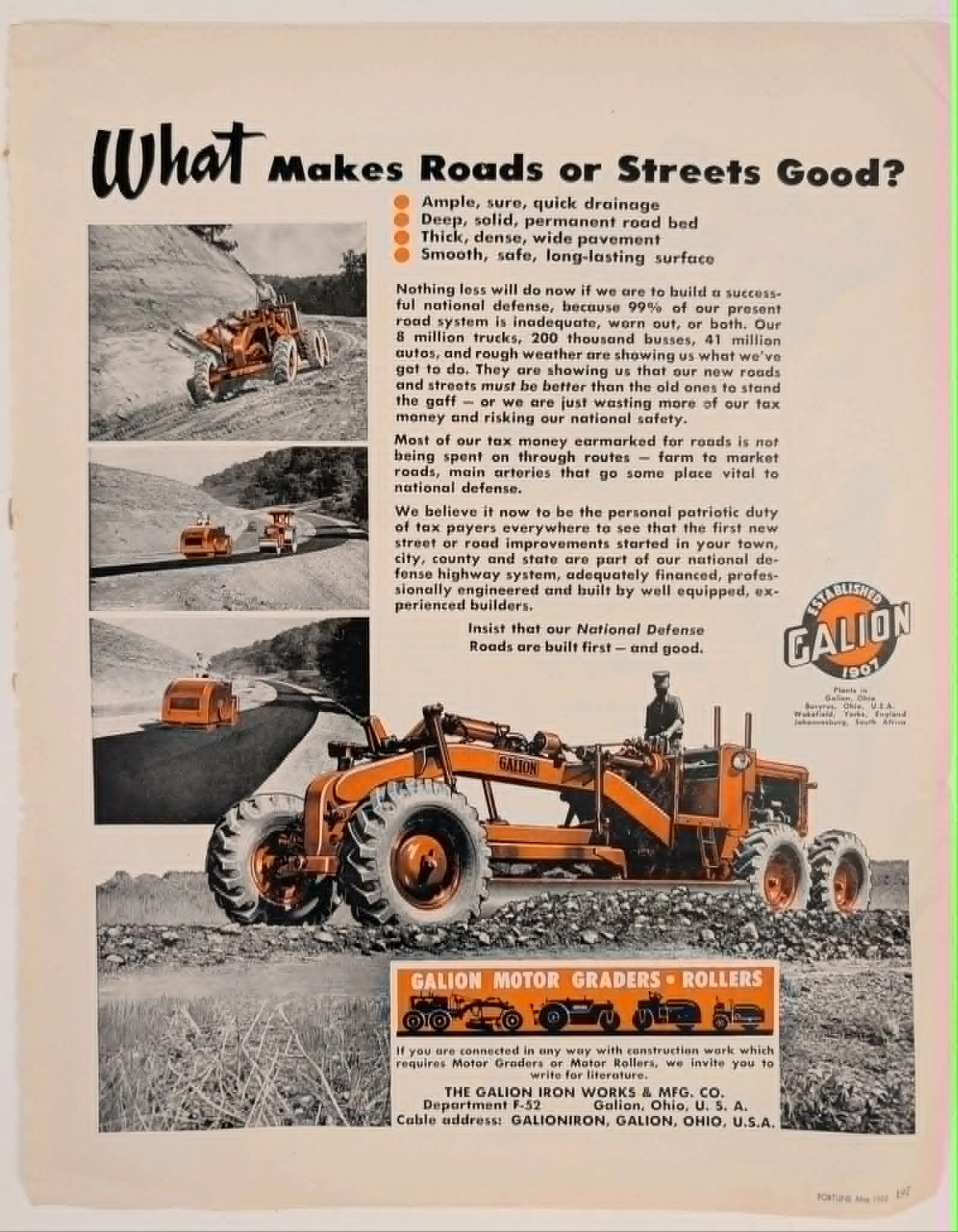
The year is 1942. The world is at war. The American homeland is mobilizing. Logistics demand efficiency. Then, roads were localized. They were built for farmers. They connected barns to markets. They were dirt, gravel, and temporary. They dissolved in the rain. They fractured under weight. Now, in the context of this artifact, a paradigm shift occurs. The road is no longer a convenience. It is a weapon of national defense. The infrastructure must support steel. It must support tonnage. It must support 41 million automobiles, 8 million trucks, and the machinery of a mobilized republic. This artifact captures the exact moment infrastructure was weaponized for survival. It is a demand for permanence.
Category: Technology
Brand: Galion
The History
The Precipice of Asphalt and War May 1942. The United States has been thrust into a global conflict. The Pacific fleet is rebuilding. The European theater demands unprecedented material output. The domestic landscape must transform into an unbroken assembly line. The arteries of this assembly line are the roads. Yet, the roads are failing. This advertisement, placed in the elite pages of Fortune Magazine, addresses a critical vulnerability. It claims that ninety-nine percent of the present road system is inadequate. It is worn out. It is obsolete. The infrastructure of the previous decade was designed for a lighter, slower America. It was designed for the Model T. It was built for local commerce. The sudden, violent demand of military logistics exposes a fragile network. Rough weather and heavy tonnage are destroying the very pathways required for national safety. A shift is demanded. The dirt track must become the engineered highway. The Philosophy of the Pavement The artifact outlines four absolute requirements for a modern road. These are not merely engineering specifications. They are a new doctrine of infrastructure. First: Ample, sure, quick drainage. Water is the enemy of the road base. Before 1942, rural roads often mirrored the natural topography. They pooled. They flooded. The new doctrine demands that water be immediately evacuated. The grader blade must cut precise ditches. The crown must be mathematically sloped. Second: Deep, solid, permanent road bed. The foundation dictates the lifespan. A road is not what lies on top. A road is what is buried beneath. The earth must be compacted. The subgrade must be stabilized. The Galion rollers, massive and unforgiving, must crush the earth into absolute submission. Third: Thick, dense, wide pavement. The vehicles of 1942 are wider. They are heavier. Eight million trucks are cited. Two hundred thousand buses. The macadam and early asphalt applications of the 1920s cannot bear the shear forces of dual-wheeled transport trucks carrying wartime freight. The pavement must be dense enough to resist rutting. It must be wide enough to allow uninterrupted two-way flow of heavy machinery. Fourth: Smooth, safe, long-lasting surface. Friction costs fuel. Potholes destroy tires. In a wartime economy, rubber is strictly rationed. Fuel is conserved. A smooth road is an economic necessity. It preserves the vital resources required overseas. The Propaganda of Infrastructure The language of the artifact is deliberate. It is calculated. It weaponizes patriotism to secure municipal funding. "Most of our tax money earmarked for roads is not being spent on through routes—farm to market roads, main arteries that go some place vital to national defense." Here lies the historical shift. Prior to this era, local taxes built local roads for local people. The farmer needed a road to the railhead. The county provided it. This artifact argues that local spending is now a matter of national survival. It reclassifies the "farm to market" road as a secondary concern. The priority is the "main artery." The route that moves tanks. The route that moves munitions from factory to port. The artifact speaks directly to the taxpayer. It assigns a "personal patriotic duty" to citizens. They must demand that their local governments prioritize National Defense Roads. They must insist these roads are adequately financed. They must insist they are professionally engineered. They must insist they are built by well-equipped, experienced builders. This is a masterclass in shifting public sentiment. The Galion Iron Works is not just selling machinery. They are selling a philosophy of prioritizing federal needs over local convenience, funded by local dollars. The Galion Iron Works Engine To understand the artifact, one must understand the machine. The Galion Iron Works & Mfg. Co. was established in 1907. Located in Galion, Ohio, with another massive plant in Bucyrus. This is the American industrial heartland. This is the Rust Belt before the rust. This is where steel is bent to human will. In 1907, road grading was a process involving horses dragging heavy iron blades. By 1942, the motor grader is a sophisticated, self-propelled leviathan. The main image features a Galion motor grader. It is a diesel-powered behemoth. Notice the tandem drive on the rear. Four massive, deeply treaded tires. This design distributes the weight. It maximizes traction in unstable soils. Notice the front leaning wheels. These are critical. When the heavy blade cuts into a dense bank of earth, the lateral force attempts to push the front of the machine sideways. Leaning the wheels against the load counters this force. It allows the operator to cut a straight, true line. The operator sits high. He commands hydraulic controls. He is not just driving a tractor. He is sculpting the earth. Beneath the main image, the rollers are displayed. Tandem rollers. Three-wheel rollers. These machines do not cut. They compress. They take the loose aggregate and bind it through sheer mass. They erase the voids. They create the impermeable surface required for the new age of transport. The Competitive Landscape Galion was not alone in this endeavor. They operated in a fiercely competitive landscape. Caterpillar Tractor Co. was the dominant force. Their auto patrols and yellow paint defined the industry. Adams, Austin-Western, and Huber were all fighting for municipal and federal contracts. How did Galion differentiate itself? Through specialization. Caterpillar built everything. Galion focused relentlessly on the grade and the roll. They built the tools for the final surface. The artifact reflects this focus. "Motor Graders - Rollers." It is a specialized pitch to the professional builder. It implies that if you want the road built to defense standards, you use the specialized tools of Galion. The Permanent Shift The rhetoric of this artifact did not die in 1945. The concept of the "National Defense Road" took deep root in the American psyche. The frustrations outlined in this 1942 advertisement—the worn-out roads, the heavy traffic, the need for wide, deep pavements—became the foundation of postwar infrastructure policy. Fourteen years after this artifact was printed, President Dwight D. Eisenhower signed the Federal-Aid Highway Act of 1956. It created the Interstate Highway System. Its official name? The National System of Interstate and Defense Highways. The seed of that massive, continent-spanning project is visible right here, in the ink of this 1942 page. The argument was formulated here. The necessity was established here. The Galion grader in the image is not just cutting a ditch in Ohio. It is cutting the conceptual path for the modern American highway system.
The Paper
The physical medium is a standard full-page magazine insert, heavily associated with high-end financial and industrial publications of the 1940s, specifically Fortune Magazine (May 1942). The stock is a heavyweight, coated mechanical paper. It was designed to hold the deep blacks of industrial photography. The printing method is a high-fidelity halftone process. Observe the stippling in the grayscale images. The contrast is aggressively managed to highlight the structural solidity of the machinery against the chaotic texture of the dirt. The focal point utilizes a distinct spot color—a specific, industrial "Galion Orange." This orange is not a standard CMYK mix. It was likely a custom-mixed ink applied in a separate pass to ensure absolute brand consistency and maximum visual disruption on the page. Decades of oxidation have slightly yellowed the unprinted margins, grounding the artifact firmly in its temporal origin.
The Rarity
Classification: Class A. Contextual Value: Immense. While mid-century industrial advertisements are relatively common, those explicitly bridging heavy machinery with early World War II domestic mobilization are highly sought after by institutional archivists. This is not merely a product catalog. It is a piece of home-front propaganda. Its value lies not in scarcity of the paper, but in the clarity of its historical message. It captures a precise month (May 1942) where American infrastructure doctrine violently pivoted toward military necessity.
Cite this article
- MLA
- Naodhinsuk, Ronin. “The Time Traveller's Dossier : Galion Iron Works - Engineering Defense.” The Record Institute, 26 May 2026, https://therecord.institute/journal/the-time-travellers-dossier-galion-iron-works-engineering-defense.
- APA
- Naodhinsuk, R. (2026, May 26). The Time Traveller's Dossier : Galion Iron Works - Engineering Defense. The Record Institute. https://therecord.institute/journal/the-time-travellers-dossier-galion-iron-works-engineering-defense
- CHICAGO
- Naodhinsuk, Ronin. 2026. “The Time Traveller's Dossier : Galion Iron Works - Engineering Defense.” The Record Institute, May 26, 2026. https://therecord.institute/journal/the-time-travellers-dossier-galion-iron-works-engineering-defense.