The Time Traveller's Dossier : GATX Mid-Century - The Architecture of Oil
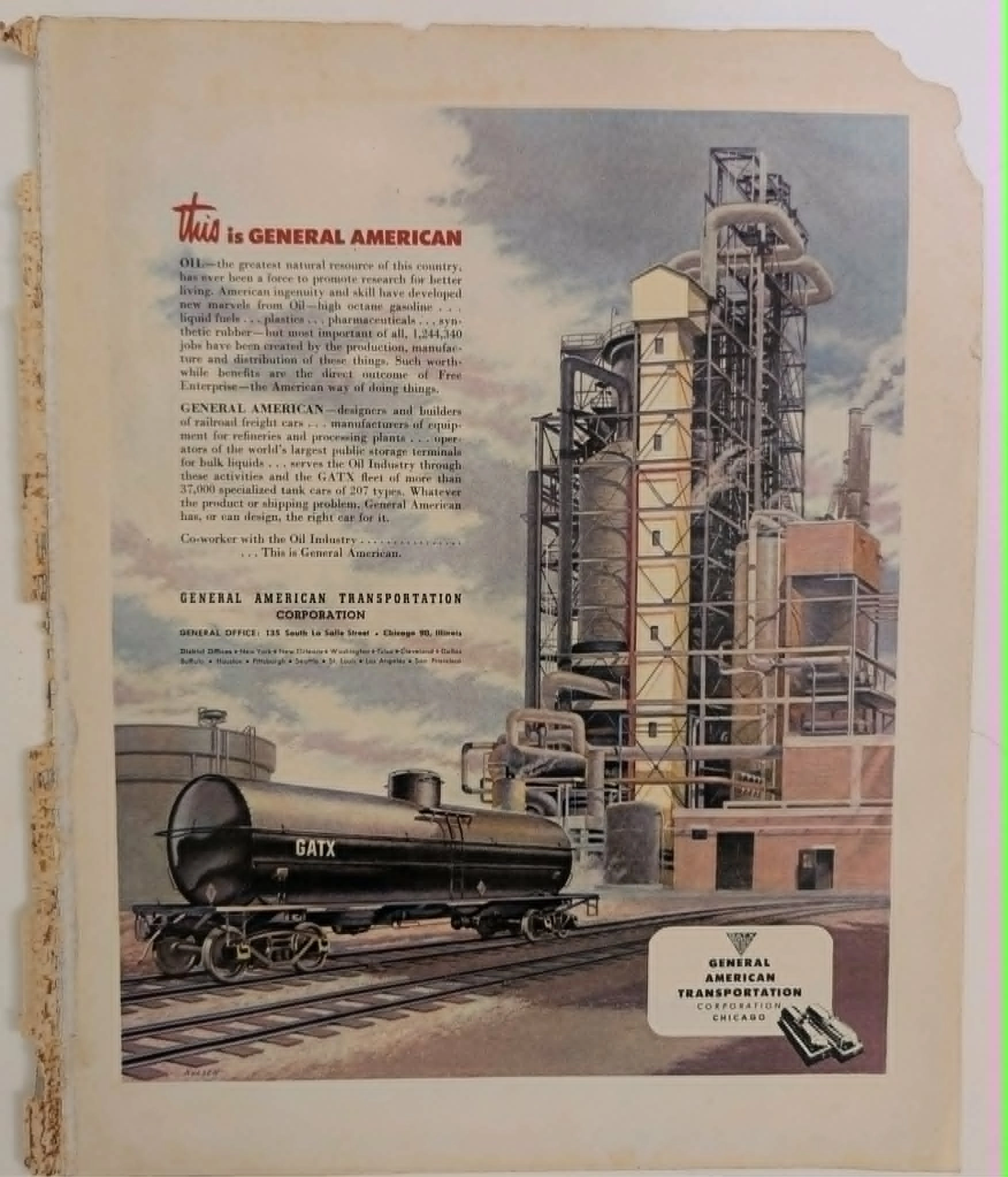
The world does not run on resources. It runs on logistics. A resource is stationary. A resource is potential. Until it moves, it is economically invisible. This artifact captures the exact moment in industrial history when the movement of complex liquids ceased to be a bottleneck and became a circulatory system. Before this era, containment was fragmented. It relied on the wooden barrel. It relied on localized scarcity. After this era, steel arteries crisscrossed the American continent. The General American Transportation Corporation (GATX) did not extract oil. They did not refine it. They provided the critical infrastructure that allowed the alchemy of the twentieth century—plastics, synthetic rubber, high-octane fuel—to exist at scale. This is not a commercial advertisement. This is a declaration of infrastructural sovereignty. It is the blueprint of the modern supply chain.
The History
The Bottleneck of the Barrel To understand the profound shift represented by this artifact, one must first examine the pre-shift paradigm. In the late nineteenth and early twentieth centuries, the movement of liquid commodities was a labor-intensive, highly inefficient endeavor. The standard unit of transport was the forty-two-gallon wooden barrel. Barrels leaked. Barrels required constant manual handling. They consumed vast amounts of physical space relative to the volume of liquid they held. The loading and unloading processes were excruciatingly slow, relying on hoists, ramps, and sheer human muscle. The petroleum industry, in its infancy, was tethered to the physical limitations of this primitive containment. The "shift" required moving from fragmented packaging to bulk fluid dynamics. The solution was the horizontal steel cylinder mounted on a rail carriage. The tank car. The Birth of the Iron River The General American Transportation Corporation did not invent the tank car, but they perfected the philosophy of its deployment. Founded in the early twentieth century in Chicago—the undisputed center of the American rail network—GATX recognized a fundamental inefficiency in the market. Railroads did not want to own highly specialized railcars. A car built specifically to haul corrosive sulfuric acid could not be used to haul milk or grain on the return trip. The "empty backhaul" was a financial drain. Refineries, conversely, did not want to sink immense capital into rolling stock that required specialized maintenance facilities spread across the continent. GATX engineered a paradigm shift: Infrastructure as a Service. They built, owned, and maintained the fleet. They leased the capacity. This allowed the railroads to focus on motive power and track maintenance, while the oil companies focused on chemistry and extraction. GATX became the invisible middleman, the neutral carrier of the industrial age. The artifact proudly declares a fleet of "more than 37,000 specialized tank cars." This was a private iron river, capable of being diverted and routed wherever the market demanded. The Anatomy of a Fleet The advertisement boasts of "207 types" of specialized cars. This single detail reveals the staggering complexity of mid-century chemical engineering. The artifact specifically names "high octane gasoline," "liquid fuels," "plastics," "pharmaceuticals," and "synthetic rubber." Transporting these substances required profound metallurgical and thermal mastery. A standard steel tank would be devoured by hydrochloric acid. Therefore, GATX engineered cars with vulcanized rubber linings. Viscous commodities like asphalt or heavy bunker crude would solidify in the freezing temperatures of the American Midwest. To solve this, GATX designed cars integrated with steam-coiled thermal jackets, allowing the contents to be heated and liquefied upon arrival for extraction. High-pressure gases required heavily riveted, and later welded, containment spheres capable of withstanding massive internal expansion. Each of the 207 types was a highly engineered, mobile vault. The physics of moving thousands of gallons of shifting liquid mass at high speeds around banked rail curves required precise internal baffling systems to prevent catastrophic derailments. GATX mastered the chaotic physics of fluid in motion. The Alchemist's Transport and the Post-War Mandate The specific mention of "synthetic rubber" firmly anchors this artifact in the immediate post-WWII socio-economic landscape. During the war, the Allied forces were entirely cut off from natural rubber plantations in the Pacific. The mandate was absolute: synthesize rubber domestically or lose the war. The American industrial complex achieved this chemical miracle, but synthesizing rubber required transporting highly volatile precursor chemicals—like butadiene and styrene—from chemical plants to polymerization facilities. GATX was the lifeline of this operation. The high-octane gasoline mentioned was the lifeblood of the newly established commercial aviation sector and the booming automotive culture of the 1950s. The artifact captures the exact moment when petroleum transitioned from being merely a fuel source for lamps and engines into the foundational building block of the modern material world. Plastics and pharmaceuticals fundamentally altered human existence, and neither could be mass-produced without the massive, continuous influx of precursor chemicals delivered by the GATX fleet. The Ideology of Free Enterprise Beyond engineering, the artifact functions as a piece of ideological propaganda. The text explicitly states: "Such worthwhile benefits are the direct outcome of Free Enterprise—the American way of doing things." In the mid-twentieth century, as the Cold War crystallized, corporate advertising frequently intertwined commercial services with patriotic philosophy. GATX is positioning its massive logistical network not as a monopoly, but as a triumph of capitalist collaboration. They label themselves a "Co-worker with the Oil Industry." At the time, the specter of state-owned infrastructure in the Soviet Union provided a stark contrast. The American model relied on massive private corporations managing the arteries of the nation. By attributing the creation of "1,244,340 jobs" to this ecosystem, GATX justifies its immense scale. It is a defense of corporate gigantism, arguing that only through massive, centralized, private coordination can such widespread prosperity be generated. The Hub of the Hub: Chicago 90, Illinois The address listed, "135 South La Salle Street • Chicago 90, Illinois," serves as a crucial temporal and geographical marker. The "90" is a postal zone, a system implemented in 1943 to handle the massive influx of wartime mail, which pre-dates the five-digit ZIP code system introduced in 1963. This confirms the artifact's precise mid-century origins. Furthermore, La Salle Street is the financial heart of Chicago. Chicago, in turn, was the undisputed center of the North American rail network. Every major trunk line converged there. For GATX to operate from this specific address was to place the brain of their operation at the exact geographical nexus of their physical network. They were the conductors of a continental symphony of steel and oil. Competitors and the Landscape GATX did not operate in a vacuum. Their primary historical rival was the Union Tank Car Company (UTLX). UTLX was originally a subsidiary of John D. Rockefeller's Standard Oil monopoly. When the Supreme Court forced the breakup of Standard Oil in 1911, UTLX became an independent entity. While UTLX carried the legacy of the Standard Oil empire, GATX positioned itself aggressively as the innovator for the entire chemical and industrial sector, not just petroleum. GATX diversified into manufacturing process equipment for refineries, as highlighted in the artifact: "designers and builders of railroad freight cars... manufacturers of equipment for refineries and processing plants." They aimed for vertical integration of the handling process. They didn't just want to move the fluid; they wanted to build the machines that refined it and the terminals that stored it. The Permanent Shift The legacy of the system described in this artifact is absolute. We live entirely within the paradigm GATX helped establish. Modern supply chains, just-in-time manufacturing, and the global distribution of chemical precursors all rely on the concept of decoupled, specialized, leased infrastructure. The black steel tank car rolling across a prairie is a silent testament to a logistical architecture that conquered distance, stabilized chemical volatility, and forged the material reality of the twentieth century.
The Paper
The physical medium of this artifact is highly indicative of mid-century mass-market business publications, such as Fortune or Time magazine. The paper is likely a machine-made, lightly coated stock, approximately 70-90 GSM. Close inspection of the magnified areas reveals a distinct, slightly coarse halftone dot pattern. This is the signature of mid-twentieth-century four-color offset lithography. The cyan, magenta, yellow, and black (CMYK) dots overlap to create the illusion of the vast, varied tones of the industrial sky and the metallic sheen of the refinery. The paper shows clear signs of oxidation along the left margin, characterized by the brittle, yellowed tearing. This acidification is common in wood-pulp papers of the era, which lacked the alkaline buffers of modern archival stock. The texture is flat but carries the microscopic topography of pressed fibers, holding ink that has polymerized and set over decades. It is a fragile skin holding heavy industrial history.
The Rarity
Classification: Class A (High Contextual Value) While vintage magazine advertisements from the mid-twentieth century are generally abundant, an artifact detailing B2B (Business-to-Business) industrial infrastructure holds a significantly higher contextual rarity than consumer-facing ads for cars or soap. Its value lies not in financial auction prices, but in its sociological and historical density. It captures the exact intersection of railroad mechanics, chemical synthesis, and Cold War capitalist ideology. Intact, full-page industrial manifesto advertisements that perfectly encapsulate a specific technological shift are highly prized by transport historians, corporate archivists, and students of mid-century graphic design.
Cite this article
- MLA
- Naodhinsuk, Ronin. “The Time Traveller's Dossier : GATX Mid-Century - The Architecture of Oil.” The Record Institute, 16 May 2026, https://therecord.institute/journal/the-time-travellers-dossier-gatx-mid-century-the-architecture-of-oil.
- APA
- Naodhinsuk, R. (2026, May 16). The Time Traveller's Dossier : GATX Mid-Century - The Architecture of Oil. The Record Institute. https://therecord.institute/journal/the-time-travellers-dossier-gatx-mid-century-the-architecture-of-oil
- CHICAGO
- Naodhinsuk, Ronin. 2026. “The Time Traveller's Dossier : GATX Mid-Century - The Architecture of Oil.” The Record Institute, May 16, 2026. https://therecord.institute/journal/the-time-travellers-dossier-gatx-mid-century-the-architecture-of-oil.