The Time Traveller's Dossier : Gilbert Paper - The Cotton Front Line
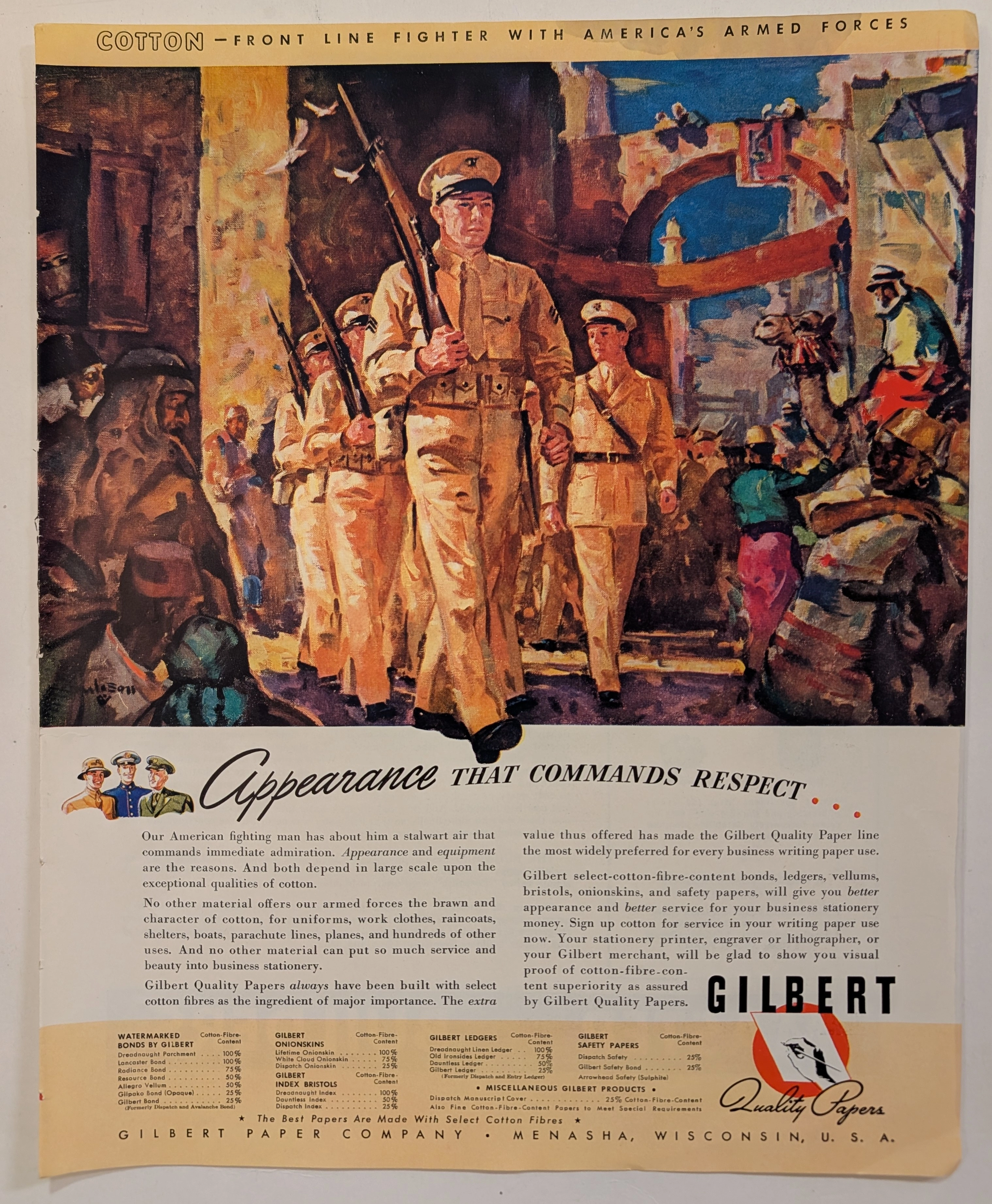
Then. A world gripped by total global conflict. Resources were not merely commodities; they were tactical assets. Cotton was the fiber of the soldier—the twill of the uniform, the canvas of the tent, and the cord of the parachute. Respect was earned through the rigidity of one's stance and the quality of one's equipment. Communication was a heavy, physical burden. Letters were the only lifelines between corporate command and distant markets, or a soldier and the home front. Now. A digital void. "Appearance" is a curated pixel on a liquid crystal display. The tactile authority of cotton-fibre paper has been relegated to a luxury niche. We have forgotten that for a century, the authority of a decree was determined by the "snap" and weight of the page. This artifact captures the precise moment when industrial manufacturing married patriotic fervor. It redefined the concept of "Respect" within the American psyche through the lens of material science.
Category: Other
Brand: Gilbert
The History
The Geopolitics of Menasha, Wisconsin In the mid-1940s, the Gilbert Paper Company of Menasha, Wisconsin, stood as a sentinel of American industrial output. The United States was deeply entrenched in World War II. The Fox River Valley was no longer just a regional paper hub; it was an engine of the "War Effort". Every industry was required to pivot toward military necessity. This was not merely a marketing slogan. It was a legislative and economic reality that dictated the survival of the private sector. The artifact represents a sophisticated strategic alignment of corporate identity with national survival. Gilbert Paper was not merely selling stationery for the office. They were selling the "Fighting Spirit" of American material science. Wisconsin found itself at a technological crossroads. While wood pulp (sulfite) was the standard for mass-market paper due to its low cost, the military demand for high-durability materials pushed the spotlight toward cotton. The Engineering of Authority: Cotton vs. Sulfite The headline "Appearance THAT COMMANDS RESPECT . . ." is a psychological anchor. It suggests that respect is not an abstract emotion. It is a byproduct of material engineering. The technical breakdown of the product highlights a "Cotton-Fibre-Content 25%". In an era before the digital cloud, the physical document was the "Front Line." A business contract or a military dispatch had to survive the humidity of the South Pacific. It had to survive the mud of North Africa and the constant handling of complex logistical chains. Cotton fibers are biologically longer, stronger, and more flexible than wood fibers. They create a paper that does not yellow as quickly through oxidation. They create a page that can withstand repeated folding without cracking at the seams. By linking the "stalwart air" of the American fighting man to the quality of their paper, Gilbert made a bold technical claim. The paper was engineered for endurance, mimicking the soldiers who carried the messages. The Semiotics of the Exotic Marketplace The illustration depicts a scene of profound cultural collision. American soldiers march with disciplined precision through a bustling marketplace. The setting is likely a depiction of North Africa or the Middle East. The contrast is highly deliberate and speaks to the "Shift" in global perception. The "stalwart" soldiers, in their crisp uniforms, represent the "New World" order: organized, industrial, and superior in "appearance". The background is filled with camels, robed locals, and ancient stone arches. It represents the "Old World"—vibrant but perceived by the 1940s American audience as chaotic and stagnant. This visual narrative served to reassure the domestic audience. It suggested that the American presence abroad was a stabilizing, respectable force. The soldiers do not merely occupy space. They "Command Respect" through their bearing and the equipment provided by American industry. This was the historical shift: the American uniform became a symbol of global standards, and American paper became the medium on which that standard was written. Competitive Landscape: The Battle for the Desk During this period, Gilbert was competing with giants like Hammermill and Crane & Co. Crane & Co. leaned into the high-end pedigree of currency-grade paper. Gilbert chose a middle path of "Tactical Excellence." They categorized their offerings into a hierarchy of functional needs. There were Watermarked Bonds for official correspondence. There were Onionskins, Ledgers, and Index Bristols. The "Onionskin" paper mentioned was particularly vital to the war effort. It was an extremely thin, lightweight paper used primarily for airmail. During the war, weight was a critical tactical variable. Every ounce of cargo on a plane was scrutinized by logistical officers. Onionskin allowed for long, detailed letters or business reports to be flown across oceans without exceeding weight limits. It maintained the strength of cotton while occupying minimal space. This was the "Shift"—engineering paper to be a lightweight tactical asset rather than a heavy desk-bound utility. The Cultural Shift: The Branding of Respect Post-war America would eventually become a society obsessed with status and corporate identity. This advertisement was a precursor to that era of status-seeking. It taught the American businessman that his "front" was his letterhead. The logic was linear and persuasive. If a soldier's uniform commanded respect in a foreign bazaar, then a CEO’s letterhead must command respect in the boardroom. The artifact explicitly states: "No other material offers our armed forces the brawn and character of cotton". The personification of a plant fiber as having "brawn" and "character" is a masterclass in brand psychology. It moved the consumer's expectation away from simple cost. It forced them to ask: "Does this paper represent my character?" This shift birthed the modern era of premium branding, where the material choice is a non-verbal communicator of power. Technological Implications: The Permanence of Cotton From an archivist's perspective, the decision to use cotton in the 1940s is the reason we can study this artifact today. Sulfite papers from that era, high in lignin, are often brittle, brown, and acidic. They are literally eating themselves through chemical decay. However, cotton-fibre paper, like the Gilbert stock advertised, remains supple. It is a "Front Line Fighter" against the passage of time itself. The artifact records a transition from the ephemeral nature of early mass production back to a demand for archival quality. This was driven by the gravity of the historical events taking place. Industry realized that the records of this conflict needed to survive for centuries, not just weeks. Mobilizing the Domestic Front The advertisement also functioned as a tool for civilian morale. It reminded those at home that even the paper they used in their offices was part of a grander, noble machine. "Sign up cotton for service in your writing paper use now," the text urges. This phrasing used the language of enlistment. It transformed a mundane purchase into an act of civic duty. The consumer was no longer just a customer; they were a participant in the industrial defense of the nation. This mobilization of the consumer mind was a hallmark of the 1940s. It laid the groundwork for the post-war boom, where consumption and patriotism were inextricably linked. The Legacy of Menasha's Innovation The Gilbert Paper Company eventual legacy is one of technical specialization. By focusing on cotton content, they ensured their survival during a time when smaller mills were being shuttered. They understood that the "Appearance" of their product was its most valuable feature. The "Shift" they navigated was one from commodity to brand. They moved from being a mill that produced paper to a company that produced "Quality Papers". The distinction is subtle but absolute. One is a utility; the other is a standard. As the soldiers in the bazaar move forward, so too did the American economy, riding on a foundation of cotton and steel.
The Paper
This artifact is a relic of the mid-20th-century magazine industry. It is printed on a heavy-weight, clay-coated paper, likely between 75 and 90 GSM. This was the standard for high-end periodicals that carried the weight of national discourse. The printing method is high-speed offset lithography. Under magnification, the CMYK rosette patterns are visible. The yellow and magenta dots are tightly packed to create the warm, sun-drenched tan of the soldiers' uniforms and the desert market. The "Shift" in the paper itself is found in its chemical composition. The 1940s saw an increase in the use of titanium dioxide for opacity and whiteness. Despite eighty years of oxidation, the paper retains its structural integrity. This is because of the high cotton-fibre content mentioned in the ad. The texture is slightly "toothed," providing a tactile feedback that modern digital papers lack. It reflects a time when ink had to bite into the fiber to remain permanent. It carries the faint, dry scent of drying lignin and old printer's oil—the literal aroma of the industrial age.
The Rarity
Classification: Class A While copies of 1940s magazines are not impossible to find, this specific advertisement carries immense "Contextual Rarity." It serves as a primary source for the intersection of Wisconsin's paper industry and American military history. Its significance is not found in its market price, but in its status as a survivor of a "Total War" economy. It records the exact moment that cotton—the historical king of the South—was rebranded as the armor of the Midwest's industrial output. It is an "Omega" of semiotic history. It shows how a nation's resources were mythologized to maintain morale and commerce during a time of global collapse.
Cite this article
- MLA
- Naodhinsuk, Ronin. “The Time Traveller's Dossier : Gilbert Paper - The Cotton Front Line.” The Record Institute, 12 May 2026, https://therecord.institute/journal/the-time-travellers-dossier-gilbert-paper-the-cotton-front-line.
- APA
- Naodhinsuk, R. (2026, May 12). The Time Traveller's Dossier : Gilbert Paper - The Cotton Front Line. The Record Institute. https://therecord.institute/journal/the-time-travellers-dossier-gilbert-paper-the-cotton-front-line
- CHICAGO
- Naodhinsuk, Ronin. 2026. “The Time Traveller's Dossier : Gilbert Paper - The Cotton Front Line.” The Record Institute, May 12, 2026. https://therecord.institute/journal/the-time-travellers-dossier-gilbert-paper-the-cotton-front-line.