The Time Traveller's Dossier : GM F-Body - The Industrialization of Rebellion
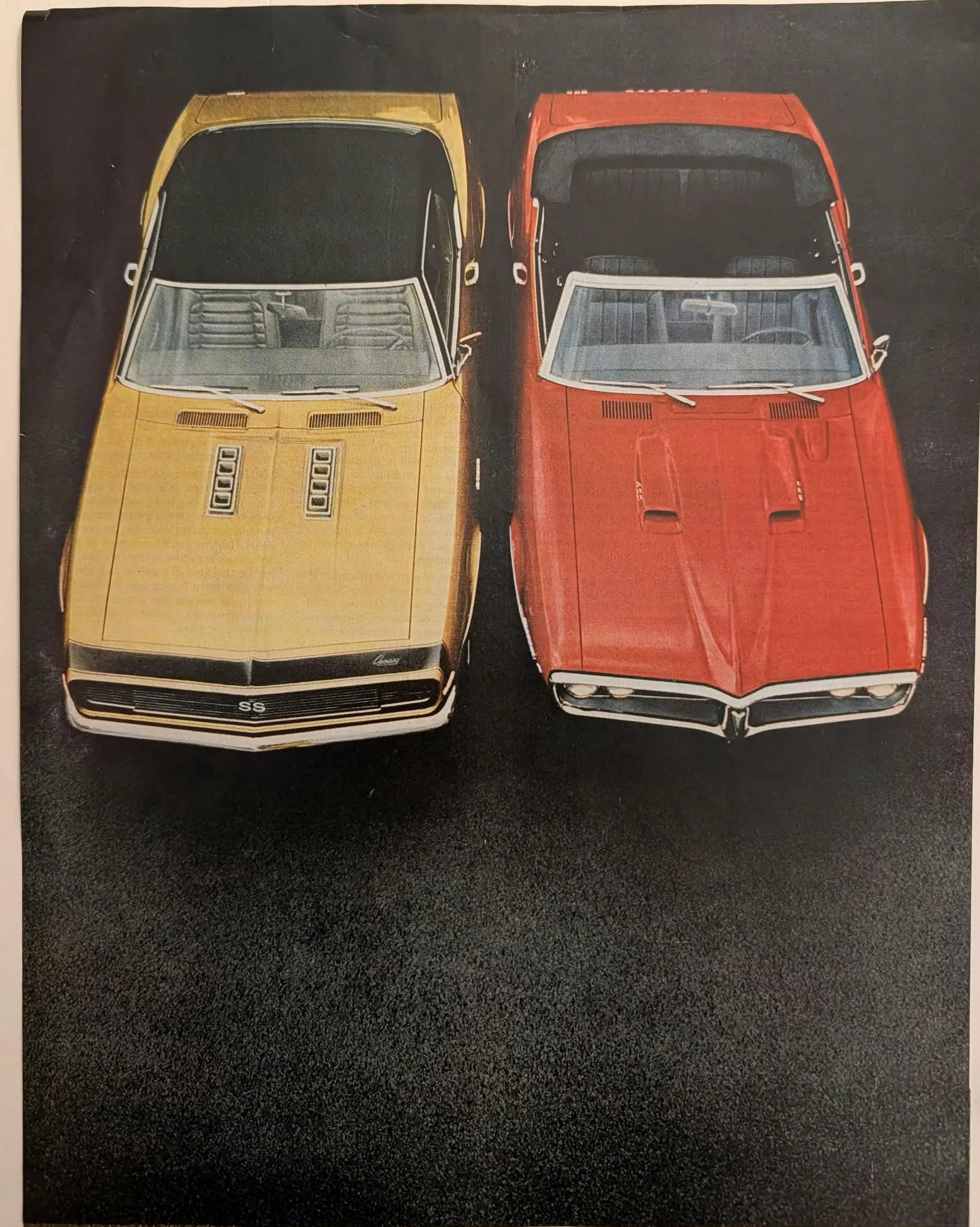
The artifact before us is a terminal fossil. It records a definitive intersection in the twentieth century. A moment when American steel was infinite, gasoline was an afterthought, and the highway operated as an unregulated theater of mechanical aggression. Prior to this, the automobile was a utilitarian vessel engineered for the nuclear family. It prioritized predictable comfort. This document records the violent rejection of that paradigm. Here, we observe the mass production of bespoke hostility. Two machines float against a void of black asphalt. To the left, the blunt pragmatism of the Chevrolet Camaro SS. To the right, the refined aggression of the Pontiac Firebird. This offered the postwar youth a binary choice in projecting identity. The shift recorded here is the exact moment Detroit pivoted to mass-producing weaponized individualism.
Category: Automotive
Brand: Chevrolet
The History
The Postwar Transportation Paradigm To grasp the magnitude of mechanical hostility presented in this artifact, one must understand the sterile domestic context it was designed to destroy. Throughout the 1950s, Detroit's output was heavily characterized by massive, chrome-laden dreadnoughts. Vehicles like the Cadillac Eldorado or the Chevrolet Bel Air were essentially living rooms on wheels. They reflected a postwar society valuing conformity, predictable domesticity, and overt displays of stable wealth. The automobile was predominantly marketed as a utilitarian vessel engineered for the nuclear family. However, the youth of the late 1960s despised this paradigm. The Baby Boomers were coming of age with unprecedented disposable income and a fierce desire to sever ties with the sanitized values of their parents. They wanted autonomy. They wanted visceral speed. They demanded a machine that reflected their own internal anxieties and aggressive individualism. The massive, floaty sedans of the previous generation were no longer acceptable; they were symbols of a suffocating societal compliance. The Dearborn Crisis and the Corporate Response In 1964, the Ford Motor Company successfully identified this massive demographic fracture. They released the Ford Mustang. It was small, possessed a long hood and a short rear deck, and crucially, it could house a V8 engine. It was an apocalyptic commercial success, creating a completely new classification of vehicle. General Motors was caught completely off guard. Their initial countermeasure was the Chevrolet Corvair. It was a rear-engine, air-cooled compact car. While it was highly innovative, it was systematically dismantled by safety controversies and a fundamental misreading of the American horsepower appetite. The youth market did not want a quirky, European-style compact. They wanted traditional, front-engine, rear-wheel-drive violence. GM needed a response that was rapid, overwhelming, and infinitely scalable to wage industrial warfare. Engineering the F-Body Architecture The solution to this crisis was an entirely new corporate architecture. Internally, it was designated as the F-Body platform. This engineering endeavor was a masterclass in brutal economic efficiency colliding with psychological marketing. To maximize efficiency, GM engineered a single, robust foundation. They utilized a unibody structure for the rear and passenger compartments, which was then bolted to a heavy steel front subframe. This modular design was chosen specifically to isolate the cabin from the harsh, violent vibrations of the high-torque engines that would inevitably be installed. It maintained the structural rigidity required for high-speed, dangerous maneuvers, while simultaneously allowing the factory assembly line to drop in powerplants ranging from docile, economical inline-sixes to monstrous, pavement-tearing big-block V8s. But General Motors understood that a single car model would not dominate the tribal youth market. They utilized their corporate umbrella to spawn two distinct psychological identities from this mechanical skeleton. This artifact perfectly encapsulates that dual-pronged assault on the American consumer. The Chevrolet Camaro SS: The Brutal Pragmatist On the left side of the composition, rendered in a heavy, metallic gold, sits the Chevrolet Camaro SS. Chevrolet was GM’s volume leader, the brand of the working class. Therefore, the Camaro was designed to be universally appealing yet infinitely customizable. The aesthetic engineered here is blunt and unashamedly muscular. We observe the broad, flat hood. It is punctuated by two simulated exhaust louvers. These specific components were not strictly functional for airflow in this iteration. Instead, they served a vital semiotic purpose. They functioned as a visual warning, signaling the presence of the Super Sport (SS) package. The SS nomenclature was not merely a cosmetic upgrade; it was a corporate commitment to violence. Checking this box on the order sheet mandated the installation of a high-displacement V8 engine, heavily upgraded suspension components, and wider, aggressive tires designed for straight-line acceleration. The front fascia shows the distinctive SS badge centered perfectly in the blacked-out grille. It features concealed headlights, an optional feature giving the car a menacing, featureless face when parked. The Camaro did not ask for attention; it demanded space. It was the manifestation of working-class aggression, a vehicle designed exclusively to dominate suburban stoplight drag races. It was raw, unpretentious, and brutally effective. The Pontiac Firebird: The Refined Brawler To the right, drenched in a visceral, hyper-saturated red, is the Pontiac Firebird. Under the leadership of John DeLorean, Pontiac cultivated a distinct image as GM's designated performance division. They catered to a buyer who desired visceral power but demanded a thin veneer of European sophistication and exclusivity. While the Firebird shared the Camaro's hidden steel skeleton, its external skin was entirely distinct. The most prominent structural difference is the front bumper assembly. The Firebird utilizes a prominent, chrome-encased split grille forming the iconic Pontiac arrowhead. This integrated Endura bumper design was highly advanced for its time. It created a seamless, aerodynamic nose that sharply contrasted with the Camaro's traditional, blocky, and squared-off front end. Furthermore, the Firebird’s hood features twin functional air scoops. They are heavily sculpted to feed dense, cold air directly into the carburetor of the massive 400 cubic-inch V8 engine lurking beneath. Positioned slightly higher on the socioeconomic ladder, the Firebird was heavier, frequently optioned with luxury trims and upgraded sound deadening. It was mechanically tuned for high-speed, sustained highway cruising rather than pure, violent off-the-line acceleration. If the Camaro was a blunt, heavy instrument, the Firebird was a weighted, polished blade. The Macroeconomic and Societal Landscape The physical existence of this artifact is inextricably linked to the specific macroeconomic conditions of late-1960s America. The nation was experiencing the final, explosive years of a post-World War II economic boom. The Interstate Highway System, a monumental feat of civil engineering, was nearing total completion, laying down thousands of miles of pristine, straight, uninterrupted asphalt across the North American continent. Gasoline was overwhelmingly abundant, cheap, and entirely unregulated. Environmental concerns regarding emissions were virtually non-existent in public consciousness. This unique environment created a dangerous feedback loop of mechanical gluttony. Rival manufacturers were engaged in a zero-sum horsepower war. They increased engine displacement year over year, chasing arbitrary performance figures. The end result was the creation of machines that possessed power-to-weight ratios bordering on the highly irresponsible. This era also coincided with immense and painful social upheaval. The shadow of the Vietnam War loomed large over the demographic purchasing these cars. The civil rights movement was actively reshaping society. The fracturing of traditional social contracts created a highly charged, anxious cultural atmosphere. For the youth of the era, these vehicles represented a literal form of mechanical escapism. The act of purchasing a 300-horsepower coupe was a bold declaration of autonomy. It was a rejection of the collective. The F-Body platform allowed consumers to mathematically codify their rebellion through a factory order sheet. You could buy a docile base model for your daily commute, or you could check a few specific boxes and purchase a street-legal race car straight off the showroom floor. The Historical Shift: The Fall of the Empire The true historical weight of this image lies heavily in what it anticipates. This is an artifact of a doomed era. The technological shift represented here is the absolute peak of unregulated internal combustion. Within a few short years of this image's publication, this automotive engineering paradigm would be forcefully dismantled. Reality was about to brutally intervene. The passage of the Clean Air Act of 1970 mandated the severe reduction of tailpipe emissions. This federal legislation forced manufacturers to dramatically lower engine compression ratios, permanently reducing horsepower outputs across the board. Shortly thereafter, the 1973 OPEC oil embargo shattered the American illusion of infinite, cheap fuel. The heavy steel unibodies, massive four-barrel carburetors, and dual-exhaust V8s were regulated out of existence. They were rapidly replaced by the compromised, choked, and downsized vehicles of the late 1970s. Therefore, this image does not merely attempt to sell cars. It actively records the final, arrogant roar of the American industrial machine before the inevitable collapse. It is a perfect snapshot of an unsustainable peak. It remains the high-water mark of a mechanical empire that did not realize it was about to fall.
The Paper
We must analyze the physical substrate. This is a mechanical transfer of ink to organic matter. The artifact exhibits the unmistakable characteristics of high-volume web offset lithography. The paper stock is a machine-coated sheet, estimated at 80 to 90 GSM, strictly required to hold the dense application of ink necessary for the deep asphalt void. Upon macro-inspection, the solid colors are complex CMYK halftone dot matrices. Time has interacted with the chemistry. The organic wood pulp base has undergone slow oxidation, introducing a warm amber tone. This aging subtly desaturates the cyan and magenta inks. Yet, the heavy black ink remains dense, anchoring the image against the decay. The paper is a temporal recording device, carrying the physical friction of half a century.
The Rarity
Classification: Class S (Historical Keystone). Monetary market value is completely irrelevant in archival terms. Rarity is dictated by contextual density and physical preservation. While millions of these advertisements were printed, the physical survival of an unblemished sheet that perfectly encapsulates the GM F-Body binary strategy is exceptionally uncommon. Its curatorial value lies in how it strips away the environment entirely to force a direct, comparative analysis of GM's dual-brand engineering philosophy. It is a pure, unadulterated visual thesis statement of Detroit's market segmentation strategy during the absolute peak of the horsepower era.
Cite this article
- MLA
- Naodhinsuk, Ronin. “The Time Traveller's Dossier : GM F-Body - The Industrialization of Rebellion.” The Record Institute, 19 July 2026, https://therecord.institute/journal/the-time-travellers-dossier-gm-f-body-the-industrialization-of-rebellion.
- APA
- Naodhinsuk, R. (2026, July 19). The Time Traveller's Dossier : GM F-Body - The Industrialization of Rebellion. The Record Institute. https://therecord.institute/journal/the-time-travellers-dossier-gm-f-body-the-industrialization-of-rebellion
- CHICAGO
- Naodhinsuk, Ronin. 2026. “The Time Traveller's Dossier : GM F-Body - The Industrialization of Rebellion.” The Record Institute, July 19, 2026. https://therecord.institute/journal/the-time-travellers-dossier-gm-f-body-the-industrialization-of-rebellion.