The Time Traveller's Dossier : Goodyear - Engineered Survivability
The road was once a wild, unpredictable vector. Travel was an equation governed by the harsh laws of physics. A mechanical failure at high speed was not an inconvenience. It was a definitive, violent end. Humanity accepted this risk as a necessary tax on mobility. We surrendered to the whims of the machine. Then came the shift. This artifact documents a profound alteration in industrial philosophy. We ceased accepting fate on the asphalt. We began to engineer our way out of catastrophe. We learned to compartmentalize disaster. We transitioned from hoping a tire would not fail, to meticulously designing what happens when it fails. This is not an advertisement for rubber. It is the commodification of time, control, and human survival.
Category: Technology
Brand: Goodyear
The History
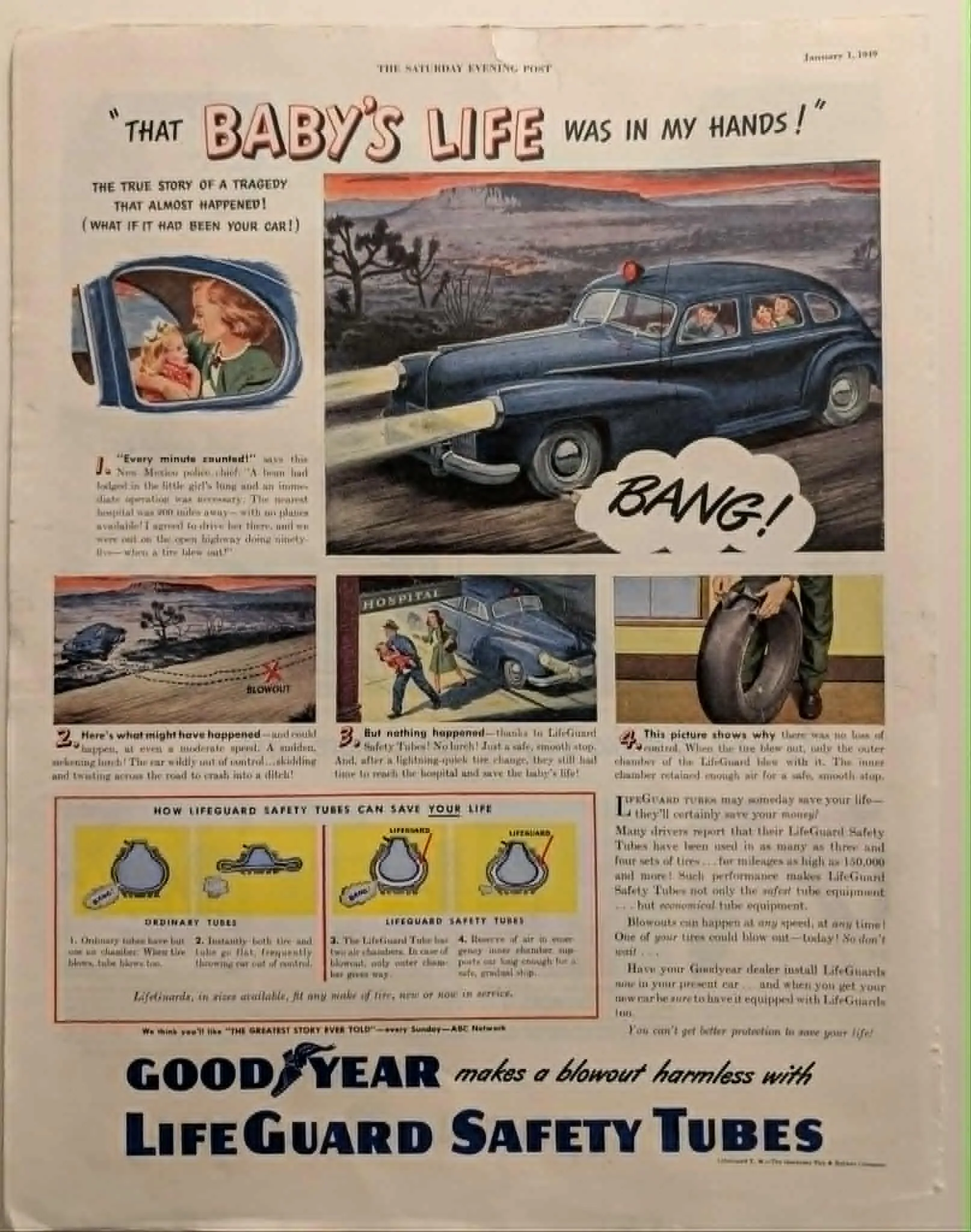
The Post-War Automotive Contract The year is 1949. The global conflict has cooled. The massive, mechanized infrastructure of the Second World War has not been dismantled. It has been violently retooled for domestic acceleration. The American highway is stretching out. It is a ribbon of asphalt, concrete, and boundless economic promise. The automobile is no longer a luxury for the elite. It is the dominant, defining architecture of modern life. It is an extension of the living room. But this new frontier is fundamentally hostile. The vehicles of 1949 are heavy, rigid masses of stamped steel. They lack crumple zones. They lack seatbelts. They lack collapsible steering columns. They are propelled by increasingly powerful engines over rudimentary highway systems. And this entire rolling fortress is tethered to the earth by four fragile balloons of vulcanized rubber and compressed air. The Physics of a 1949 Blowout To understand the gravity of this artifact, one must understand the anatomy of a blowout in the 1940s. Tires of this era utilized a single, ordinary inner tube. It was a solitary chamber of atmospheric pressure. It bore the weight of two tons of metal moving at lethal velocities. When the structural integrity of the rubber failed—due to a nail, glass, or heat friction—the result was not a slow leak. It was a kinetic explosion. The pressurized air escaped instantly. The heavy steel rim collapsed onto the pavement with a sickening lurch. The vehicle would drop on one axis. The steering wheel would be violently ripped from the driver's hands. The car transformed instantly from a guided transport into an unguided missile. A skid. A roll. A crash into a ditch. Death and severe injury were routinely accepted as mechanical variables. It was considered an act of God. An unavoidable consequence in the pursuit of speed. The Engineering of Survivability This artifact documents the exact moment that fatalistic equation was permanently rewritten. Goodyear did not just introduce a new rubber tube. They introduced the concept of mechanical redundancy to the civilian consumer market. They conceded a brutal truth: rubber will fail. The road is full of unseen hazards. Punctures are inevitable. But catastrophe is not. Examine the diagrammatic architecture in the lower half of the artifact. It illustrates a monumental shift in engineering logic. The "LifeGuard Safety Tube" is a tire within a tire. It contains two distinct, nested atmospheric chambers. When the outer tire and outer tube suffer a catastrophic blowout, the inner chamber remains intact. It gives way slowly. It retains a critical reserve of air pressure. It supports the heavy steel rim just long enough. It converts a violent, fatal, unpredictable lurch into a "safe, gradual stop." By physically separating mechanical failure from human catastrophe, Goodyear engineered survivability. They sold the ultimate luxury to the speeding motorist. They sold time. The time to grip the wheel. The time to apply the brakes. The time to retain control. The Commodification of Panic Observe how this engineering breakthrough is communicated. It is a masterpiece of engineered panic and psychological manipulation. The artifact constructs a high-stakes melodrama. The typography screams: "THAT BABY'S LIFE WAS IN MY HANDS!" The use of quotation marks frames it as a grounded, empirical testimonial. The narrative is hyper-specific. A New Mexico police chief. A little girl with a bean lodged in her lung. A frantic, two-hundred-mile race to the nearest hospital. The speed is explicitly documented: ninety miles per hour. In 1949, ninety miles per hour in a rigid, heavy sedan was a terrifying dance with the reaper. Then, the inevitable failure. "BANG!" The speech bubble is jagged, mimicking the sudden auditory violence of the blowout. The imagery moves sequentially, like a comic book, guiding the viewer's psychological state. We see the mother, clutching the blonde child in the blue interior. We see the dark blue police car speeding through the desolate, isolated desert landscape. We see the red 'X' marking the site of the blowout. This is the weaponization of empathy. It frames a consumer purchase as a strict moral imperative. It equates the physical product with maternal terror and paternal responsibility. If you do not equip your vehicle with these tubes, you are negligent. You are gambling with the lives of the innocent. The Competitive Landscape In the late 1940s, the tire industry was a brutal, highly capitalized oligopoly. Firestone, BF Goodrich, Michelin, and US Rubber were locked in a war for the post-war consumer. The standard marketing strategy of the era was durability. Competitors promised thicker treads. They promised stronger cotton cords. They promised rubber that would simply outlast the elements. Goodyear took a different, highly strategic path. They bypassed the logic of durability and tapped directly into the primal fear of mortality. They shifted the metric of what defined a superior tire. It was no longer about how many miles the tire could roll before wearing out. It was about what happened in the split second that the tire died. This positioned the LifeGuard tube not as an automotive accessory, but as a life insurance policy fabricated from vulcanized rubber. The Psychological Shift of Post-War America The psychological state of the consumer in 1949 cannot be ignored. This was a population that had just survived a decade of severe global economic depression, immediately followed by the most destructive war in human history. They had been subjected to trauma, rationing, and an acute awareness of human fragility. As they entered the post-war economic boom, their primary psychological drive was the establishment of absolute security. They sought safety in suburban enclaves. They sought safety in stable corporate employment. And they sought safety in their consumer choices. Goodyear brilliantly recognized this deep-seated cultural anxiety. The LifeGuard tube was an antidote to vulnerability. It whispered a powerful, seductive promise to the traumatized American psyche: You can buy your way out of danger. You cannot control the nail on the highway, but you can purchase a shield against its consequences. This marked the birth of the modern automotive safety industry. It laid the conceptual groundwork for seatbelts, airbags, and modern crumple zones. It established the paradigm that a responsible citizen is a protected citizen, and that ultimate protection is acquired at the retail level.
The Paper
This artifact is a physical manifestation of mid-century mass communication. It is extracted from the January 1, 1949, edition of The Saturday Evening Post. The substrate is a classic, machine-made mechanical pulp paper. It is highly acidic, likely weighing around forty-five to fifty grams per square meter. This acidity has initiated the inevitable, slow-motion chemical reality of lignin degradation. The paper is actively consuming itself. It transitions from a presumed crisp, chemically bleached white to a brittle, archival sepia. The printing technique is high-volume letterpress or early web offset. Under magnification, the continuous tones of the desert landscape and human faces dissolve entirely. They are revealed to be a rigid, geometric matrix of halftone dots. The black and colored inks bleed slightly into the porous, cheap cellulose fibers, softening the edges of the images. It is an ephemeral medium, engineered to be read and discarded within a week. Yet, it has survived. Its physical fragility stands in stark, poetic contrast to the heavy, vulcanized durability it advertises. It is an artifact actively recording its own temporal decay, while perfectly preserving a permanent shift in industrial logic.
The Rarity
Classification: Class A In purely physical terms, this document is not inherently unique. The Saturday Evening Post possessed a circulation in the millions. Copies were ubiquitous across America. However, physical scarcity is only one metric of rarity. The true, overriding weight of this artifact is its immense contextual value. It captures the exact historical inflection point where the automotive industry realized that human survival was a highly lucrative product feature. It is a pristine, unadulterated record of the moment mechanical redundancy was introduced to the civilian highway. Finding this specific artifact, preserved in a condition that allows for a complete typographical and psychological analysis, elevates its status. It is a flawless window into the architecture of mid-century commercial panic.
Cite this article
- MLA
- Naodhinsuk, Ronin. “The Time Traveller's Dossier : Goodyear - Engineered Survivability.” The Record Institute, 16 July 2026, https://therecord.institute/journal/the-time-travellers-dossier-goodyear-engineered-survivability.
- APA
- Naodhinsuk, R. (2026, July 16). The Time Traveller's Dossier : Goodyear - Engineered Survivability. The Record Institute. https://therecord.institute/journal/the-time-travellers-dossier-goodyear-engineered-survivability
- CHICAGO
- Naodhinsuk, Ronin. 2026. “The Time Traveller's Dossier : Goodyear - Engineered Survivability.” The Record Institute, July 16, 2026. https://therecord.institute/journal/the-time-travellers-dossier-goodyear-engineered-survivability.