The Time Traveller's Dossier : Greyhound Scenicruiser - The Democratization of Luxury
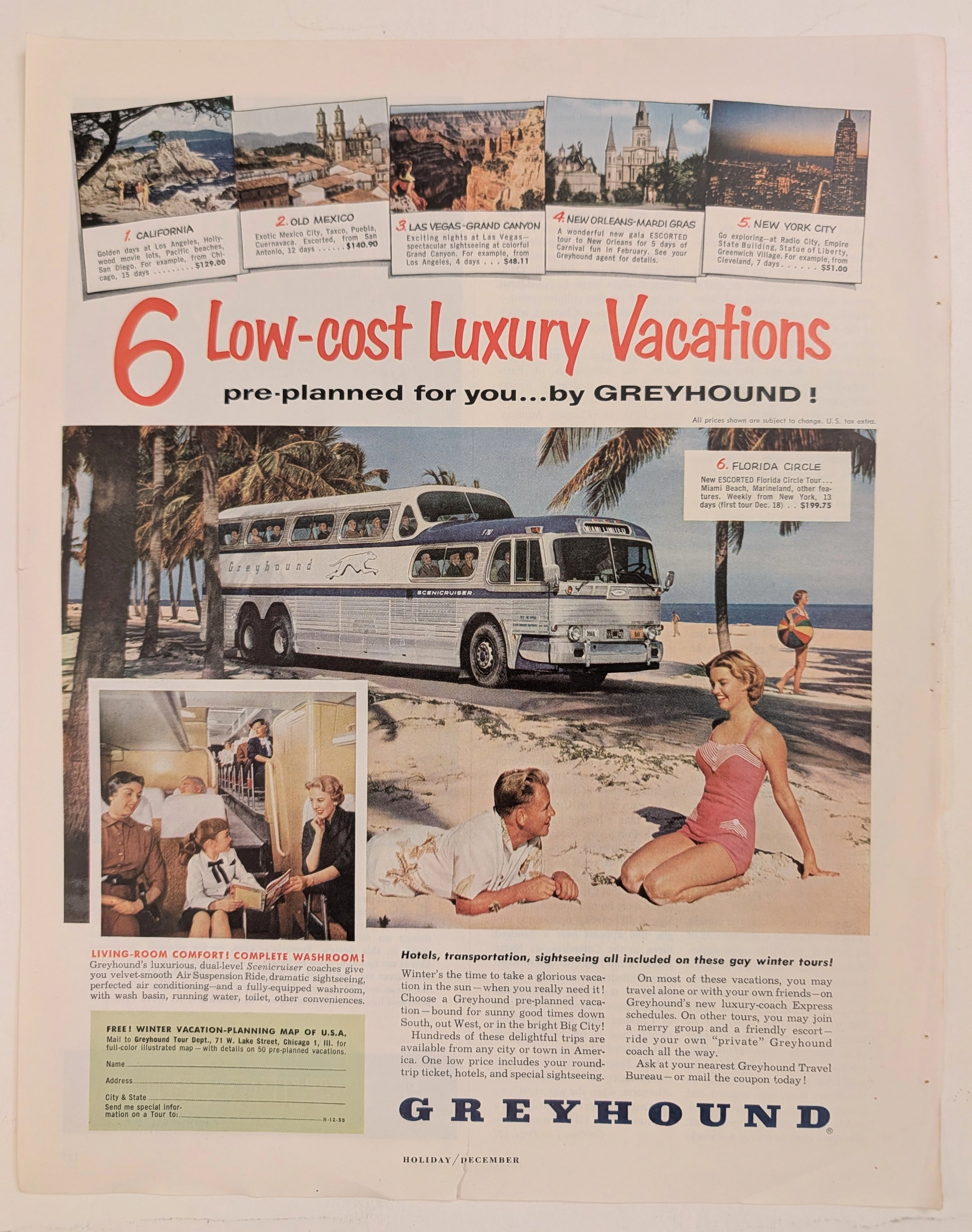
Geography was once a prison. For the vast majority of human history, the horizon was a hard limit. The wealthy could afford to escape it. The working class was forced to endure it. Travel, in its truest sense, was an aristocratic privilege, a luxury measured not just in currency, but in the ultimate currency: disposable time. Before the mid-twentieth century, if the American industrial worker travelled, it was out of desperate necessity—to find work, to flee dust bowls, to go to war. They did not travel for pleasure. Leisure was a localized phenomenon. Then, the post-war economic boom ignited. The factories that had built bombers pivoted to building consumer goods. Unions secured paid vacation time. The American middle class suddenly possessed unprecedented surplus capital and the time to spend it. But the infrastructure of luxury travel—the ocean liners and the first-class Pullman rail cars—was still psychologically and economically barred to them. The artifact presented here—a December 1955 advertisement for Greyhound from Holiday magazine—captures the exact moment the tourism industry solved this equation. This is the commercialization of Manifest Destiny. It is the moment the "Grand Tour" was stripped from the European aristocracy, repackaged into a 14-day domestic itinerary, and sold to the American everyman. The Greyhound Scenicruiser was not merely a bus. It was a terrestrial spaceship designed to conquer the sheer, terrifying scale of the North American continent. It democratized the horizon. It transformed the sprawling, intimidating geography of the United States into a pre-packaged, fixed-price commodity.
Category: Travel
Brand: Greyhound
The History
The Architecture of the Open Road and the Post-War Boom To fully grasp the historical weight of this vibrant, seemingly innocuous travel advertisement, one must first understand the socio-economic tectonic shift of the 1950s. The end of the Second World War triggered an economic expansion of unprecedented velocity. Millions of GIs returned home, armed with government-backed mortgages and a ferocious appetite for normalcy. Simultaneously, the American labor movement achieved one of its most profound, yet under-analyzed victories: the widespread implementation of the two-week paid vacation. Suddenly, the working-class citizen had fourteen days of uninterrupted, compensated freedom. However, possessing time and possessing the means to exploit it are two different things. Commercial aviation was in its infancy and remained prohibitively expensive, a realm of propeller-driven luxury reserved for executives and movie stars. The passenger railroad industry, battered by wartime overuse and suffering from chronic underinvestment, was beginning its slow, agonizing decline. The personal automobile was becoming ubiquitous, but the Interstate Highway System—which would eventually pave over the American landscape—was still a theoretical concept, officially enacted by President Eisenhower only in 1956, a year after this artifact was printed. The vast, intimidating expanses of the American West, the deep South, and the urban labyrinths of the East Coast remained daunting to a family from a small Midwestern town. They wanted to see the world, but they did not know how to navigate it. Greyhound recognized this monumental void in the market. They did not just sell transportation; they engineered a comprehensive psychological safety net. They invented the "pre-planned" luxury vacation for the masses. Raymond Loewy and the PD-4501 Scenicruiser The absolute centerpiece of this artifact, dominating the visual hierarchy, is the bus itself. But to call the General Motors PD-4501 a "bus" is a historical insult. It was the Scenicruiser. Designed by the legendary industrial designer Raymond Loewy—the man who streamlined the Pennsylvania Railroad locomotives, designed the Coca-Cola fountain dispenser, and crafted the Studebaker—the Scenicruiser was a masterpiece of mid-century modernism. Loewy understood that the American public was infatuated with the jet age and the promise of tomorrow. Therefore, he designed a vehicle that looked like it was moving at Mach 1 even when idling at a terminal. The Scenicruiser utilized a revolutionary split-level design. The driver and a small contingent of passengers sat on the lower level, while the majority of the passengers ascended to a raised observation deck. This was a direct, aggressive counter-attack against the "Vista-Dome" rail cars of the era. Loewy wrapped the upper deck in massive, tinted panoramic windows, turning the vehicle into a rolling cinema where the American landscape was the feature film. Notice the visual language of the bus in the illustration. The fluted, anodized aluminum siding catches the light, mimicking the fuselage of a commercial airliner. The iconic leaping Greyhound dog is stretched out in full stride. It is an aesthetic of unstoppable, frictionless forward momentum. It was an industrial design specifically engineered to make the middle-class passenger feel elite. The Engineering of Dignity: Air Suspension and the Onboard Washroom Beyond its visual prestige, the advertisement heavily promotes two mechanical innovations that fundamentally altered the psychology of mass transit: "velvet-smooth Air Suspension Ride" and a "fully-equipped washroom." To the modern reader, a toilet on a bus is an unremarkable, often unpleasant given. In 1955, it was a technological liberation. Prior to the Scenicruiser, long-distance bus travel was an exercise in physical endurance. Buses were rigidly suspended on steel leaf springs, transmitting every pothole and crack of the underdeveloped highway system directly into the passenger's spine. Furthermore, they lacked onboard plumbing. This necessitated frequent, time-consuming stops at rural rest stops and desolate gas stations, subjecting passengers to the unpredictable hygiene of roadside America. By integrating a chemical washroom into the lower deck of the Scenicruiser, Greyhound eradicated the anxiety of the human biological clock. They severed the vehicle’s dependence on local infrastructure. The bus could now travel for hours uninterrupted, drastically reducing travel times between major cities. Coupled with the pneumatic air suspension—which utilized rubber bellows filled with compressed air to float the chassis above the axles—the Scenicruiser offered a ride that rivaled the finest Pullman rail cars. The advertisement explicitly uses the phrase "LIVING-ROOM COMFORT!" This was the mechanical engineering of human dignity. It allowed a working-class family to travel a thousand miles without feeling like cargo. The Economics of Escapism: The Fixed-Price Dream The most crucial textual element of this artifact is the pricing matrix at the top of the page. This is the exact mathematical formula of the democratized vacation. Look at the numbers. "LAS VEGAS - GRAND CANYON... 4 days... $48.11." "OLD MEXICO... Escorted, from San Antonio, 12 days...
The Paper
The physical substrate of this artifact speaks directly to the luxurious aspirations of the mid-century publishing industry. Removed from the December issue of Holiday magazine—a premium publication dedicated to leisure, travel, and the affluent lifestyle—the paper is a high-grade, coated calendared stock. Under the scrutiny of a macro lens, the mechanical realities of the 1950s printing press are beautifully exposed. The dominant central image of the Scenicruiser parked incongruously on a tropical beach is a masterful blend of photography and commercial illustration. The CMYK (Cyan, Magenta, Yellow, Black) halftone dot patterns are tight and strictly regimented, designed to mimic the rich, saturated colors of Kodachrome film. The ink sits atop the clay-coated paper with a distinct, tactile sheen. The vibrant, unyielding red of the massive number "6" and the word "Vacations" is designed to act as a visual anchor, stopping the reader's eye as they flip through the magazine. Time has been remarkably kind to this fragment. The high-quality coating has resisted severe oxidation, leaving only a subtle, warm patina around the extreme edges. A small printer's code, "H-12-55," sits quietly in the bottom left corner, permanently locking this piece of commercial art to the precise moment of December 1955. It is a flawless mechanical reproduction of an optimistic era.
The Rarity
Classification: Class B (High Contextual & Archival Value) In the realm of vintage ephemera, tear sheets from mass-circulation magazines like Holiday, Life, or The Saturday Evening Post are not inherently rare in terms of sheer numbers. Greyhound spent millions on national advertising campaigns, and countless copies survive in attics and archives. However, the true rarity of this artifact is not defined by its scarcity, but by its absolute contextual perfection. It is a Class B artifact. It provides a flawless, uncorrupted cross-section of 1950s American consumerism, industrial design, and the economics of leisure. For historians studying the democratization of travel, the industrial legacy of Raymond Loewy, or the sociological shift of the post-war middle class, this single page is an invaluable, primary data point. It is common in volume, but supreme in historical utility.
Cite this article
- MLA
- Naodhinsuk, Ronin. “The Time Traveller's Dossier : Greyhound Scenicruiser - The Democratization of Luxury.” The Record Institute, 15 April 2026, https://therecord.institute/journal/the-time-travellers-dossier-greyhound-scenicruiser-the-democratization-of-luxury.
- APA
- Naodhinsuk, R. (2026, April 15). The Time Traveller's Dossier : Greyhound Scenicruiser - The Democratization of Luxury. The Record Institute. https://therecord.institute/journal/the-time-travellers-dossier-greyhound-scenicruiser-the-democratization-of-luxury
- CHICAGO
- Naodhinsuk, Ronin. 2026. “The Time Traveller's Dossier : Greyhound Scenicruiser - The Democratization of Luxury.” The Record Institute, April 15, 2026. https://therecord.institute/journal/the-time-travellers-dossier-greyhound-scenicruiser-the-democratization-of-luxury.