The Time Traveller's Dossier: Gridline Velocity – Kenwood Car Stereo and the Cybernetic Dawn of Automotive High-Fidelity
The History
To fully appreciate the immense historical gravity, cultural magnitude, and sociological importance of this artifact, one must meticulously contextualize the complex, highly competitive landscape of the 1980s mobile audio industry. Prior to this era, factory-installed car radios were largely functional, low-wattage AM/FM receivers equipped with single, paper-cone dashboard speakers. The 1980s, however, witnessed a tectonic shift in youth culture, driven by the advent of bass-heavy electronic music, hip-hop, and hard rock, alongside the proliferation of the high-fidelity cassette tape. The automobile interior suddenly became the primary, isolated environment where young consumers could experience music at concert-level volumes.
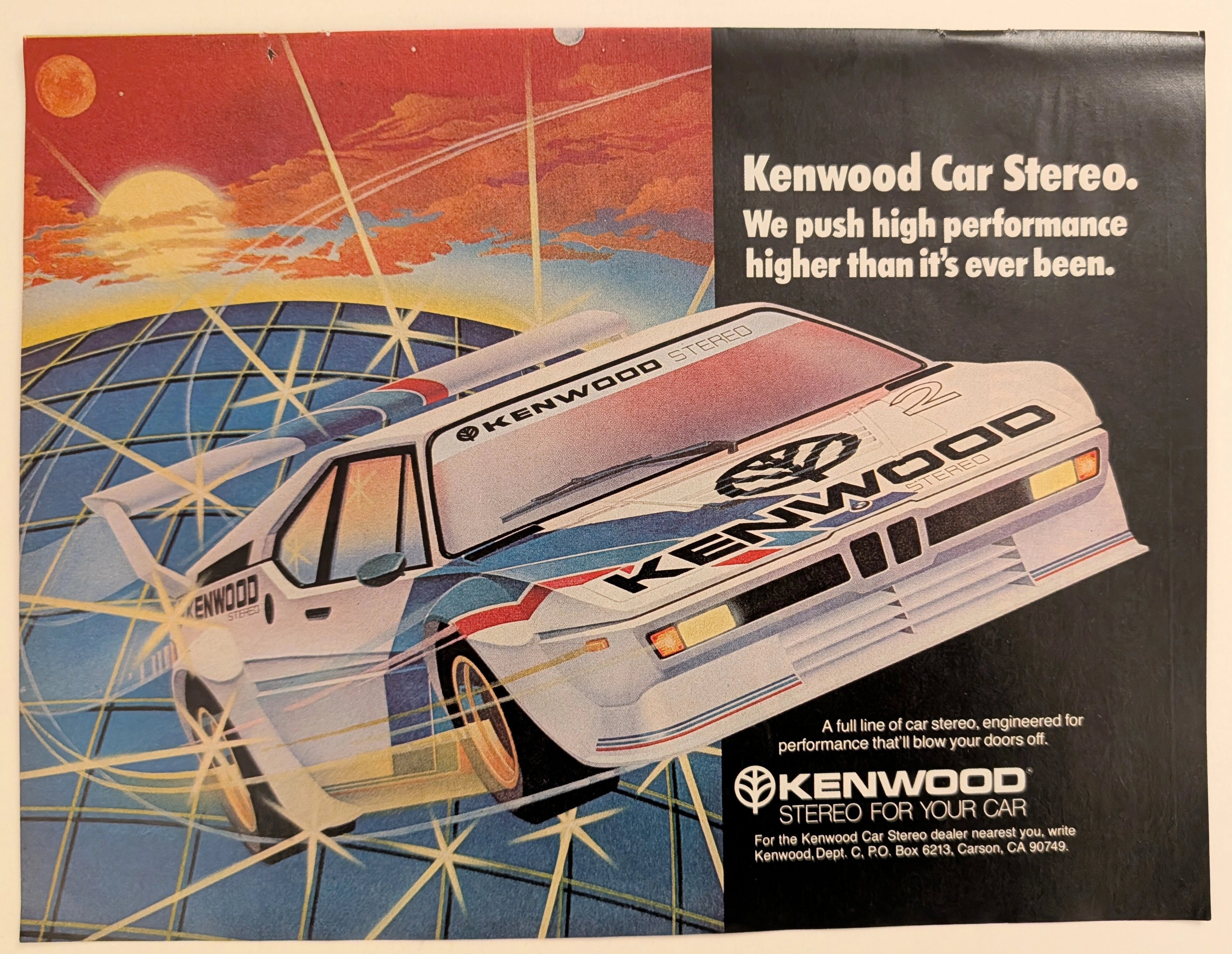
This cultural demand birthed the multi-billion-dollar aftermarket car audio industry. Brands like Kenwood, Alpine, and Pioneer engaged in a fierce technological arms race to produce the highest-wattage amplifiers, the most sophisticated graphic equalizers, and the most robust component speakers. The marketing warfare documented in this artifact illustrates a crucial strategy: aligning audio equipment with extreme automotive performance. Kenwood’s headline, "We push high performance higher than it's ever been," is deliberately ambiguous, blurring the lines between engine horsepower and acoustic wattage.
The visual narrative of the advertisement is an absolute masterclass in 1980s commercial illustration. It heavily utilizes the "Cyberpunk" or "Synthwave" aesthetic—a futuristic visual language popularized by early computer graphics, arcade games, and sci-fi cinema (such as Tron). The illustration features a heavily modified, wedge-shaped sports car (evocative of Group B rally cars or IMSA racers of the era, complete with massive aerodynamic wings and wide-body flares) adorned in Kenwood racing livery. The vehicle is depicted traveling at breakneck speed across a glowing, blue wireframe grid, moving toward a stylized, alien sunset with binary moons. Starburst lens flares emanate from the car's headlights and reflections, a staple technique of 80s airbrush artists used to convey intense energy and pristine technological perfection.
This dreamscape effectively communicates to the consumer that installing a Kenwood system is akin to upgrading to a supercar. The closing copywriting is aggressively visceral: "A full line of car stereo, engineered for performance that'll blow your doors off.". This is not a refined appeal to classical audiophiles; it is a raw, adrenaline-fueled promise to a generation that equated acoustic volume with personal power and freedom. It cemented Kenwood's status as a brand for the bold, the fast, and the unapologetic.
The Paper
As a physical entity, this printed artifact functions as a living, breathing, and profoundly detailed record of late-twentieth-century graphic reproduction and substrate chemistry. Under exceptional, high-magnification macro-lens examination, this document reveals the stunning complexity and mathematical precision of analog color offset printing, specifically in how it attempts to reproduce the smooth gradients of hand-painted airbrush art.
The extraordinary macro photographs of the Kenwood logo and the starburst reflections on the vehicle's flank provide a textbook, museum-grade visualization of a CMYK halftone rosette pattern. The vibrant, glowing neons of the wireframe grid and the soft, fiery gradients of the alien sunset are not solid, continuous swatches of ink. Instead, they are meticulously and flawlessly constructed from a precise, mathematically rigorous galaxy of microscopic ink dots. The Cyan, Magenta, Yellow, and Key (Black) inks are elegantly and systematically layered at highly specific angles to trick the human eye and the biological visual cortex into perceiving a continuous, luminous, and dimensional cybernetic reality out of mere clusters of overlapping pigment. The way the sharp, black "KENWOOD" typography sits atop the textured halftone dot matrix of the car's white bodywork is a testament to the immense mechanical pressure and precise registration capabilities of the commercial presses of the era.
Yet, the most profound and impactfully beautiful factor elevating the immense value of this artifact in the contemporary global collector's market is the natural, organic, and entirely irreversible process of Material Degradation. The expansive margins of the page exhibit a genuine, unavoidable "Toning." This gradual, chronological transition from the original bright, bleached manufactured paper to a warm, antique ivory hue is caused by the slow, relentless chemical oxidation of Lignin—the complex organic phenolic polymer that naturally binds cellulose fibers together within the raw wood pulp of the paper. As the substrate is exposed to ambient atmospheric oxygen and ultraviolet light over a span of four decades, the molecular structure of the lignin gracefully breaks down and darkens. This naturally evolving patina represents the absolute core of the wabi-sabi aesthetic. It is precisely this authentic, unreplicable degradation that acts as the primary engine driving up its market value exponentially among elite curators and collectors. When meticulously severed from its original binding as an individual sheet, it provides the ultimate, irrefutable scientific proof of the artifact's historical authenticity and its delicate, unbroken journey through time, making it an exceptionally highly prized candidate for conservation framing.
The Rarity
RARITY CLASS: B (Very Good Archival Preservation with Natural Margin Toning)
Evaluated under the most exacting, rigorous, and uncompromising archival parameters established by The Record Institute (which spans a meticulous classification system from Pristine Class A down to Heavily Degraded Class D), this artifact is definitively and securely designated as Class B.
The remarkable and defining paradox of 1980s commercial ephemera is that these specific documents were produced by the millions as explicitly and intentionally "disposable media." Inserted into high-volume, mass-market consumer or automotive publications, they were inherently destined by their very nature to be briefly observed, casually folded, used as scrap paper, or ultimately discarded into the recycling bins and incinerators of history. For a full-page, graphically complex, and highly color-saturated advertisement to survive entirely intact without catastrophic structural tearing, without destructive moisture staining, or without the fatal, irreversible fading of the delicate, light-sensitive halftone inks constitutes a highly significant statistical archival anomaly.
The structural integrity of this paper remains exceptionally sound. While the rich analog colors—particularly the vibrant, saturated oranges of the sunset and the glowing blues of the neon grid—remain astonishingly vivid, there is a beautiful, mathematically even, natural lignin oxidation reflecting its era. This displays a pronounced, warm ivory patina heavily along the margins. This environmental interaction does not detract from its immense value; rather, it authentically validates the document's chronological journey. The sheer visual impact and sociological weight of the subject matter—the definitive documentation of the aftermarket car audio boom and the zenith of 80s synthwave commercial art—makes this a highly prized, museum-worthy piece of consumer culture heritage, perfectly suited for acquisition as an individual artifact for acid-free, UV-protected conservation framing.
Visual Impact
The aesthetic brilliance and psychological power of this artifact lie in its masterful execution of "Kinetic Futurism and Airbrushed Supremacy." The art director was tasked with communicating the invisible, auditory power of a car stereo using purely visual, static elements, necessitating an illustration that crackled with kinetic energy and aggressive forward momentum.
The composition utilizes a highly effective diagonal tension. The vehicle itself is angled aggressively downward and forward, bursting out of the neon wireframe grid and creating a profound sense of velocity that sweeps from the bottom left toward the typography on the right. The background is a masterwork of 1980s airbrush technique, utilizing smooth, dreamlike gradients to render an otherworldly sky that contrasts sharply with the hard, geometric lines of the blue grid below. The ubiquitous use of starburst lens flares—on the car's edges, the headlights, and the grid intersections—acts as a visual metaphor for high-frequency treble and explosive acoustic clarity. The stark, black right-hand column grounds the chaotic energy of the illustration, providing a severe, authoritative canvas for the bold white typography. It is a masterclass in utilizing commercial illustration to simultaneously educate the consumer on the brand's aggressive identity while intensely stroking their deepest psychological desires for speed, technological superiority, and visceral acoustic power.
The Archive Continues
Continue the Exploration

๋Joy De Jean Patou · Fashion
The Time Traveller's Dossier: The Semantics of Arrogance – JOY de Jean Patou Advertisement (Circa 1980s)
History is not written by the victors; it is printed by the industrialists. Long before digital algorithms began to sterilely dictate human consumption and virtual reality stripped away authentic tactile sensation, societal engineering and consumer psychology were executed through the calculated, mathematical geometry of the four-color offset press and the absolute mastery of analog darkroom photography. The historical artifact before us is not merely a disposable magazine tear sheet meant to peddle a fragrance. It is a perfectly weaponized blueprint of absolute capitalist supremacy, a visual declaration of class warfare, and an unwavering testament to an era of uncompromising, unapologetic ultra-luxury. This museum-grade, academic archival dossier presents an exhaustive deconstruction of a late-analog print advertisement for the legendary fragrance "JOY de Jean Patou," dating from the late 1970s to the early 1980s. Operating on a profound and ruthless binary structure, this document records a calculated paradigm shift within the global luxury goods industry. It captures the precise historical fracture where luxury transitioned conceptually from being a mere indicator of high-quality craftsmanship into a blatant, arrogant weapon of socioeconomic exclusion. Through the highly specialized lens of late-analog commercial artistry and stringent visual forensics, this document serves as a masterclass in psychological marketing. It established the foundational archetype for selling astronomically priced, exclusionary items—an archetype that unconditionally dictates the visual and strategic totems of modern ultra-luxury brands today.

Bose · Automotive
The Time Traveller’s Dossier: 1983 Delco-GM/Bose Music System Vintage Advertisement — The Anthropomorphic Architecture of Sound
Within the expansive, carefully curated archive of vintage ads, the 1983 Delco-GM/Bose Music System vintage advertisement stands as a profound testament to the intersection of automotive engineering and early psychoacoustics. This executive dossier examines a pivotal moment in consumer technology marketing, highlighted by the enigmatic figure of "Morgan," an acoustic computer brain developed at M.I.T. As a cornerstone among old advertisements, this piece transcends mere commercial promotion; it offers a fascinating, tactile glimpse into algorithmic audio design before the digital era fully matured. Collectors, audiophiles, and historians of classic print ads will recognize the profound cultural shift this campaign represents: the definitive transition from basic, aftermarket car radios to custom-tuned, acoustically mapped vehicular auditoriums. By merging General Motors' formidable industrial might with Bose's avant-garde acoustic science, this document captures a true revolution in high-fidelity sound. Explore the physical preservation, deep historical context, and striking visual rhetoric of an artifact that permanently altered how society perceives the driving experience, turning the automobile interior into a meticulously calculated chamber of sonic perfection.

ฺีฺBulova · Fashion
The Time Traveller's Dossier: The Anatomy of Autonomy – The 1966 Bulova Commander Collection and the American System of Watchmaking
The evolution of the mid-twentieth-century luxury consumer market was fundamentally propelled by an intense post-war desire for unwavering reliability and transparent corporate accountability. The historical artifact elegantly and securely positioned upon the analytical table of The Record Institute today is a striking, full-page print advertisement for the 1966 Bulova Commander Collection, originating from a highly transformative era in global horology. This document completely transcends the standard, utilitarian boundaries of jewelry marketing. It operates as a highly sophisticated, multi-layered cultural mirror, reflecting the precise era when American industrial might directly challenged the fragmented traditions of European watchmaking, explicitly packaging and selling the concept of total mechanical autonomy to the American middle-class consumer. This world-class, comprehensive dossier conducts a meticulous, unyielding, and exceptionally exhaustive examination of the artifact, operating under the absolute most rigorous parameters of historical, sociological, and material science evaluation. With the vast majority of our analytical focus dedicated to its immense historical gravity, we will decode the brilliant marketing psychology embedded within the "If you want something done right, do it yourself" campaign, analyze the sociopolitical impact of the "American System of Watchmaking," and dissect the profound visual semiotics of the exploded mechanical view. Furthermore, as we venture deeply into the chemical and physical foundations of this analog printed ephemera, we will reveal the precise mechanical fingerprints of the CMYK halftone rosettes captured in the macro imagery of the watch dial and alligator strap. Finally, we will assess its archival rarity, exploring how the graceful, natural oxidation of the paper substrate cultivates a serene wabi-sabi aesthetic—a natural, irreversible phenomenon that serves as the primary engine driving up its market value exponentially within the elite global spheres of Vintage Commercial Ephemera and Horological Archives.