The Time Traveller's Dossier : Gucci Flora Porcelain - The Domestication of European Luxury
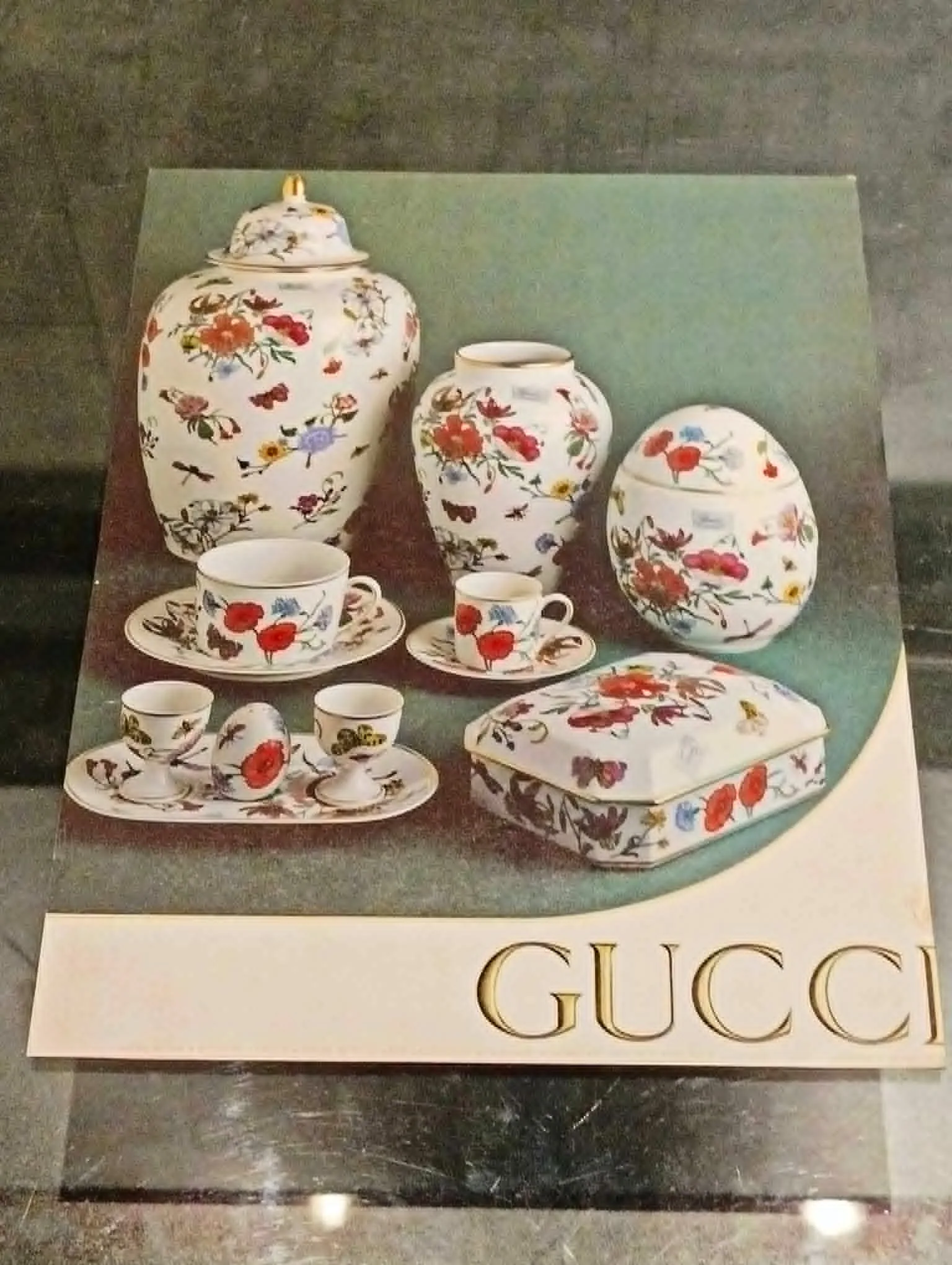
A handbag exists in the public sphere. It is designed for the street, the transit lounge, and the gaze of the stranger. Porcelain, however, exists behind closed doors. It is designed for the private dining room, the intimate breakfast, and the gaze of the invited guest. Before this era, the grand European leather goods houses were strict purveyors of transit. They equipped the wealthy for their journeys. This artifact—a vintage commercial advertisement for Gucci’s Flora pattern ceramic homewares—represents a fundamental shift in the architecture of luxury commerce. It marks the precise moment a brand realized that dressing the consumer was insufficient. They needed to dress the consumer’s domestic reality. The strategy shifted from outfitting the traveler to colonizing the home. This is not merely a catalogue of teacups and ginger jars. It is a documented blueprint of the lifestyle brand's genesis. It represents the historical pivot where heritage houses transitioned from manufacturing specialized goods to engineering totalized, encompassing aesthetic ecosystems.
Category: Fashion
Brand: Gucci
The History
The Epoch of Interior Colonization To understand this artifact, one must understand the limitations of the mid-twentieth-century luxury market. Historically, the Florentine house of Gucci built its empire on saddlery, leather goods, and luggage. Their primary utility was locomotion. Their demographic was the burgeoning international jet set—a postwar elite who required durable, recognizable containers for their transatlantic migrations. However, by the late 1970s and early 1980s, a structural ceiling approached. A wealthy patron can only purchase a finite number of suitcases. The modern corporation, driven by the necessity of perpetual growth, required a new frontier. That frontier was the domestic interior. This advertisement captures the execution of a new strategy: the totalization of the brand. If the consumer trusted the house to construct their briefcase, they could be conditioned to trust the house to fire their porcelain. The luxury brand ceased to be a mere manufacturer of leather; it became an arbiter of living. It offered a curated, pre-packaged aristocratic European domesticity, ready to be exported and unpacked in American and Asian dining rooms. The Migration of the Flora Motif: From Silk to Silicate The visual anchor of this campaign is the Flora motif. The pattern's genesis is deeply entrenched in the mythology of the house. Commissioned in 1966 for Princess Grace of Monaco, the original illustration by Vittorio Accornero featured forty-three varieties of flowers, plants, and insects. It was initially designed for silk—a soft, draped, and transient material. This artifact documents the mechanical and conceptual migration of that motif from soft silk to hard silicate. Observe the macro details of the ceramics. Red poppies, blue cornflowers, meticulous beetles, and hovering dragonflies are transposed onto rigid, fired white clay. There is a calculated tension here. The fragility of the painted butterfly mirrors the physical fragility of the porcelain demitasse cup and the lidded egg container. It is a botanical encyclopedia rendered on tableware. By utilizing the Flora print, Gucci bypassed the need to invent a new visual language for their homewares. They weaponized their own archives. They took a pattern already encoded with aristocratic associations (Grace Kelly) and stamped it onto domestic objects, instantly transferring the prestige of the silk scarf to the ginger jar. The Cartography of Global Consumption Perhaps the most culturally significant element of this artifact is located in the typography at the absolute bottom margin. It reads: NEW YORK • BEVERLY HILLS • PALM BEACH • BAL HARBOUR • CHICAGO • ROME • FLORENCE • MILAN • LONDON • PARIS • CANNES • HONG KONG. This is not merely a list of addresses. It is a geopolitical map of late-twentieth-century wealth. It delineates the exact architecture of global aspiration during this specific decade. The list begins not in Italy, but in America. New York and Beverly Hills represent the established bi-coastal American elite. Palm Beach and Bal Harbour denote the highly specific enclaves of old money and localized extreme wealth in Florida. Chicago represents the industrial heartland's upper echelon. Only after establishing this American dominance does the list retreat to Europe: Rome, Florence, Milan (the holy trinity of Italian heritage), followed by London and Paris (the old imperial capitals), and Cannes (the playground of the Riviera). Finally, the list terminates with Hong Kong. This single inclusion is a massive historical indicator. It marks the awakening of the Asian luxury market. It is the precursor to the massive eastern expansion that would sustain the luxury industry in the subsequent decades. This single line of text records the shifting tectonic plates of global capital. The Competitor Landscape and the Porcelain Cold War Gucci was not operating in a vacuum. This expansion into homewares was part of a broader "Porcelain Cold War" among heritage brands. Hermès, across the border in France, was heavily investing in Limoges porcelain, utilizing their equestrian motifs. Tiffany & Co. in America was dominating the bridal registry with their localized version of luxury ceramics. Cartier was producing crystal and silver for the home. Gucci’s deployment of the Flora pattern was a calculated differentiation. Hermès offered rigidity and leather-strap iconography. Tiffany offered American minimalism and silver-screen romance. Gucci offered Italian romanticism, chaotic naturalism, and a slightly decadent, maximalist aesthetic. The ginger jars, the trinket boxes, and the highly specific double-egg cups shown in the artifact were designed for a consumer who wished to project a specific type of cultured, European eccentricity. The Socio-Economic Pivot Ultimately, this artifact records the democratization of the luxury logo, albeit a restricted democratization. Not everyone could afford a customized Gucci wardrobe or a complete set of leather luggage. However, a middle-class consumer with upward mobility could potentially purchase a single Flora porcelain egg cup or a demitasse saucer. It was an entry-level drug into the ecosystem of the brand. By applying their intellectual property to smaller, static household items, the house lowered the barrier to entry while simultaneously infiltrating the daily domestic rituals of the consumer. The artifact proves that the ultimate goal of the luxury sector was not merely to be worn, but to be lived within.
The Paper
The physical substrate of this artifact is a lightweight, highly calendered, coated magazine stock, typical of high-end fashion publications of the late 1970s and early 1980s. It was manufactured to withstand the aggressive speed of commercial web offset printing. The coating is engineered to hold ink sharply on the surface, preventing the bleeding of the highly detailed Flora illustrations. Under microscopic inspection, the blue cornflowers and the red poppies resolve into a rigid, mathematical structure of Cyan, Magenta, Yellow, and Key (Black) halftone rosettes. The paper is inherently flawed. It contains wood pulp and lacks the archival cotton rag content of fine art prints. Consequently, the edges of the page exhibit subtle oxidation, a slow chemical burning known as acid hydrolysis. The white margins are shifting towards a brittle, warm yellow. This decay is essential to its identity as an artifact. It is a mass-produced commercial vehicle that was never intended to survive its monthly billing cycle. Its survival is an anomaly, transforming a disposable advertisement into a permanent historical record.
The Rarity
Classification: Class B. In terms of pure numerical existence, this artifact is not singularly rare. It was printed in the tens or hundreds of thousands for distribution in international fashion glossies like Vogue, Harper’s Bazaar, or Town & Country. However, its classification rises to Class B based on strict contextual value. The vast majority of these pages were discarded, recycled, or destroyed by natural attrition. Finding an intact, well-preserved specimen that clearly delineates the complete twelve-city global boutique network and the specific homeware product line offers high documentary value. It is an unadulterated data point regarding the commercial strategy of a major fashion house prior to the conglomerate consolidation era of the 1990s.
Cite this article
- MLA
- Naodhinsuk, Ronin. “The Time Traveller's Dossier : Gucci Flora Porcelain - The Domestication of European Luxury.” The Record Institute, 6 July 2026, https://therecord.institute/journal/the-time-travellers-dossier-gucci-flora-porcelain-the-domestication-of-european-luxury.
- APA
- Naodhinsuk, R. (2026, July 6). The Time Traveller's Dossier : Gucci Flora Porcelain - The Domestication of European Luxury. The Record Institute. https://therecord.institute/journal/the-time-travellers-dossier-gucci-flora-porcelain-the-domestication-of-european-luxury
- CHICAGO
- Naodhinsuk, Ronin. 2026. “The Time Traveller's Dossier : Gucci Flora Porcelain - The Domestication of European Luxury.” The Record Institute, July 6, 2026. https://therecord.institute/journal/the-time-travellers-dossier-gucci-flora-porcelain-the-domestication-of-european-luxury.