The Time Traveller's Dossier : Hertz - Engineering Freedom
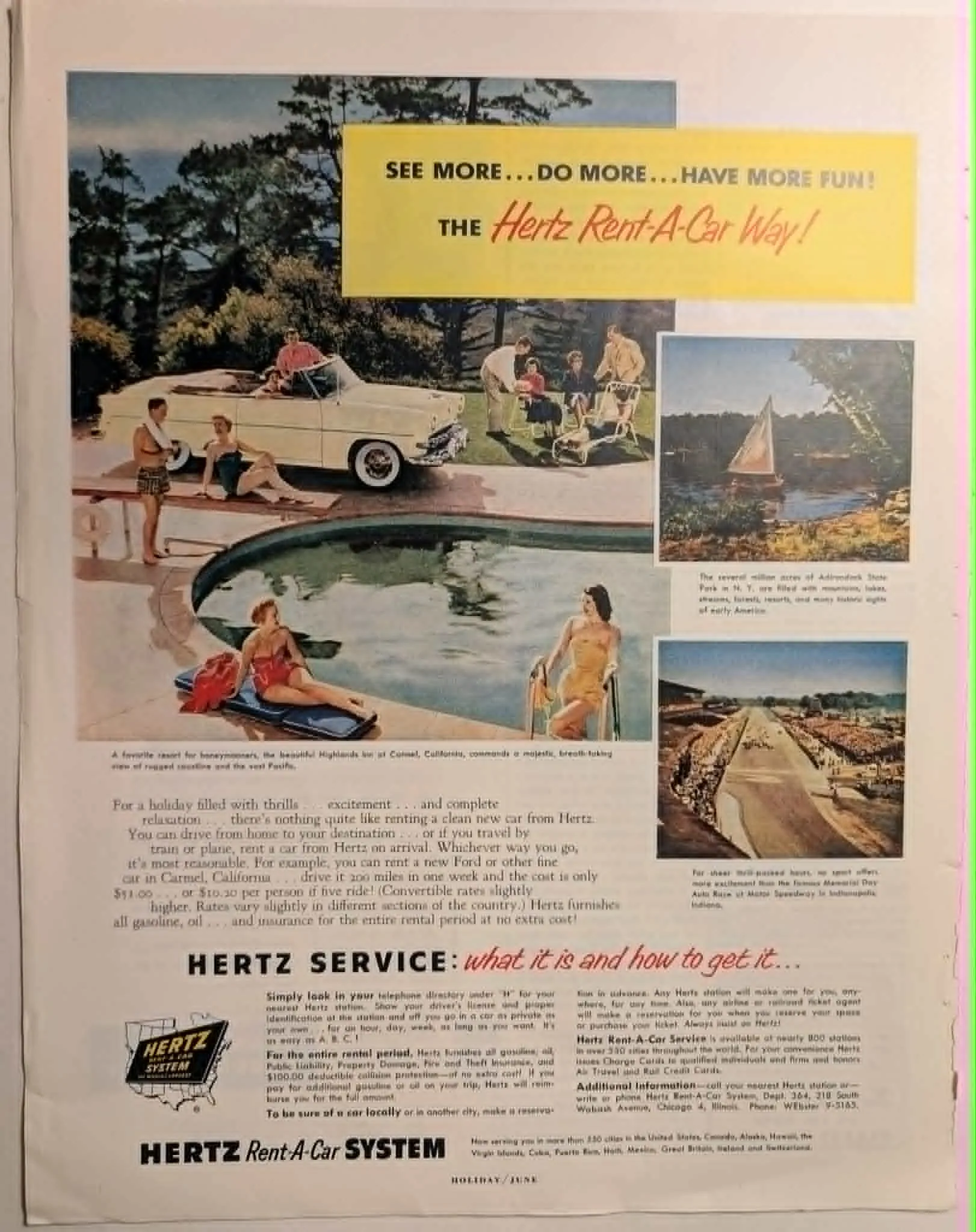
An artifact from the mid-1950s. A window into the absolute decentralization of American leisure. This is not merely an advertisement for a vehicle. It is the blueprint for a continental logistical grid. Then, vacations were profoundly linear and static. You boarded a train in a metropolis, arrived at a designated resort, and remained immobilized until the return journey. Mass transit dictated the geography of your rest. Now, mobility is fluid, ubiquitous, and completely detached from ownership. You cross oceans in hours, land at a terminal, and instantly acquire temporary, localized autonomy. This document captures the exact historical friction point where a corporation successfully solved the "last mile" problem of modern tourism. They commodified the steering wheel. They engineered, insured, and sold decentralized freedom by the hour.
Category: Technology
The History
The Post-War Paradigm The American landscape in the mid-1950s was a vast, sprawling canvas waiting to be aggressively traversed. The heavy, consuming machinery of the Second World War had finally cooled. The massive industrial factories that once stamped out bomber fuselages were now rapidly churning out consumer steel and chrome. The middle class was not merely growing; it was exploding outward with a sudden, violent velocity. Disposable income was a new, potent force across the nation. The psychological requirement for control, autonomy, and exploration was paramount after years of rationing, wartime regimentation, and economic austerity. The Infrastructure of Escape Before this specific era, the architecture of the American vacation was rigidly stationary. A traveler boarded a Pullman train car in a dense metropolis. The fixed iron arteries of the rail network carried them to a predetermined terminus. They arrived at a grand hotel or a mountain resort, and they simply remained there. The concept of the cross-country "road trip" existed, certainly, but it was a grueling, mechanical endeavor. It required owning a highly reliable vehicle, enduring weeks of continuous driving, and suffering the inevitable mechanical failures along the primitive predecessors of the Interstate Highway System. Mass transit was highly efficient, but it was inherently inflexible. It delivered you to a hub, and then stripped you of your momentum. The Systemic Solution Hertz did not invent the rental car. Walter L. Jacobs began renting repaired Model Ts in Chicago as early as 1918, a company John D. Hertz purchased shortly after. However, what this specific artifact from the June issue of Holiday magazine represents is not the invention of the rental transaction. It represents the maturation of a decentralized, continental mobility grid. Notice the heavy, deliberate emphasis on the word "System" in the lower-left quadrant. "Hertz Rent-A-Car SYSTEM." They were not selling access to a cream-colored Ford convertible. They were selling temporary ownership of a vast, invisible logistical network. Overcoming the Last Mile The critical logistical problem of mid-century travel was the "last mile." Commercial aviation was rapidly entering its golden age of pressurized cabins and transcontinental routes. The passenger rail network was still operating at peak capacity. Yet, both of these powerful technologies deposited the traveler at a central hub. The traveler was then immobilized, utterly dependent on local taxis, fixed bus routes, or the schedules of others. Hertz engineered the bridge between mass transit and individual autonomy. They stationed fleets of standardized vehicles directly at railway terminals and municipal airports. They operationalized the "fly-drive" and "train-drive" paradigm. A citizen could cross the continent at the speed of commercial flight, and upon arrival, instantly reclaim the localized, absolute autonomy of the automobile. The Psychological Engineering Analyze the rhetoric embedded in the copy. "Show your driver's license and proper identification at the station and off you go in a car as private as your own." The language is meticulously crafted to eliminate friction and anxiety. After the strict regimentation of military service and the deprivations of a global conflict, the American consumer craved absolute, unquestioned autonomy. The rental car provided the flawless illusion of infinite freedom, meticulously underwritten by corporate insurance, standardized maintenance, and pre-calculated depreciation. It was freedom without the burden of long-term mechanical responsibility. The Trinity of Destinations The advertisement utilizes a fractured, multi-paneled layout—mimicking a personal photo album—to present three distinct, highly calculated archetypes of the American holiday. First, the swimming pool at Carmel, California. This is the archetype of elite leisure and status. The pristine convertible, the diving board, the manicured landscaping. Second, the Adirondack State Park in New York. The solitary sailboat resting on calm waters represents the pastoral escape, the quiet return to nature. Third, the Indianapolis Motor Speedway. This represents the archetype of mechanical spectacle, speed, and raw thrill. By utilizing these three specific locations, Hertz positioned its "System" as the universal key required to unlock every conceivable psychological desire of the mid-century traveler. The Economics of the Grid The listed price within the text is a fascinating economic fossil. "$51.00... or
The Paper
The physical medium carrying this complex message is a standard, heavyweight coated magazine stock characteristic of the mid-1950s, likely weighing between 80 and 90 GSM. Extracted carefully from the binding of Holiday magazine, this single page demonstrates the absolute pinnacle of commercial web offset lithography available during that decade. The tactile quality is smooth, yet it lacks the impenetrable, high-gloss polymer coatings of modern digital publications. This lack of synthetic protection leaves the organic cellulose fibers highly vulnerable to atmospheric degradation. Under digital magnification, the intricate CMYK halftone dot structure becomes clearly visible, revealing the mechanical, automated separation of the original composite photographs. The artifact exhibits undeniable signs of chemical oxidation and mild foxing along the extreme edges. The distinct Hertz yellow block, however, retains a startling saturation. The paper is not merely a static carrier of ink; it is a biological chronometer, recording its seventy-year survival through the vast, disposable archives of human consumption.
The Rarity
Classification: Class B This artifact is not a unique, one-of-a-kind painting. It is, by definition, a mass-produced consumer object designed for temporary circulation. However, its survival rate in this pristine, unaltered condition is remarkably low. Magazines of the 1950s were ephemeral by design; they were engineered to be read, discarded, and replaced by the next month's issue. Its true rarity, therefore, lies entirely in its contextual value. It is increasingly rare to find mid-century artifacts that so explicitly, unabashedly document the exact logistical intersection of mass transit and private rental. It is a critical, primary source document of economic history, highly sought after by transportation historians, advertising archivists, and scholars examining the infrastructural mechanics of post-war American mobility.
Cite this article
- MLA
- Naodhinsuk, Ronin. “The Time Traveller's Dossier : Hertz - Engineering Freedom.” The Record Institute, 8 July 2026, https://therecord.institute/journal/the-time-travellers-dossier-hertz-engineering-freedom.
- APA
- Naodhinsuk, R. (2026, July 8). The Time Traveller's Dossier : Hertz - Engineering Freedom. The Record Institute. https://therecord.institute/journal/the-time-travellers-dossier-hertz-engineering-freedom
- CHICAGO
- Naodhinsuk, Ronin. 2026. “The Time Traveller's Dossier : Hertz - Engineering Freedom.” The Record Institute, July 8, 2026. https://therecord.institute/journal/the-time-travellers-dossier-hertz-engineering-freedom.