The Time Traveller's Dossier : International Sterling - Legacy on Layaway
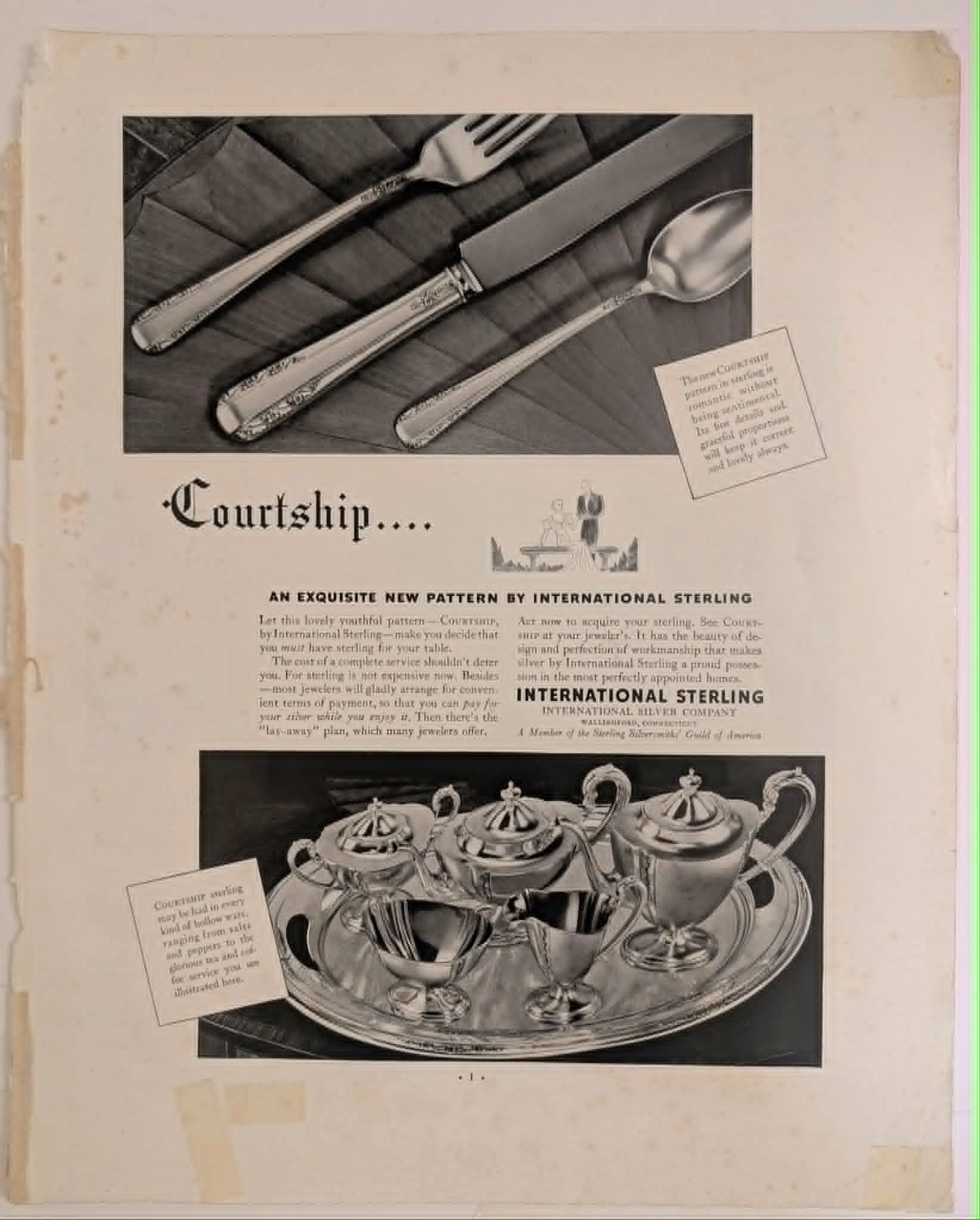
The era is likely the late 1930s. A period caught between the devastation of a global depression and the looming shadow of a second world war. Before this specific juncture in consumer history, sterling silver was an impermeable boundary. It was a metallurgical marker of aristocracy. You did not buy legacy. You inherited it. By the time this advertisement went to print, that barrier had been breached. The solution to a stalled economy was not merely producing cheaper goods. The solution was the financialization of aspiration. This artifact, a seemingly simple promotional page for the International Silver Company, documents a profound sociological pivot. It captures the exact moment when generational wealth was repackaged as a retail commodity. From the locked vaults of the elite to the dining tables of the emerging middle class. It is a monument to the democratization of luxury. The moment humanity decided that prestige could be acquired through calculated, monthly installments.
Category: Other
The History
The Economic Thermostat: The Shadow of the Thirties To comprehend the gravity of this artifact, one must first calibrate to the economic temperature of its origin. The world was recovering from a catastrophic financial hemorrhage. The Great Depression had shattered the illusion of permanent prosperity. Banks had failed. Fortunes had evaporated overnight. The public psyche was scarred by scarcity. Yet, as the decade progressed, a fragile stabilization began to take hold. People sought anchors. They craved tangible assets, materials that could not be wiped out by a fluctuating ticker tape. They wanted permanence. Sterling silver represents ultimate permanence. But the traditional consumer base for such luxury—the wealthy elite—was no longer sufficient to sustain massive industrial silversmithing operations. The industry needed a new demographic. They needed the aspirational middle class. But the middle class lacked capital. This was the paradox that the International Silver Company sought to resolve. The Metallurgy of Aspiration Sterling is not merely a metal; it is a legal and chemical standard. By definition, sterling silver is an alloy of 92.5 percent silver and 7.5 percent copper or other metals. This ratio was established to give pure silver the strength required for functional use while maintaining its luminous, incorruptible sheen. For centuries, owning a complete service of sterling hollowware and flatware was the definitive proof of arrival in polite society. It was heavy. It required polishing. It required servants to maintain it. It was an asset that held intrinsic commodity value. This advertisement is selling more than forks and teapots. It is selling entry into a specific social stratum. The text explicitly states: "...make you decide that you must have sterling for your table." It frames the metal not as a luxury, but as a domestic imperative. The Architecture of "Courtship" The design pattern featured here is named "Courtship". The naming convention is a masterstroke of psychological marketing. Courtship implies a prelude to marriage, the foundation of the traditional nuclear family. By naming the pattern "Courtship," the corporation binds the acquisition of silver to the ritual of matrimony. It suggests that a marriage without sterling is somehow incomplete, lacking a proper foundation. The aesthetic philosophy of the pattern is articulated with clinical precision: "romantic without being sentimental." This is a critical distinction in design history. The Victorian era, which had recently passed, was drowning in sentimentality and hyper-ornamentation. Conversely, the emerging Bauhaus and Art Deco movements were often stark, cold, and radically geometric. The middle class of this era wanted neither the suffocating clutter of their grandparents nor the alienating severity of the avant-garde. "Courtship" offers the perfect compromise. Its "fine details and graceful proportions" provide a safe, transitional elegance. It is modern enough to feel fresh, yet traditional enough to signal established wealth. It is designed to be "correct and lovely always"—a promise of aesthetic immortality in an uncertain world. The Industrial Leviathan of Wallingford The International Silver Company was not a quaint workshop of artisans. It was a massive corporate conglomerate. Formed in 1898 through the merger of numerous independent New England silversmiths, it centralized and industrialized the production of silver. Wallingford and Meriden, Connecticut, became the epicenter of this production. They brought assembly-line efficiency to a craft that was historically painstaking and slow. This industrial scale was the only way to produce sterling at a volume that could supply a national market. The inclusion of "A Member of the Sterling Silversmiths' Guild of America" at the bottom of the ad is a vital piece of corporate signaling. It reassures the buyer that despite the industrial scale of production, the ancient standards of the craft are being upheld. It is a stamp of institutional authority. The Core Shift: The Birth of Financed Heritage The most historically significant text in this artifact is not about the design. It is about the economics of acquisition. "The cost of a complete service shouldn't deter you. For sterling is not expensive now." This is a radical redefinition of value. But the true paradigm shift lies in the following sentence: "Besides—most jewelers will gladly arrange for convenient terms of payment, so that you can pay for your silver while you enjoy it. Then there's the 'lay-away' plan..." Here lies the absolute core of the historical shift. The democratization of luxury through the instrument of credit. In previous generations, if you could not afford a complete silver service, you simply did not possess one. You bought silverplate, or you used steel. The concept of purchasing generational heritage on an installment plan was revolutionary. The "lay-away" plan allowed a working-class family to reserve an asset of the aristocracy and pay it off fractionally. This is the financialization of domestic life. It shifted the burden of acquiring legacy from the accumulation of capital to the management of cash flow. You no longer needed a lump sum; you only needed a steady job and a commitment to monthly payments. This system bridged the massive gap between middle-class income and upper-class expectation. It trained a generation of consumers to leverage their future labor for immediate material prestige. The Illusion of Immediate Elevation This advertisement represents the moment the American Dream became a commodity that could be financed. It taught the public that social mobility did not require decades of saving. It only required a visit to the local jeweler and a signature on a lay-away contract. By acquiring the "Courtship" pattern, a young couple could immediately project the aura of established wealth, even if their bank account was nearly empty. We built a society based on leveraged aesthetics. We created a system where the symbols of success were distributed far wider than the actual capital they represented. And we placed our societal self-worth entirely in the hands of the credit terms provided by our jewelers. This document does not just sell spoons. It is a blueprint for the modern, credit-driven consumer economy. It states: We have unlocked the vaults of the elite. We are ready to sell you your heritage, one payment at a time.
The Paper
The physical reality of this artifact is a testament to survival and decay. The paper stock is typical of mid-century mass-market periodicals, likely a lightweight, machine-made wood pulp paper. It lacks the heavy, archival stability of purely rag-based paper. The printing relies on a standard commercial halftone process. When inspecting the teapots in the hollowware arrangement, the illusion of reflective metallic surfaces is achieved entirely through the microscopic spacing of black ink dots. There is no silver ink used to represent the silver product; it is a cognitive trick played by the density of standard black pigment. The paper is actively deteriorating. The margins exhibit significant foxing—the brown, spotted blemishes caused by the oxidation of iron, copper, and other impurities within the wood pulp, reacting to ambient humidity over decades. The edges are brittle, showing micro-tears and a distinct yellowing (acidification) due to the lignin breaking down in the presence of light and oxygen. This paper is a fragile, temporary vessel. It is slowly crumbling into dust, while the solid sterling silver objects it advertises will outlast the hands that bought them, the jewelers that sold them, and the very civilization that manufactured them.
The Rarity
Classification: Class B Contextual Value: High. Market Value: Low. Vintage advertisements for flatware are abundant. The International Silver Company ran aggressive, nationwide campaigns for decades. Therefore, the physical scarcity of this page is negligible. However, its contextual rarity elevates its status for the archivist. Finding an ad that explicitly details the sociological mechanism of the "lay-away" plan in relation to a high-luxury good like sterling silver provides a perfect, localized snapshot of economic history. It is a Class B artifact—common in form, but exceptionally rich in its demonstration of early consumer credit frameworks.
Cite this article
- MLA
- Naodhinsuk, Ronin. “The Time Traveller's Dossier : International Sterling - Legacy on Layaway.” The Record Institute, 17 May 2026, https://therecord.institute/journal/the-time-travellers-dossier-international-sterling-legacy-on-layaway.
- APA
- Naodhinsuk, R. (2026, May 17). The Time Traveller's Dossier : International Sterling - Legacy on Layaway. The Record Institute. https://therecord.institute/journal/the-time-travellers-dossier-international-sterling-legacy-on-layaway
- CHICAGO
- Naodhinsuk, Ronin. 2026. “The Time Traveller's Dossier : International Sterling - Legacy on Layaway.” The Record Institute, May 17, 2026. https://therecord.institute/journal/the-time-travellers-dossier-international-sterling-legacy-on-layaway.