The Time Traveller's Dossier: Inver House Scotch 1967 - The Golden Age of Endurance
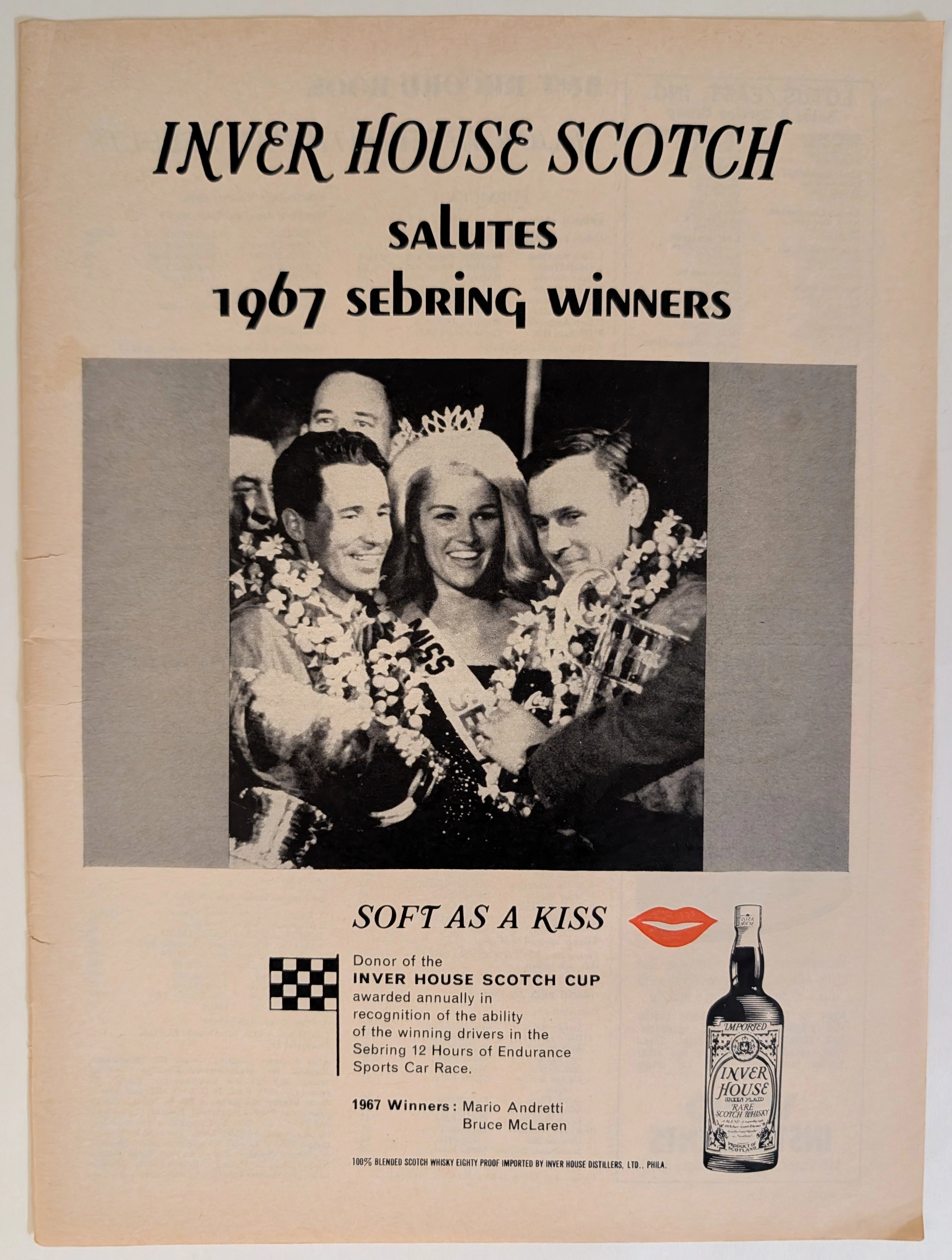
นักเขียนบทความระดับสูงสุด Custom Gem The Time Traveller's Dossier: Inver House Scotch 1967 - The Golden Age of Endurance Summary Then, motor racing was a lethal, deafening, and romantic pursuit. It was an era where the men who piloted experimental, overpowered prototypes for 12 to 24 hours at a time were viewed as a mix of gladiators and jet-set playboys. Now, motorsport is heavily sanitized, and the deep, symbiotic advertising relationships between high-speed danger, hard liquor, and tobacco have been entirely regulated out of existence. The problem for a Scottish whisky brand in the late 1960s was how to inject itself into the glamorous, adrenaline-fueled world of the American sports car boom. The solution was the "Inver House Scotch Cup," a masterful stroke of corporate sponsorship that permanently tied their bottle to the pinnacle of automotive endurance racing: The 12 Hours of Sebring. This artifact is a portal. It transports us to the humid, exhaust-choked winner's circle in Florida, March 1967. It documents a legendary pairing of two motorsport titans—Mario Andretti and Bruce McLaren—and perfectly captures the specific, mid-century masculine pageantry of victory, juxtaposed against a surprisingly delicate corporate slogan.
Category: Automotive
Brand: Inver
The History
The Ford GT40 Mk IV and the Titans of Track To understand the historical gravity of the photograph in this advertisement, one must know what these men had just survived. Mario Andretti and Bruce McLaren didn't just win the 1967 Sebring 12 Hours; they dominated it in the debut of the legendary Ford GT40 Mk IV. This was the height of the legendary Ford vs. Ferrari war. The Mk IV was an American-built monster designed to conquer Le Mans, and Sebring was its proving ground. Andretti and McLaren—two of the greatest drivers in the history of motorsport—pushed the car to an effortless victory. The exhaustion and elation on their faces in this press photo are entirely genuine. They had just wrestled a 500-horsepower V8 around a bumpy Florida airfield for half a day. The "Soft as a Kiss" Dichotomy The brilliance of this advertisement lies in its jarring thematic contrast. On one hand, you have a photograph representing the brutal, grueling, and highly dangerous reality of 1960s endurance racing. On the other hand, you have Inver House's trademark slogan: "SOFT AS A KISS," complete with a bright red graphic of feminine lips. This juxtaposition was highly intentional. It assured the consumer that while the men who drink this scotch are rugged, brave, and victorious, the product itself is refined, smooth, and accessible. It marketed a sophisticated smoothness to a demographic captivated by raw mechanical violence. The Pageantry of the 1960s Winner's Circle Nestled between the two exhausted racing legends is "Miss Sebring," adorned with a rhinestone tiara and a sponsor sash. The trio is draped in thick flower garlands, a tradition in racing victory lanes of that era. From an archival standpoint, this photograph is a perfect time capsule of 1960s sports marketing. The victory lane was a highly orchestrated theater of masculinity and glamour. The presence of the beauty queen and the flowers served to soften the grit of the drivers, making the photograph palatable and appealing for national magazine distribution.
The Paper
This artifact is a standard example of late 1960s mass-market magazine stock. The paper is an uncoated, relatively lightweight wood-pulp blend that has oxidized over the last nearly 60 years, resulting in a warm, uniform off-white patina. The printing utilizes high-volume offset lithography. The advertisement is primarily a stark monochrome, utilizing black ink to render the typography, the checkered flag, the bottle, and the central halftone photograph. The standout feature is the localized use of a single "spot color"—the vibrant, saturated red ink used exclusively for the lips graphic. This spot color requires a separate printing plate and alignment (registration), which is handled perfectly here, creating a visual anchor that immediately draws the eye down from the gritty photograph to the smooth branding.
The Rarity
Classification: Class A (High Crossover Contextual Value) While vintage liquor advertisements are abundant, this specific piece ascends to Class A due to its crossover appeal. It is not merely a Scotch advertisement; it is a primary document of a legendary motorsport event. Collectors of Mario Andretti memorabilia, Bruce McLaren historians, and Ford GT40 enthusiasts highly prize ephemera from the 1967 Sebring victory. Because it captures two racing icons at the peak of their powers, its value far exceeds that of a standard Inver House ad.
Cite this article
- MLA
- Naodhinsuk, Ronin. “The Time Traveller's Dossier: Inver House Scotch 1967 - The Golden Age of Endurance.” The Record Institute, 21 April 2026, https://therecord.institute/journal/the-time-travellers-dossier-inver-house-scotch-1967-the-golden-age-of-endurance.
- APA
- Naodhinsuk, R. (2026, April 21). The Time Traveller's Dossier: Inver House Scotch 1967 - The Golden Age of Endurance. The Record Institute. https://therecord.institute/journal/the-time-travellers-dossier-inver-house-scotch-1967-the-golden-age-of-endurance
- CHICAGO
- Naodhinsuk, Ronin. 2026. “The Time Traveller's Dossier: Inver House Scotch 1967 - The Golden Age of Endurance.” The Record Institute, April 21, 2026. https://therecord.institute/journal/the-time-travellers-dossier-inver-house-scotch-1967-the-golden-age-of-endurance.