The Time Traveller's Dossier : ITT Corp - The Silent Architecture of Assimilation
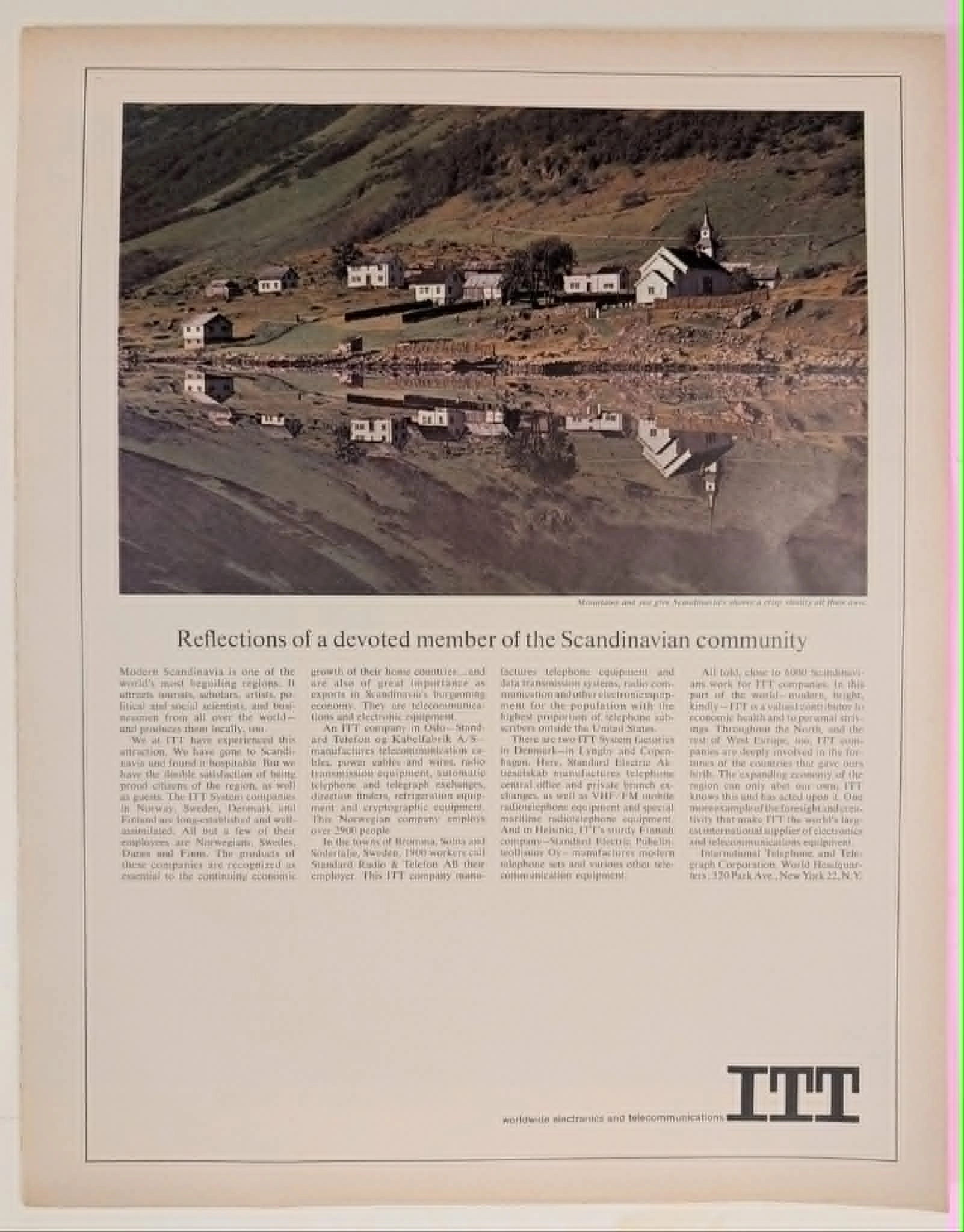
This is not an advertisement. It is a declaration of presence. It is a corporate monolith demonstrating the art of camouflage. Then, national infrastructure was built by national hands. A country’s nervous system—its telecommunications—was a matter of sovereign pride and security. Now, infrastructure is a borderless web, owned by invisible conglomerates holding subsidiary titles. This artifact captures the exact moment that shift was perfected. International Telephone and Telegraph (ITT) did not invade the Scandinavian market. They became it. They purchased the local bloodline, adopted the local name, and subtly wired an entire geopolitical region back to a boardroom in New York. The problem was foreign resistance. The solution was total, localized assimilation.
Category: Technology
Brand: ITT
The History
The Architecture of a Corporate Empire The mid-twentieth century was not defined by the rise of new nations. It was defined by the rise of the multinational conglomerate. Corporations began to realize that borders were merely suggestions. Capital had no nationality. At the vanguard of this realization was ITT. Under the relentless command of Harold Geneen, ITT transformed from a moderately successful telecommunications firm into an apex predator of the industrial age. Geneen’s philosophy was simple. Growth through acquisition. Constant, unbroken, mathematical growth. However, entering a foreign market as a dominant American force during the geopolitical tension of the Cold War was dangerous. Nations were protective. They guarded their communication lines fiercely. Telephones were not just consumer goods. They were the logistical backbone of defense. To control the wires was to control the state. ITT understood this. Therefore, they did not export their identity. They exported their capital. They purchased established, trusted companies in foreign lands and let them keep their names. They bought the history. They bought the trust. This artifact is a masterclass in that specific brand of corporate diplomacy. The Scandinavian Problem: Geography as an Adversary Scandinavia presented a unique logistical and political challenge. Look at the landscape depicted in the document. Mountains. Deep fjords. Isolated fishing villages. Freezing temperatures. Geography here is an adversary. It actively resists connection. To build a telecommunications network in Scandinavia requires engineering that defies the elements. It requires deep-sea cables that can withstand oceanic pressure and ice. It requires radio frequencies that can bounce over granite peaks. Furthermore, the geopolitical climate of the region was a delicate balancing act. Norway and Denmark were NATO members. Sweden and Finland were staunchly neutral, carefully navigating the space between Western interests and the Soviet shadow. An American defense and communications contractor could not simply walk into Stockholm or Helsinki and lay wire. The political friction would have been immense. The suspicion would have been terminal. Therefore, ITT became invisible. Infiltration by Assimilation: The Subsidiary Strategy The text of the document reveals the brilliance of the strategy. ITT does not boast about its American roots. It boasts about its Scandinavian workforce. "All told, close to 6000 Scandinavians work for ITT companies." They list their assets not as conquests, but as native sons. In Norway, they are Standard Telefon og Kabelfabrik A/S. In Sweden, they are Standard Radio & Telefon AB. In Denmark, Standard Electric Aktieselskab. In Finland, Standard Electric Puhelinteollisuus Oy. Each entity retains its native language in its corporate title. Each employs local citizens. They manufacture locally. The artifact explicitly states these companies are "recognized as essential to the continuing economic growth of their home countries." This is the shift. Imperialism requires force. Assimilation requires only capital. By embedding themselves into the very fabric of the local economy, ITT made itself indispensable. If you cut ITT out, you cut out jobs in Bromma, Solna, Södertälje, Lyngby, and Copenhagen. You destroy local industry. They engineered a scenario where their host countries became entirely dependent on a foreign-owned nervous system. The Hardware of Sovereignty: Copper, Crypto, and Cold War The inventory listed in this document is heavily specialized. It is not merely civilian technology. "Power cables and wires, radio transmission equipment... direction finders, refrigeration equipment and cryptographic equipment." Cryptographic equipment. This is the phrase that anchors the artifact firmly in the reality of the Cold War. Norway, sharing a critical border with the Soviet Union, required highly secure communications. ITT, through its Norwegian subsidiary, was supplying the cryptographic hardware. An American conglomerate was securing the classified transmissions of a NATO ally, all under the guise of a local manufacturer. They also supplied VHF/FM marine radiotelephones. In a region defined by its maritime economy, controlling the maritime frequencies means controlling the lifeblood of the nation's trade and defense. The copper wire they manufactured was not just conductive metal. It was political leverage. Signal attenuation—the loss of signal strength over distance—was the enemy. ITT’s localized factories produced the repeaters, the heavy cables, and the automatic exchanges necessary to push signals through the hostile Scandinavian topography. They built the physical reality of the region's modernization. The Permanent Shift in the Global Paradigm This document serves as a quiet manifesto for modern globalization. It documents the exact moment when the "multinational corporation" figured out how to be everywhere and nowhere all at once. Before this era, a company’s origin was its primary marketing tool. British engineering. American manufacturing. German precision. This artifact represents the death of that model. The new model was total localization. The advertisement is placed not to sell telephone sets to consumers. It is a corporate relations piece. It is designed to reassure governments, investors, and the public that ITT is a "devoted member" of the community. It uses a serene, symmetrical, peaceful image of a mirrored village to convey stability. The reflection in the water is the perfect metaphor. ITT is the reflection. It looks exactly like Scandinavia. It mirrors the landscape perfectly. But it is a projection. The real body, the controlling entity, sits on 320 Park Avenue, New York 22, N.Y., as quietly noted in the final paragraph. This was the shift. The realization that ultimate power does not roar. Ultimate power adapts, assimilates, and silently wires the world.
The Paper
The artifact is a physical record of mass-market mechanical reproduction from the mid-twentieth century. The substrate is a lightweight, coated magazine stock, likely hovering around 90 GSM. The printing method is web offset lithography. Under magnification, the image is not a continuous tone. It is constructed of precise, overlapping halftone dots. The black ink (Key) carries the structural weight of the image, holding the shadows of the mountains and the geometry of the houses. The paper exhibits inevitable acidic degradation. The edges will show a slight yellowing, a process of oxidation as the lignin within the wood pulp reacts with ambient air over decades. This slow decay is a metric of time. The document was built to be disposable, read once and discarded. Its survival transforms it from commercial ephemera into historical evidence. The matte finish of the ink against the slight gloss of the aged paper creates a tactile history of 1960s industrial printing standards.
The Rarity
Classification: Class B - Contextual Paradigm This is not a singular, hand-crafted artifact. Millions of these pages were printed and bound into periodicals. Therefore, its physical scarcity is low. Its true rarity lies entirely in its contextual value. It is a pristine, unredacted confession of early corporate globalization strategy. Finding a document that so openly details the acquisition and assimilation tactics of a major Cold War contractor is historically vital. It is a Class B artifact because its value is educational and structural. It represents a pivot point in economic history. It is a tool for understanding how the modern, invisible corporate state was constructed.
Cite this article
- MLA
- Naodhinsuk, Ronin. “The Time Traveller's Dossier : ITT Corp - The Silent Architecture of Assimilation.” The Record Institute, 1 June 2026, https://therecord.institute/journal/the-time-travellers-dossier-itt-corp-the-silent-architecture-of-assimilation.
- APA
- Naodhinsuk, R. (2026, June 1). The Time Traveller's Dossier : ITT Corp - The Silent Architecture of Assimilation. The Record Institute. https://therecord.institute/journal/the-time-travellers-dossier-itt-corp-the-silent-architecture-of-assimilation
- CHICAGO
- Naodhinsuk, Ronin. 2026. “The Time Traveller's Dossier : ITT Corp - The Silent Architecture of Assimilation.” The Record Institute, June 1, 2026. https://therecord.institute/journal/the-time-travellers-dossier-itt-corp-the-silent-architecture-of-assimilation.