The Time Traveller's Dossier : Kawasaki GTO - The Two-Stroke Shift (TEST)
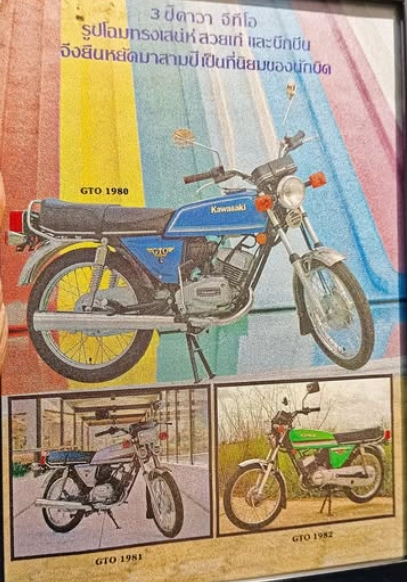
Then, distance was an insurmountable barrier. It dictated where one could work, live, and exist. Now, distance is merely a calculation of time and fuel. The machine bridged this fundamental gap. The early 1980s required a utilitarian workhorse for emerging economies. Kawasaki answered with the GTO series. This specific archival advertisement documents a three-year reign of static perfection. It is not merely a commercial endeavor attempting to sell molded plastic and stamped metal. It is the commercialization of predictable, reliable, and accessible human motion. It marks the era where mobility ceased to be a luxury and became a foundational human utility.
Category: Automotive
Brand: Kawasaki
The History
The Economic Crucible of the 1980s The dawn of the 1980s represented a distinct economic crucible across Southeast Asia. Nations were fundamentally transforming their societal structures. Agrarian lifestyles were rapidly yielding to urban industrialization. Cities expanded outward with frantic energy, severely outpacing the development of formal infrastructure. The physical space between the domestic hearth and the centers of labor widened exponentially. Distance became the primary friction in the daily life of the working class. To participate in this aggressively modernizing economy, the common citizen had to conquer this geographic distance. Bicycles lacked the necessary velocity and carrying capacity. Public transportation networks were nascent, unreliable, or entirely absent. Automobiles remained an unattainable luxury reserved for the upper echelons of society. This vast socioeconomic void demanded a highly specific mechanical solution. It required the mass democratization of the internal combustion engine. Japanese manufacturers understood this geographic and economic void with absolute clarity. They industrialized the necessary solution. They exported not just assembled metal components, but the very concept of independent mobility. The Engineering of the Shift: The Two-Stroke Ascendancy Enter the standard commuter motorcycle. Specifically, the Kawasaki GTO. It utilized a ruthlessly simple engineering formula designed for ultimate endurance. A tubular steel frame formed the unbreakable skeletal structure. At its heart sat a single-cylinder, two-stroke engine. It was entirely air-cooled, discarding the complexity and weight of liquid cooling systems. Crucially, Kawasaki engineered this engine to breathe through a rotary disc valve. This was Kawasaki's distinct and deliberate engineering choice for small displacement commuter machines. Unlike rudimentary piston-port designs, the rotary valve precisely altered the intake timing. It provided a significantly broader and more usable powerband. It generated necessary torque where the rider required it most. Low down in the revolution range. This torque was vital for pulling heavy, uncalculated loads. It was essential for navigating violently congested urban streets or rutted rural pathways. The mechanics of this machine were intentionally transparent. A rider possessing only fundamental tools and basic knowledge could rebuild the top end of the engine on the side of a dirt road. This was not an exercise in mechanical luxury. This was applied survival technology. It was engineered resilience. The Industrial War: Four-Stroke vs. Two-Stroke The Kawasaki GTO did not exist in an isolated market vacuum. The Japanese Big Four—Honda, Yamaha, Suzuki, and Kawasaki—were locked in an intense industrial war. The prize was absolute dominance over the developing world's transportation sector. Honda aggressively pushed the four-stroke agenda. They fielded machines like the CG110 and CG125. These utilized overhead valve pushrod engines. They were universally recognized as bulletproof, yet they carried a penalty of increased weight and mechanical complexity. Yamaha countered with their legendary RX series. These were high-revving, aggressive two-strokes. They were incredibly agile but demanded constant mechanical attention and high engine speeds. Suzuki offered the GP and A-series, reliable but often lacking distinguishing characteristics. The Kawasaki GTO positioned itself precisely in the center of this battlefield. It offered the raw mechanical simplicity and low weight of a two-stroke platform. However, it was deliberately tuned for longevity rather than outright performance. It was the pragmatist's machine. It represented a calculated balance between power, durability, and operational cost. The Philosophy of Stagnation: The Three-Year Thesis Examine the text within the artifact. It explicitly highlights a three-year lineage. It displays the 1980 model in a stark, utilitarian blue. It presents the 1981 model in an unpretentious, industrial silver. It concludes with the 1982 model in the brand's iconic racing green. This is a highly deliberate industrial narrative crafted by the advertising agency. In an era where Western consumer culture was rapidly adopting the concept of planned obsolescence, this advertisement does the opposite. It loudly sells continuity. It sells the profound lack of change as a paramount virtue. The core silhouette remains stubbornly static. The fundamental engineering remains entirely untouched over the thirty-six months. The Thai copy translates roughly to: "Standing firm for three years as a favorite." This is a testament to the engineering philosophy of getting it exactly right upon the first iteration. The historical shift here is entirely psychological. The consumer is trained to stop seeking the novel and the new. The consumer begins to place ultimate value on the proven, the tested, and the unchanging. Consistency became the ultimate commodity. The Societal Impact and Localized Mobility We must contextualize this artifact within the specific societal framework of Thailand. In this environment, the motorcycle transcends the definition of a mere vehicle. It is the undisputed lifeblood of the micro-economy. It birthed the "Win" motorcycle taxi system, moving millions through gridlocked concrete arteries daily. It served as the primary delivery apparatus for goods, services, and food. It routinely functioned as a transport vessel for entire families of four or five. The Kawasaki GTO became a foundational pillar of this localized, aggressive mobility network. It literally democratized distance for the working class. An agrarian worker could transport their harvest to the market before the sun peaked. A factory worker could reliably commute from the rapidly expanding, affordable suburbs into the dense urban industrial zones. The two-stroke internal combustion engine accelerated massive economic participation. It allowed human energy to be expended on labor rather than merely surviving the commute to that labor. The Inevitable Twilight of the Blue Smoke Finally, we must view this printed advertisement as a historical tombstone. It inadvertently marks the absolute apex of an era that is now permanently closed. The relentless march of global environmental regulations altered the trajectory of engineering. The modern necessity for stringent fuel efficiency doomed the architecture. The undeniable, visible emissions of burning a mixture of oil and gasoline together finalized the execution. The two-stroke street motorcycle was legislated out of existence. The characteristic blue smoke that once served as the visual symbol of forward progress eventually became universally recognized as a symbol of unacceptable pollution. The Kawasaki GTO represents a specific, closed technological window in human history. It was a raw, analog time before the advent of complex electronics. Before the mandate of precision electronic fuel injection. Before the implementation of restrictive catalytic converters. It was an era when a functioning spark plug, a clean carburetor, and a steady, unmeasured supply of two-stroke oil were the only prerequisites for achieving forward momentum. The era is gone, but the shift it caused in how humanity perceives distance remains eternal.
The Paper
This artifact is preserved on standard 1980s commercial publication stock. It possesses a weight of approximately 80 to 90 GSM. The surface features a mild coated gloss, typical of period magazine inserts or dealership promotional flyers. The printing method is traditional offset lithography. Under heavy magnification, the distinct, overlapping CMYK rosette patterns are clearly visible, revealing the mechanical nature of the color reproduction. The physical degradation is a testament to the passage of time. The paper is undergoing slow, inevitable oxidization. Acidic compounds within the wood pulp are reacting with atmospheric moisture, causing the edges to yellow and brittle. The ink pigments are shifting at different rates; the cyan and magenta elements hold their saturation reasonably well, while the yellows are beginning to retreat into the background. The artifact itself is a clock, slowly ticking toward its own physical dissolution, even as it preserves the memory of the machines printed upon it.
The Rarity
Classification: Class A (High Contextual Value) This specific artifact does not command exorbitant prices in the global antiquarian market. Mass-produced commercial advertising from the late 20th century rarely does. However, its rarity is not defined by its financial valuation, but by its contextual gravity. It is a Class A artifact within our archival framework. It survives as a vital piece of socio-industrial evidence. It documents the precise moment when Japanese manufacturing solidified its grip on Southeast Asian transportation norms. Finding these prints in intact, legible condition is becoming increasingly difficult as humidity and time consume the fragile paper stock of that specific era.
Cite this article
- MLA
- Naodhinsuk, Ronin. “The Time Traveller's Dossier : Kawasaki GTO - The Two-Stroke Shift (TEST).” The Record Institute, 22 May 2026, https://therecord.institute/journal/the-time-travellers-dossier-kawasaki-gto-the-two-stroke-shift-test.
- APA
- Naodhinsuk, R. (2026, May 22). The Time Traveller's Dossier : Kawasaki GTO - The Two-Stroke Shift (TEST). The Record Institute. https://therecord.institute/journal/the-time-travellers-dossier-kawasaki-gto-the-two-stroke-shift-test
- CHICAGO
- Naodhinsuk, Ronin. 2026. “The Time Traveller's Dossier : Kawasaki GTO - The Two-Stroke Shift (TEST).” The Record Institute, May 22, 2026. https://therecord.institute/journal/the-time-travellers-dossier-kawasaki-gto-the-two-stroke-shift-test.