The Time Traveller's Dossier : Kearney & Trecker - The Industrial Fix for Post-War Scarcity
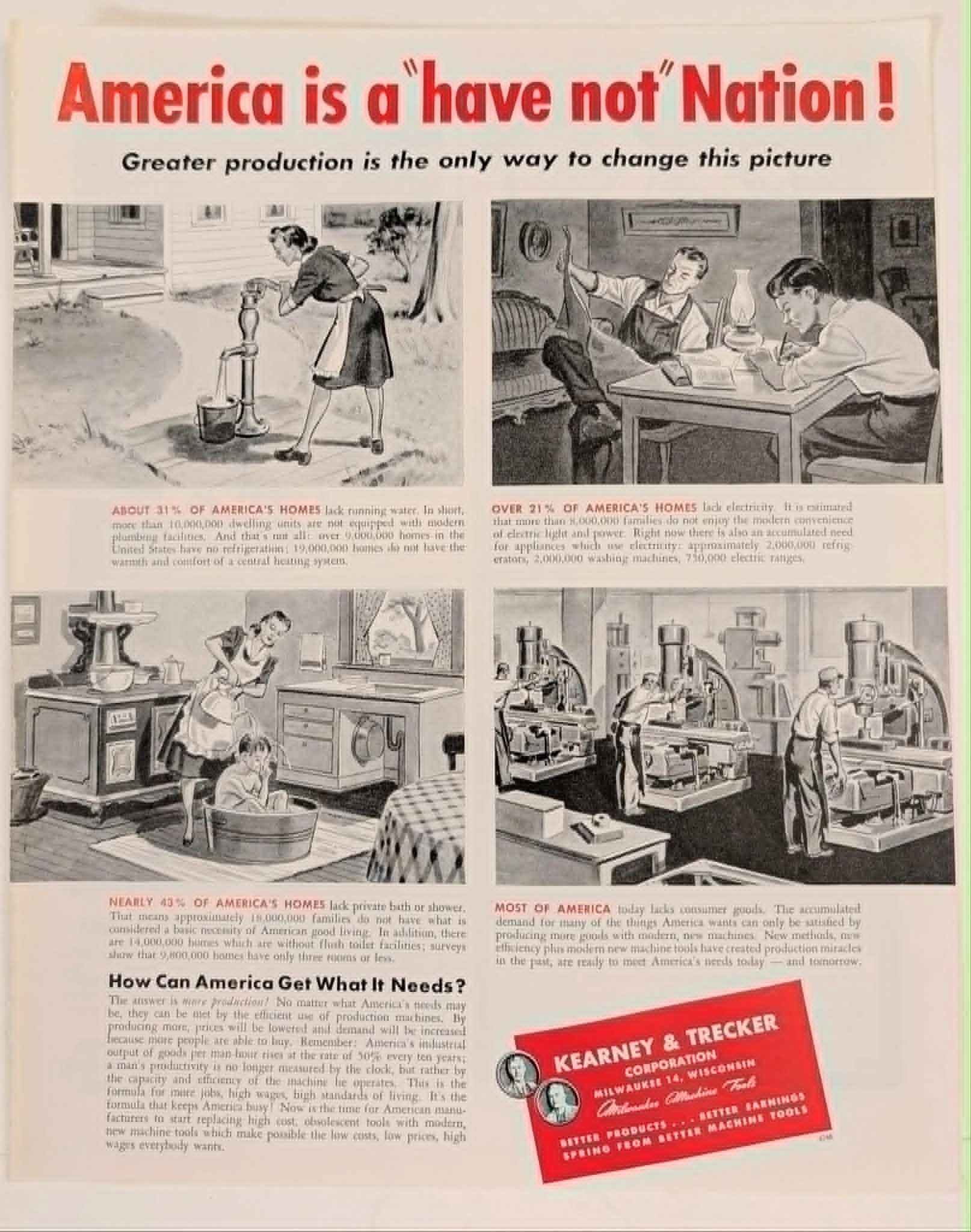
We view history backward, through the comfort of the present. We see the victor of a global conflict and assume immediate, universal prosperity. We assume the end of war equates to the birth of a consumer utopia. This artifact shatters that illusion. It is a document from the immediate post-war era. The guns have fallen silent, yet within the borders of the most powerful nation on earth, an invisible crisis reigns. Millions of citizens are pumping water by hand. Millions are reading by the dim flicker of kerosene. This is not a plea for charity. It is a corporate manifesto. It is the stark realization that before a nation can consume, it must build the capacity to produce. The artifact highlights a profound societal shift: the transition from a wartime economy of total sacrifice to a peacetime economy paralyzed by mechanical obsolescence. It frames the solution not in the hands of politicians, but in the steel jaws of the milling machine.
Category: Technology
Brand: Kearney & Trecker
The History
The Illusion of the American Zenith To comprehend the gravity of this document, one must dismantle the myth of the immediate post-war American utopia. The collective, sanitized memory dictates that upon the surrender of the Axis powers, the United States glided into a golden age. We picture sprawling suburbs, gleaming appliances, and an infinite parade of consumer goods. This advertisement, titled "America is a 'have not' Nation!", serves as a brutal historical corrective. America was victorious, but America was structurally exhausted. The preceding two decades had been defined by catastrophic interruption. The Great Depression of the 1930s had paralyzed domestic infrastructure development, drying up capital and halting expansion. Following that, the total war effort of the early 1940s commandeered every ounce of steel, every sheet of rubber, and every hour of manufacturing capacity for the military industrial complex. The domestic sphere was locked in a state of suspended animation. The artifact quantifies this stagnation with chilling precision. Thirty-one percent of homes lacked running water; twenty-one percent lacked electricity; and forty-three percent lacked a private bath or shower. These are not the statistics of an empire at its zenith. These are the metrics of a developing nation struggling under the weight of its own victory. The Logistics of Deprivation and the Gathering Storm of Demand The copy does not merely list numbers; it outlines a profound logistical bottleneck that threatened the stability of the burgeoning post-war order. Ten million dwelling units existed without modern plumbing, while eight million families lived without electric light. Fourteen million homes were without flush toilets, a statistic that underscores the primitive conditions persisting despite the nation's technological prowess in the aeronautical and naval sectors. A storm was gathering. The text speaks urgently of "accumulated demand". Millions of returning soldiers were mobilizing, and the GI Bill was fueling an unprecedented hunger for housing and normal domestic life. A massive demographic explosion was imminent. However, a house is merely a wooden shell without infrastructure. It requires a nervous system of copper wiring and a digestive tract of indoor plumbing. It requires the modern miracles of refrigerators, washing machines, and electric ranges. The artifact calculates a desperate need: two million refrigerators and two million washing machines. The existing domestic supply chain was entirely paralyzed in the face of this surge. One cannot simply legislate consumer goods into existence; they must be forged, stamped, and assembled. To manufacture these goods at an unprecedented scale, the nation required an intermediate, foundational layer of technology—the machines that build the machines. The Mechanics of the Mother Machine This brings us to the architect of the artifact: Kearney & Trecker Corporation, located in Milwaukee, Wisconsin. They did not manufacture the refrigerators or the bathtubs. They sold "Milwaukee Machine Tools," specifically masters of the milling machine. In the taxonomy of industrial equipment, a machine tool is the apex predator, often referred to as a "mother machine." It is heavy, power-driven equipment utilizing hardened cutting tools to sheer, shape, and bore solid metal into precise, complex geometries. Without advanced milling machines, industrial mass production halts. One cannot manufacture the complex die-cast molds for a refrigerator's compressor casing or precision-cut the intricate gears for a washing machine's transmission without this foundational equipment. By placing this advertisement in a broad, general-interest business publication, Kearney & Trecker executed a brilliant bypass maneuver. They circumvented their immediate technical buyers—the factory floor managers—and spoke directly to the public consciousness and corporate investors. They elevated their product from factory equipment to a tool of national salvation. The Competitive Landscape of the Iron Age The era was marked by fierce, unforgiving competition. The American machine tool industry was the indisputable backbone of global industrial dominance. Kearney & Trecker operated in a crowded arena alongside giants like the Cincinnati Milling Machine Company, Bridgeport Machines, and Brown & Sharpe. Everyone fought viciously for the tidal wave of post-war capital expenditure. Most competitors relied on terrestrial marketing, selling technical specifications—spindle speeds, horsepower, and table feed rates. Kearney & Trecker shifted the paradigm. They abandoned the simple spec sheet and engaged in macroeconomic philosophy. They positioned themselves not as vendors of cast iron, but as enablers of the new American standard of living. They explicitly linked their corporate output with the eradication of national poverty. The equation they presented was ruthless and elegant: Obsolete tools equal high costs and low volume. Modern machine tools equal greater production. Greater production drastically lowers per-unit costs, translating to lower consumer prices. Lower prices, combined with sustained high wages, eradicate the "have not" status. This was the purest distillation of mid-century industrial capitalism ever committed to paper. The Labor-Capital Paradigm Shift Hidden within the copy is a philosophical pivot that would define the rest of the twentieth century. The text states with absolute authority: "A man's productivity is no longer measured by the clock, but rather by the capacity and efficiency of the machine he operates". This sentence marks the definitive, psychological transition from human-centric labor to machine-centric capital. It is the ultimate evolution of Taylorism. The burden of economic output is officially removed from the physical muscle and stamina of the human worker and transferred entirely to the engineering, the rigidity, and the speed of the machine tool. This message was a strategic necessity for the era. The post-war years were highly volatile; labor unions had grown immensely powerful, and 1946 saw the largest wave of labor strikes in American history. Kearney & Trecker provided the capitalist counter-narrative, arguing that simply paying higher wages without increasing output would only trigger crippling, runaway inflation. The only sustainable method to pay a worker more while charging a consumer less was to drastically increase per-capita output. The machine tool became the mechanical lever that allowed the worker to earn a premium wage while driving down the cost of goods. The factory floor, depicted in the lower right quadrant of the advertisement, represents this hyper-rational future—orderly, mechanized, and relentlessly efficient.
The Paper
This artifact is suspended on standard mid-century publication stock, almost certainly a 70 GSM coated groundwood paper. This was the workhorse material for heavy-circulation business magazines of the 1940s, designed for speed and volume, not for eternity. The printing utilizes a high-capacity offset lithography process. The visual presentation relies on a striking, economical two-color separation. Standard, dense black ink handles the extensive typography and the highly detailed halftone illustrations, violently punctuated by a bold, urgent red spot color. Time acts as both a destroyer and a curator. The inevitable oxidation of the lignin within the cheap paper fibers has warmed the base tone. What was once a stark, industrial white has degraded into a muted, archival cream. The ink remains deeply embedded in the porous, unembossed surface, reflecting an era where the rapid dissemination of an idea superseded the physical luxury of the medium. The decaying paper itself stands as a testament to the fleeting nature of the present, constantly overridden by the industrial progress the advertisement demands.
The Rarity
Classification: Class A (Contextual Ephemera) This is not a culturally ubiquitous consumer brand advertisement. It is not selling the glamour of a soft drink or the freedom of an automobile. Its rarity is derived entirely from its immense ideological weight. It earns a Class A classification due to its supreme value as a socio-economic baseline document. Finding corporate-to-corporate advertisements that actively and intentionally deconstruct the myth of immediate post-war prosperity is exceedingly uncommon. Most advertising of this specific era leaned heavily into naive, utopian futurism. This artifact chose a different path—gritty realism—highlighting the dirt, the darkness, and the profound domestic deprivation to justify the sale of heavy machinery. Its value to historians of technology, labor, and economics far outstrips its nominal market price in the vintage ephemera trade.
Cite this article
- MLA
- Naodhinsuk, Ronin. “The Time Traveller's Dossier : Kearney & Trecker - The Industrial Fix for Post-War Scarcity.” The Record Institute, 27 May 2026, https://therecord.institute/journal/the-time-travellers-dossier-kearney-trecker-the-industrial-fix-for-post-war-scarcity.
- APA
- Naodhinsuk, R. (2026, May 27). The Time Traveller's Dossier : Kearney & Trecker - The Industrial Fix for Post-War Scarcity. The Record Institute. https://therecord.institute/journal/the-time-travellers-dossier-kearney-trecker-the-industrial-fix-for-post-war-scarcity
- CHICAGO
- Naodhinsuk, Ronin. 2026. “The Time Traveller's Dossier : Kearney & Trecker - The Industrial Fix for Post-War Scarcity.” The Record Institute, May 27, 2026. https://therecord.institute/journal/the-time-travellers-dossier-kearney-trecker-the-industrial-fix-for-post-war-scarcity.