The Time Traveller's Dossier : Kennecott Copper - Airborne Magnetometry
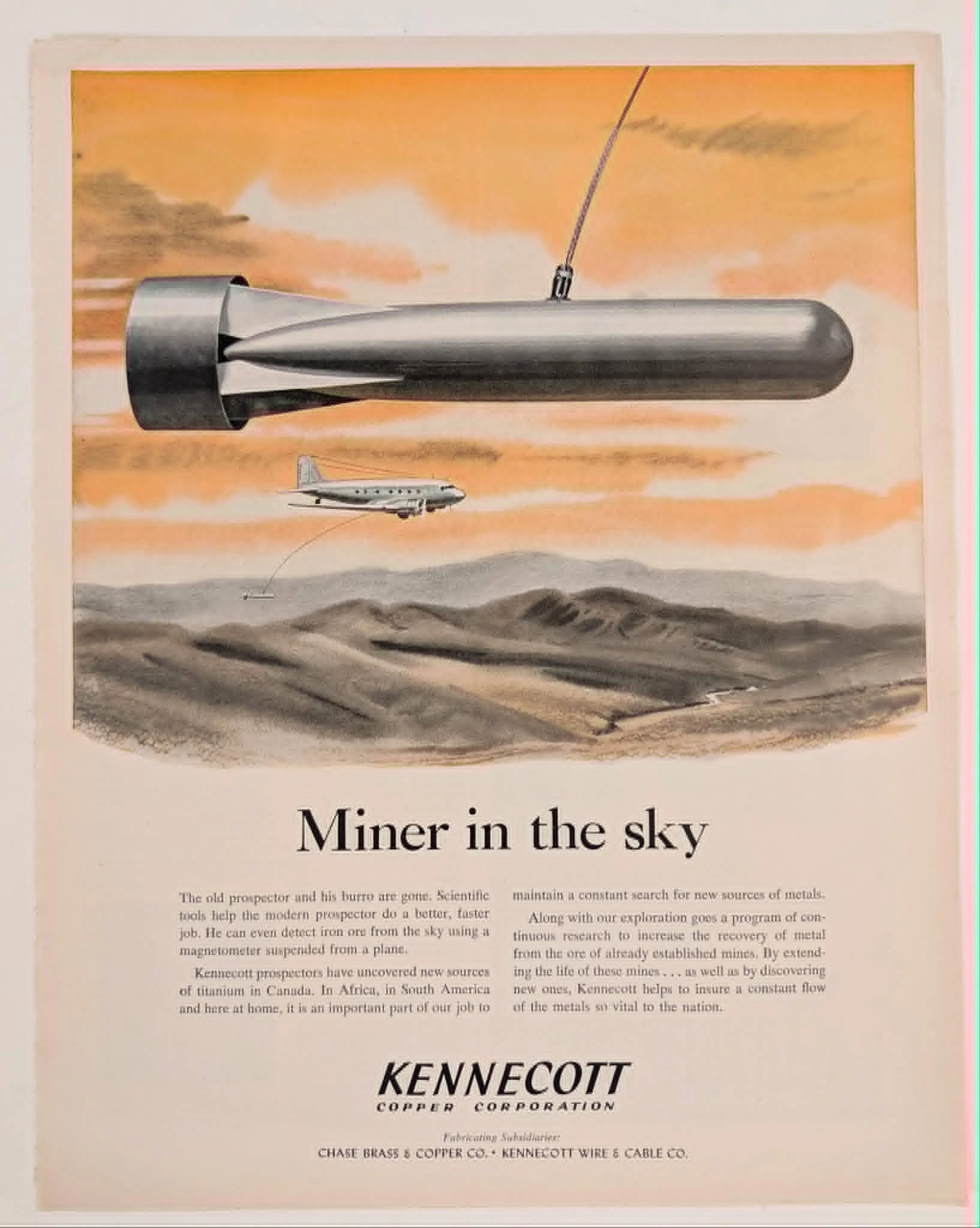
The era of intuition is dead. The era of the algorithm has begun. Before this moment, the earth was read through calloused hands. It was mapped by boots on dust, by pickaxes striking rock, by the slow, grueling labor of the lone prospector. The search for resources was a physical dialogue with the terrain. This artifact documents the severance of that relationship. It announces a profound shift in human interaction with the planet. We no longer needed to touch the earth to extract its secrets. We could fly above it. We could scan it. We could render its invisible magnetic forces into actionable, profitable data. The "Miner in the sky" is not just an advertisement. It is the declaration of a new industrial paradigm. Remote sensing had arrived. The earth was no longer a landscape. It was a grid of anomalies waiting to be decoded.
Category: Technology
Brand: Kennecott Copper
The History
The Death of the Pickaxe and the Burro The opening line of the artifact’s copy is a corporate obituary. "The old prospector and his burro are gone." It is stated without sentimentality. It is stated as a matter of scientific triumph. For centuries, geology was an artisanal pursuit. It relied on surface outcroppings. It relied on the intuitive reading of typography. It was limited by human endurance and terrestrial friction. Mountains, jungles, and ice caps were formidable barriers to the acquisition of capital in the form of mineral wealth. Kennecott Copper Corporation, a titan of the mid-twentieth century, recognized that intuition could not sustain a global empire. The post-war economy demanded an acceleration of extraction. The lone prospector was a bottleneck. Science, specifically physics applied at scale, was the solution. The advertisement celebrates the mechanization of discovery. It replaces the human element with the precise, unblinking eye of the magnetometer. This was a monumental shift in the psychology of resource acquisition. The earth was transformed from a mysterious, resistant entity into a transparent dataset. Swords to Plowshares: The Atomic Age Magnetometer The technology celebrated here was not born of peaceful intent. It was forged in the crucible of the Second World War. The trailing silver cylinder shown in the illustration is a direct descendant of the Magnetic Anomaly Detector (MAD). During the battle of the Atlantic, Allied aircraft needed a way to hunt submerged German U-boats. Radar could not penetrate the ocean depth. However, a massive steel submarine creates a localized distortion in the Earth’s natural magnetic field. Physicists developed airborne magnetometers sensitive enough to detect these invisible distortions from the sky. When the war ended, the technology was demobilized. Geophysicists, notably those at Gulf Research and Development Company, realized that if a sensor could detect a steel submarine in water, it could detect an iron ore body in solid rock. Military surplus was adapted for corporate dominion. Kennecott adopted this technology to map vast swaths of the planet. The instrument, known colloquially as a "bird," was towed behind an aircraft. This trailing distance was critical. It isolated the highly sensitive fluxgate sensor from the magnetic interference generated by the airplane's own steel engines and electronic systems. The Mechanics of Unseen Extraction To understand the artifact is to understand the physics it represents. The fluxgate magnetometer housed within that silver torpedo is an instrument of profound elegance. It relies on the principle of magnetic saturation. Two parallel cores of highly permeable magnetic material are wrapped in drive coils. An alternating current is pushed through these coils, driving the cores in and out of magnetic saturation in opposing directions. In a perfect void, these opposing magnetic fields cancel each other out. But when introduced to the Earth's ambient magnetic field, a bias is introduced. A secondary "sense" coil measures this minute electrical asymmetry. This allows the instrument to record tiny fluctuations in the magnetic field far below the aircraft. Iron ore (magnetite, hematite) produces massive magnetic signatures. However, Kennecott was primarily a copper company, and they explicitly mention searching for titanium. Neither copper nor titanium is highly magnetic. The magnetometer was used to find "indicator" minerals. Geologists mapped the structural geology of the deep crust—faults, folds, and intrusions where valuable, non-magnetic ores were likely to be trapped alongside magnetic ones. They were reading the shadows of the rocks. The Post-War Resource Hunger The timeline of this artifact aligns with the explosive economic expansion of the 1950s. The world was rebuilding from ashes. The Cold War had begun. There was an unprecedented demand for base and strategic metals. The electrification of the burgeoning American suburbs required unimaginable quantities of copper. Every new home, every new appliance, every mile of telephone wire demanded the conductive metal. Simultaneously, the dawn of the jet age and the aerospace race created a critical hunger for titanium. Titanium offered the strength of steel at a fraction of the weight, and it could withstand the extreme temperatures of jet propulsion. Kennecott’s copy reflects this geopolitical reality. "In Canada. In Africa, in South America and here at home." The corporation operated on an imperial scale. The magnetometer allowed them to survey thousands of square miles of hostile terrain—the Canadian shield, the African interior, the Andes—in a matter of days. What would have taken a team of men with burros a decade was accomplished in a single afternoon flight. This was not just exploration; it was the rapid, systemic cataloging of the earth's remaining wealth. The Monolith: Kennecott, Chase, and the Supply Chain The artifact reveals its true structural power at the bottom of the page. "Fabricating Subsidiaries: CHASE BRASS & COPPER CO. • KENNECOTT WIRE & CABLE CO." This is the architecture of vertical integration. Kennecott did not simply extract raw earth. They controlled the entire lifecycle of the material. They owned the magnetometer that found the ore. They owned the massive open-pit mines, like Bingham Canyon, that ripped it from the ground. They owned the smelters that refined it. And through Chase Brass and Kennecott Wire, they owned the factories that turned that raw copper into the very arteries of the modern industrial world. The advertisement is a projection of absolute self-sufficiency. From the sky to the subterranean depths, to the consumer's wall outlet, the corporation was omnipresent. The logo itself, set in bold, unyielding typography, anchors this reality. It sits heavy at the base of the page, the foundation upon which the ethereal "Miner in the sky" operates. The Philosophical Shift in Human Topography The ultimate significance of this artifact lies in the psychological distance it created. Aerial magnetometry detached the observer from the observed. The geologist no longer needed to break a sweat, touch the soil, or feel the texture of the rock. The landscape was flattened into a two-dimensional contour map of magnetic intensities. This was the beginning of the earth as an abstract data environment. It paved the way for satellite telemetry, multispectral imaging, and the modern algorithmic mining industry. The artifact captures the precise moment when human intuition surrendered to mechanical precision. We stopped looking at the ground. We started looking at the dials. The earth was conquered not by the pickaxe, but by the airborne sensor. The burro was dead. The machine had taken the sky.
The Paper
The physical substrate of this artifact is a testament to mid-century mass media production. It is printed on standard, machine-made magazine stock from the post-war era, likely falling between an 80 to 90 GSM weight. The paper is predominantly composed of chemical wood pulp. This inherently acidic composition dictates its current state of preservation. We observe localized oxidation, commonly known as foxing, particularly at the margins where the artifact was exposed to atmospheric moisture and fluctuating temperatures. The printing technique is a high-volume, continuous-feed rotary letterpress or early offset lithography. Under magnification, the image of the magnetometer and the aircraft dissolves into a precise, mathematical grid of halftone dots. The smooth, gradient transitions in the sky—from raw ochre to soft sepia—are illusions created by the varying density of these monochromatic ink deposits. The paper is not merely a carrier of the image; its slow decay is a physical recording of the decades that have passed since the era of the sky miner began.
The Rarity
Classification: Class A This document possesses a high degree of contextual and historical significance, securing its Class A designation. Physically, as a clipping from a widely circulated national periodical of the mid-20th century, it is not uniquely rare in the open market. Thousands of copies were printed. However, its true rarity lies in its conceptual preservation. It perfectly encapsulates a pivot point in the history of geophysics and industrial capitalism. Finding an artifact that so cleanly and unapologetically articulates the transition from artisanal labor (the burro) to remote militarized sensing (the magnetometer) is uncommon. Its value is derived from its utility as a historical anchor point for technological evolution, rather than pure scarcity of the physical pulp.
Cite this article
- MLA
- Naodhinsuk, Ronin. “The Time Traveller's Dossier : Kennecott Copper - Airborne Magnetometry.” The Record Institute, 26 May 2026, https://therecord.institute/journal/the-time-travellers-dossier-kennecott-copper-airborne-magnetometry.
- APA
- Naodhinsuk, R. (2026, May 26). The Time Traveller's Dossier : Kennecott Copper - Airborne Magnetometry. The Record Institute. https://therecord.institute/journal/the-time-travellers-dossier-kennecott-copper-airborne-magnetometry
- CHICAGO
- Naodhinsuk, Ronin. 2026. “The Time Traveller's Dossier : Kennecott Copper - Airborne Magnetometry.” The Record Institute, May 26, 2026. https://therecord.institute/journal/the-time-travellers-dossier-kennecott-copper-airborne-magnetometry.