The Time Traveller's Dossier : Keuffel & Esser - The Geometry of War
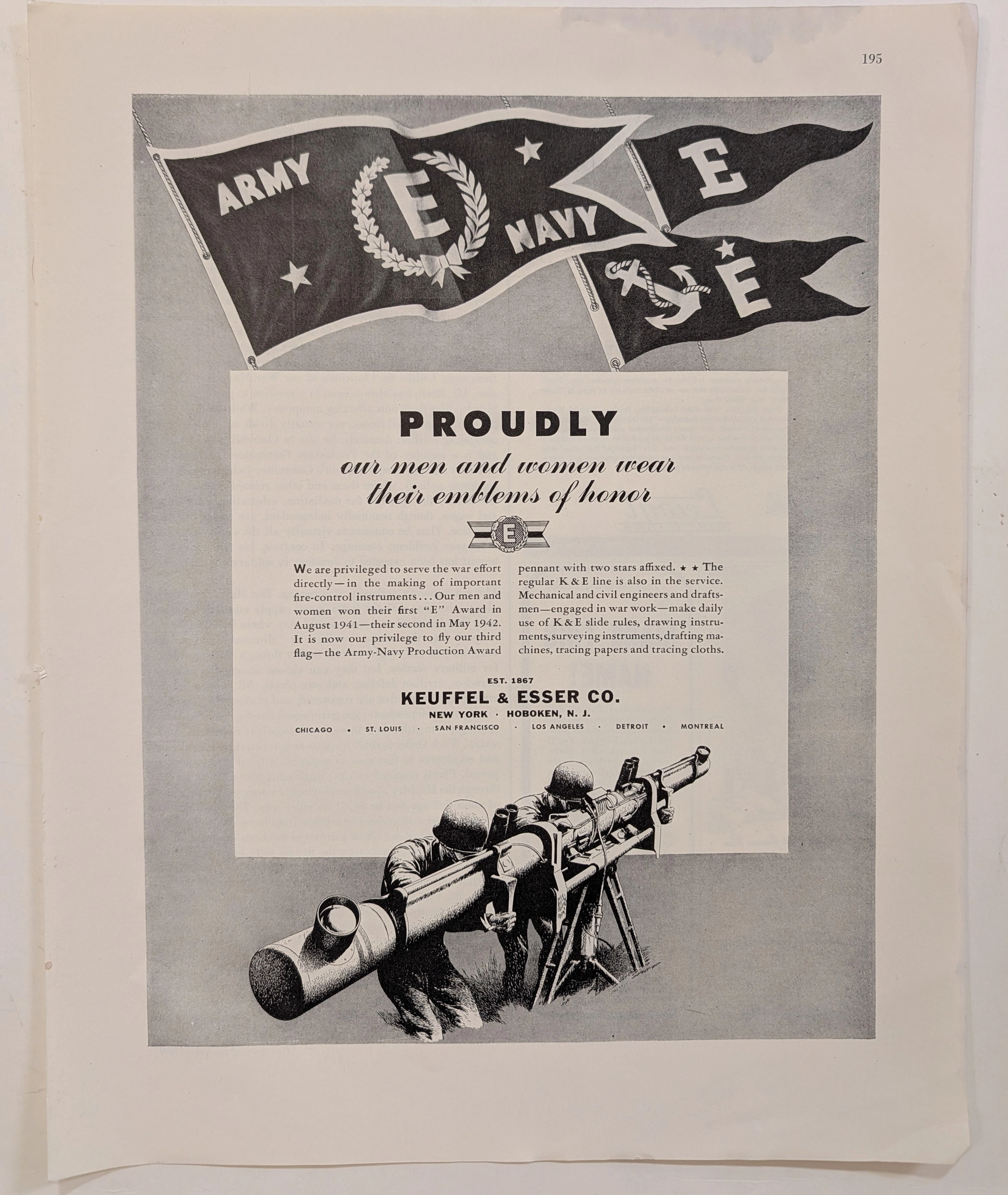
Before the microchip, there was the slide rule. Before the guided missile, there was the optical rangefinder. This fragment—a World War II-era advertisement for Keuffel & Esser Co. (K&E)—is not merely corporate boasting. It is a schematic of industrial survival. It documents a time when the fate of nations relied on the flawless manufacturing of brass, glass, and mechanical trigonometry. Then, warfare was a problem of analog geometry. The calculation of distance and trajectory required human operators physically manipulating gears and prisms to solve spatial equations in real-time. Now, warfare is a problem of algorithmic processing. Distance is calculated by lasers; trajectory is automated by invisible silicon logic gates. The human eye has been removed from the mathematical equation of artillery. The problem of the mid-twentieth century was accuracy at an unprecedented scale and distance. The sky had become a battlefield, and the targets were moving at hundreds of miles per hour. The solution was the mass production of precision fire-control instruments by companies that previously drafted civilian blueprints. This artifact is the physical proof of that violent, mathematical mobilization.
Category: Other
Brand: Keuffel & Esser
The History
The Architecture of Measurement To understand this artifact, one must first dismantle the history of its creator. Keuffel & Esser Co. was not established to build weapons. Founded in 1867, K&E was the premier architect of American measurement. They were the undisputed titans of the drafting table. They manufactured the slide rules, the surveying transits, and the tracing papers that designed the modern United States. If a bridge was suspended, a skyscraper erected, or a dam poured during the late nineteenth and early twentieth centuries, it was likely calculated on a K&E slide rule and drafted on K&E paper. They were in the business of absolute precision. They dealt in fractions of a millimeter. When World War II erupted, the United States military realized that raw explosive power was useless without accuracy. The mechanisms of war had grown too fast and too distant for the naked eye. The government did not just need steel mills; it needed the masters of measurement. K&E was conscripted. Their transition from civilian engineering to military optical manufacturing represents a profound industrial pivot. The Geometry of the Invisible War Look at the bottom half of the artifact. Two soldiers, their faces obscured by the harsh steel of their M1 helmets, operate a massive, tubular device. This is a stereoscopic rangefinder, a critical component of anti-aircraft and coastal defense fire-control systems. During this era, warfare underwent a severe technological shift. The enemy was no longer standing across a field. The enemy was a heavy bomber flying at twenty thousand feet, or a battleship on the distant horizon. Hitting these targets required solving complex mathematical problems instantly. A shell fired from an anti-aircraft gun took time to reach its altitude. By the time the shell arrived, the plane had moved. The gunners had to aim at a predicted point in empty space. To find that point, they needed to know the exact distance to the target. This was the purpose of the instrument depicted. It was an analog computer. It functioned on the rigid laws of optical triangulation. The instrument features a long baseline tube with objective lenses at both ends. The human operator looks through the central eyepieces, utilizing their binocular vision to perceive depth. By adjusting mechanical dials, the operator manipulates internal prisms to merge the two separate optical paths into a single, unified stereoscopic image. The mathematics behind this physical act are governed by a foundational trigonometric principle. If B represents the fixed baseline distance between the two outer lenses, and θ represents the parallax angle created by focusing on the target, the distance D is mechanically solved within the instrument based on the equation: D= tan(θ) B The dial that the soldier turns is physically linked to a scale that reads out this calculated distance. There was no digital display. There was no battery. It was pure mechanical intelligence, reliant on flawless optical alignment. A deviation of a thousandth of an inch in the manufacturing of those prisms meant the artillery shell would miss its target by hundreds of yards. K&E's civilian obsession with perfection was weaponized. The Psychology of the Pennant The top half of the artifact is dominated by three flags. The central flag bears the letter "E" encased in a wreath, flanked by the words "ARMY" and "NAVY". Two stars are affixed to the pennant. This is the Army-Navy "E" Award for Excellence in Production. It is crucial to analyze this not as a mere decoration, but as an instrument of psychological warfare on the home front. The United States government understood that the factory worker was as vital as the infantryman. However, the factory worker was removed from the adrenaline and immediate consequence of combat. The "E" Award was designed to bridge that psychological gap. Instituted in 1942, it was awarded to facilities that demonstrated exceptional efficiency, quality control, and dedication to the war effort. It was incredibly rare. Only roughly five percent of the estimated 85,000 war contractors ever received the award. When a factory won, every employee was given a silver lapel pin. They were inducted into the military hierarchy. The text of the advertisement explicitly states, "Proudly our men and women wear their emblems of honor." It instilled a militarized sense of duty in the civilian workforce. The stars on the pennant are the true indicators of historical weight. A facility received the initial flag for their first award. To receive a star, they had to maintain that grueling, flawless level of production for an additional six months. The artifact documents that K&E won their first award in August 1941, their second in May 1942, and are now flying their third flag. This signifies over a year and a half of unbroken, high-stress, zero-defect manufacturing. It is a testament to the endurance of the American industrial machine. The Mobilization of the Draftsman The text block contains a quiet, yet deeply significant, secondary narrative. It reads: "Mechanical and civil engineers and draftsmen—engaged in war work—make daily use of K & E slide rules, drawing instruments, surveying instruments, drafting machines, tracing papers and tracing cloths." This paragraph highlights the invisible infrastructure of victory. Every tank, every bomber, every rifle, and every Liberty ship began as a line on tracing paper. Before the metal was stamped, it was drawn. Millions of blueprints were generated during the war. The slide rule was the calculator that built the Arsenal of Democracy. By mentioning this, K&E subtly reminds the reader that they are fighting the war on two fronts: directly, by building the fire-control optics, and indirectly, by supplying the tools that allow every other engineer in the country to do their job. The Historical Shift This piece of paper represents the absolute zenith of the analog era. It captures a moment just before a massive technological paradigm shift. The fire-control instruments built by K&E were the most advanced mechanical calculators ever conceived. They were marvels of gears, cams, and glass. But they were approaching their physical limit. Moving aircraft were becoming too fast for human operators to track manually. Even as this advertisement was printed, the seeds of its obsolescence were being sown. Deep in government laboratories, scientists were developing early radar targeting systems and the first electronic computers, like the ENIAC, which was initially designed specifically to calculate artillery firing tables. The shift was imminent: from the mechanical to the electronic. From the physical turning of a prism to the invisible processing of a vacuum tube. K&E mastered the physical universe just in time for the world to move into the electronic one. This artifact captures the proud, final roar of mechanical warfare before the dawn of the digital age.
The Paper
The substrate is a medium-weight, machine-made magazine stock, likely falling within the 60 to 70 GSM (Grams per Square Meter) range. Unlike the rough pulp of daily newspapers, this paper possesses a slight calendared finish. It was pressed between heavy steel rollers during manufacturing to create a smoother, tighter surface. This was a technical necessity. The printing method for the imagery is a high-resolution halftone screen. To reproduce the smooth gradients of the sky and the metallic sheen of the rangefinder, the original artwork—likely a highly detailed lithographic wash or charcoal illustration—was photographed through a mesh screen, breaking the continuous tones into thousands of microscopic dots. A rougher paper would have caused the ink to spread (dot gain), muddying the image. The calendared surface held the dots crisp and precise, mirroring the precision of the K&E instruments it advertised. The paper exhibits moderate oxidation. The edges have begun to yellow, a chemical reaction as the residual lignin within the wood pulp slowly breaks down upon prolonged exposure to ambient light and oxygen. It is aging gracefully, retaining the sharp contrast of its black carbon-based ink.
The Rarity
Classification: Class B From a purely numerical standpoint, artifacts of this nature are not exceedingly rare. Mass-market publications of the 1940s, such as Life, Time, and The Saturday Evening Post, were printed by the millions. Many were saved by families as historical keepsakes of the war years. However, its classification rises to Class B due to its highly specific contextual value. Most wartime advertisements focus on consumer goods promising a return to normalcy (refrigerators, cars) or emotional appeals (buying war bonds). Advertisements detailing the specific, highly classified nature of optical fire-control instruments and the precise tracking of the Army-Navy "E" Award milestones are narrower in scope. It holds immense value for military historians, industrial archaeologists, and historians of technology, serving as primary source evidence of the analog computing industry's role in global conflict.
Cite this article
- MLA
- Naodhinsuk, Ronin. “The Time Traveller's Dossier : Keuffel & Esser - The Geometry of War.” The Record Institute, 12 May 2026, https://therecord.institute/journal/the-time-travellers-dossier-keuffel-esser-the-geometry-of-war.
- APA
- Naodhinsuk, R. (2026, May 12). The Time Traveller's Dossier : Keuffel & Esser - The Geometry of War. The Record Institute. https://therecord.institute/journal/the-time-travellers-dossier-keuffel-esser-the-geometry-of-war
- CHICAGO
- Naodhinsuk, Ronin. 2026. “The Time Traveller's Dossier : Keuffel & Esser - The Geometry of War.” The Record Institute, May 12, 2026. https://therecord.institute/journal/the-time-travellers-dossier-keuffel-esser-the-geometry-of-war.