The Time Traveller's Dossier : Kodak Retina IIIc - Modular Era
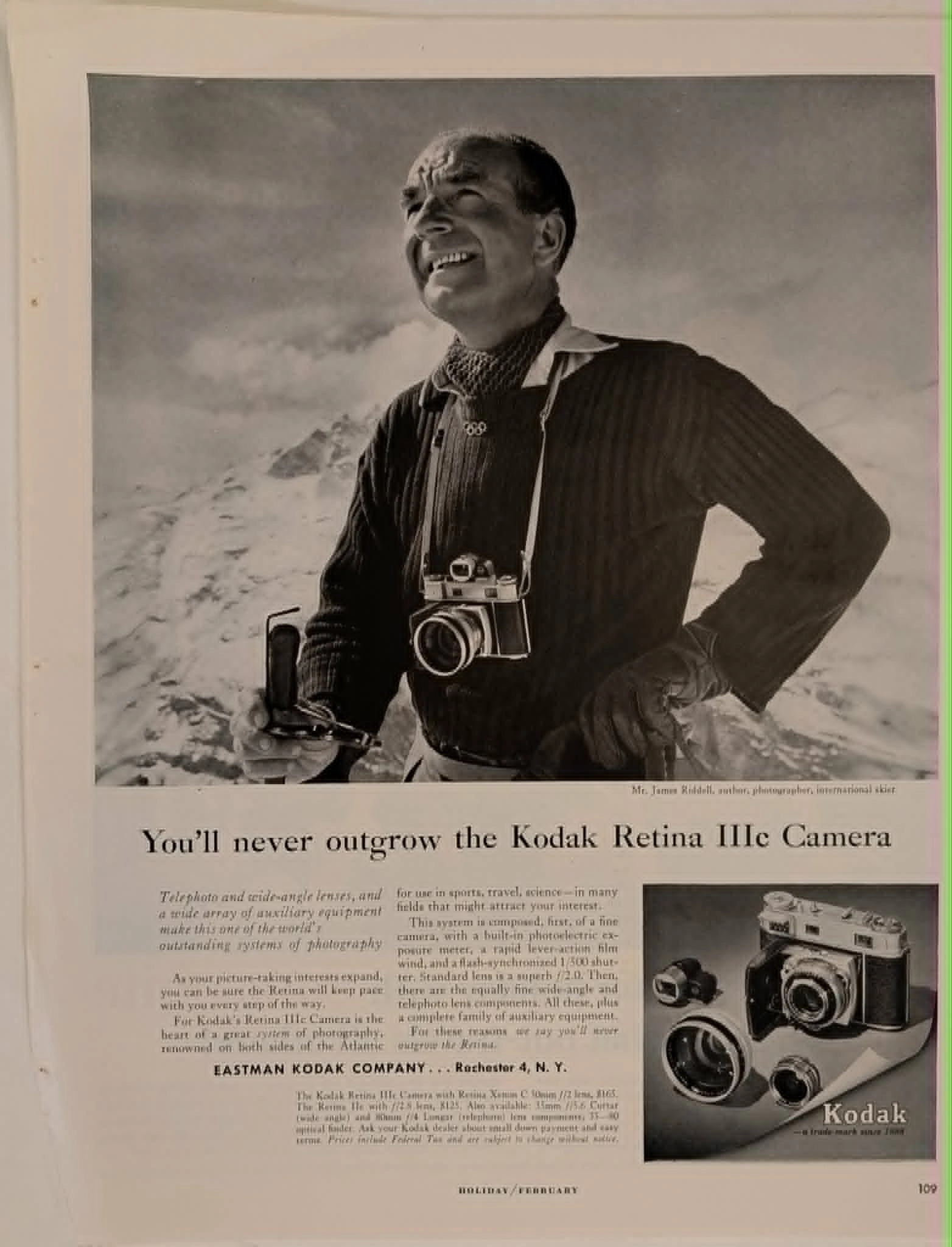
An artifact from 1956. A portal into the post-war mechanical boom. Before this era, cameras were largely binary. They were either simple, rigid boxes for the masses. Or they were complex, heavy contraptions for the professional. There was little middle ground. There was no concept of systemic growth for the consumer. This advertisement documents a critical pivot. The Eastman Kodak Company introduces a philosophy. "You'll never outgrow the Kodak Retina IIIc Camera." It is the shift from the singular product to the modular ecosystem. The user is no longer merely buying a tool. They are investing in a platform. A core unit designed to accept auxiliary components. Lenses. Finders. Meters. It solved the problem of technological obsolescence. It monetized the user's expanding curiosity. This is the genesis of modern consumer electronics architecture.
Category: Technology
Brand: Kodak
The History
The year is 1956. The global economy has stabilized following the Second World War. A new sociodemographic segment is solidifying in the West. The affluent middle class. They possess disposable income. More importantly, they possess leisure time. Travel is no longer exclusively a matter of migration or military deployment. Travel becomes recreation. It becomes a pursuit of experience. The setting of this artifact is telling. Snow-capped peaks. High altitudes. Skiing represented the apex of this new leisure class. It was a sport requiring specialized gear, travel, and a certain physical audacity. By placing the Retina IIIc in this environment, Kodak establishes a baseline. This is a machine for the capable. A machine for the adventurous. It is positioned far away from the domestic, living-room photography of previous decades. The subject is Mr. James Riddell. Author. Photographer. International skier. He is the archetype of the mid-century Renaissance man. He is not merely a model. He is a validation. His presence signals that the camera is a serious instrument. It implies that the technology can withstand the elements. It can document altitude, speed, and severe light conditions. This was a calculated psychological alignment. The Stuttgart Connection and Mechanical Lineage To understand the Retina IIIc, one must understand its origin. The camera is branded Eastman Kodak, Rochester, N.Y. Yet, its soul is entirely German. In 1931, Kodak acquired the Nagel Camera Company in Stuttgart, Germany. Dr. August Nagel was a visionary of optical engineering. This acquisition married American marketing capital with German mechanical precision. The Retina lineage began in 1934. It was responsible for a monumental shift in photographic history. The original Retina I introduced the 135 daylight-loading film cartridge. The standard 35mm cassette we recognize today. Before this, 35mm film had to be loaded in the dark. The Retina series was fundamentally about removing barriers while maintaining precision. The Retina IIIc, released in 1954 and advertised here in 1956, represents the zenith of this folding rangefinder lineage. It was the culmination of two decades of iterative refinement. It was not built in a vacuum. It was a deliberate response to the mechanical demands of the era. Engineering the Modular Illusion The headline proclaims: "You'll never outgrow..." This is a masterclass in consumer psychology and engineering compromise. The Retina IIIc was a folding camera. The lens board retracted into the body, covered by a clamshell door. This made it highly portable. A pocketable precision instrument. However, folding cameras historically could not change lenses. To change a lens entirely, a camera requires a focal-plane shutter situated near the film plane. The Retina IIIc utilized a Synchro-Compur leaf shutter. This shutter was housed within the lens assembly itself. This presented a massive engineering challenge. How does one create an interchangeable lens system around a fixed shutter? The engineers in Stuttgart devised a complex solution. They made the front lens elements interchangeable. The rear elements and the shutter remained fixed to the camera body. The artifact details this system. The standard lens is the Retina Xenon C 50mm f/2. A fast, highly capable piece of glass. To expand the system, the user could purchase the 35mm f/5.6 Curtar for wide-angle. Or the 80mm f/4 Longar for telephoto. This was technically demanding. It required meticulous optical calculations to ensure the interchangeable front elements matched perfectly with the fixed rear elements. It was heavier and more cumbersome than true interchangeable lenses. But it maintained the folding, compact nature of the camera. It was a compromise. Yet, it effectively delivered the "ecosystem" promise to the consumer. The Integration of the Exposure Meter The Retina IIIc features a built-in photoelectric exposure meter. This is another crucial technological marker of the era. Prior to this, exposure was calculated via external hand-held meters or rudimentary rules of thumb. The meter on the IIIc was a selenium cell. It did not require batteries. It generated a micro-current from ambient light. However, it was "uncoupled." This means the meter did not automatically adjust the aperture or shutter speed. The user had to read a light value from the meter's needle. Then, manually transfer that value to the exposure rings on the lens barrel. This interaction is profoundly significant. It represents a transitional phase in automation. The machine provides the data. The human executes the mechanical adjustment. It required the user to understand the physics of light. It kept the photographer engaged in the mechanical process. This level of interaction was considered a feature, not a flaw. It reinforced the narrative that the user was an "expert." The Competitive Landscape In the mid-1950s, the 35mm rangefinder market was a battlefield. In 1954, Ernst Leitz released the Leica M3. The M3 is widely considered the greatest rangefinder ever engineered. It utilized a focal-plane shutter and fully interchangeable lenses. It was the absolute pinnacle of professional 35mm photography. However, the Leica M3 was extraordinarily expensive. It was a luxury tool. Kodak positioned the Retina IIIc as the highly capable, upper-middle-class alternative. The artifact lists the price:
The Paper
The physical artifact is a page extracted from Holiday magazine, dated February 1956. It utilizes a mid-weight, coated mechanical paper, approximately 90 to 105 GSM. This stock was engineered specifically for high-volume, continuous web offset or rotogravure printing. The coating allows for sharper ink retention, crucial for photographic reproduction in advertising. The image is rendered via a dense halftone dot matrix. Under magnification, the grayscale tones of the snow and the shadow on the skier's sweater dissolve into precise geometric patterns of black ink. The aging process of the artifact is evident in the subtle oxidation of the paper fibers. The edges show a faint yellowing, a chemical reaction of residual lignin interacting with ultraviolet light over seven decades. This degradation is the physical mechanism of the artifact recording its own temporal journey. It is a fragile membrane holding a heavy mechanical truth.
The Rarity
Classification: Class A. Mass-produced in standard national circulation. Its scarcity is not defined by production numbers. Millions of these magazines were printed. Its value lies entirely in its high contextual significance. It is a flawless, intact record of a specific technological pivot. Surviving examples in this state of preservation—free from heavy foxing, moisture damage, or severe clipping—are increasingly uncommon. It serves as a primary source document for the history of industrial design and early modular consumer economics.
Cite this article
- MLA
- Naodhinsuk, Ronin. “The Time Traveller's Dossier : Kodak Retina IIIc - Modular Era.” The Record Institute, 6 June 2026, https://therecord.institute/journal/the-time-travellers-dossier-kodak-retina-iiic-modular-era.
- APA
- Naodhinsuk, R. (2026, June 6). The Time Traveller's Dossier : Kodak Retina IIIc - Modular Era. The Record Institute. https://therecord.institute/journal/the-time-travellers-dossier-kodak-retina-iiic-modular-era
- CHICAGO
- Naodhinsuk, Ronin. 2026. “The Time Traveller's Dossier : Kodak Retina IIIc - Modular Era.” The Record Institute, June 6, 2026. https://therecord.institute/journal/the-time-travellers-dossier-kodak-retina-iiic-modular-era.