The Time Traveller's Dossier : Lear 1959 - The Cold War Paradigm Shift
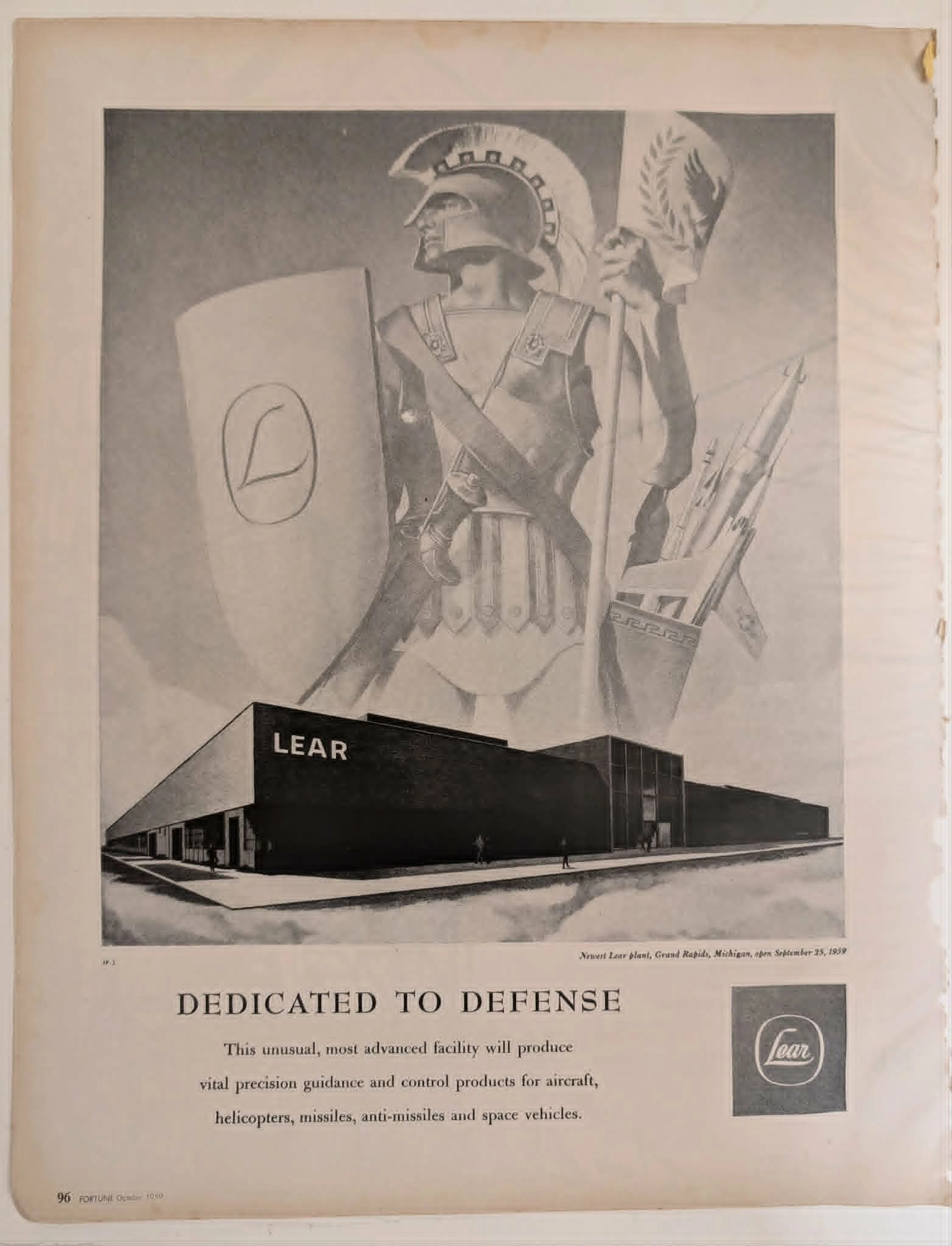
The year is 1959. The sky is no longer merely a ceiling. It is a theater of existential threat. Before this era, defense was a matter of human eyes. Human hands. Human calculation. By October 1959, human limitation became a liability. The threat moved too fast. It crossed oceans in minutes, not hours. The solution was not a better soldier. The solution was an autonomous, thinking machine. This artifact, plucked from the pages of Fortune Magazine, documents that precise pivot. It captures the moment when the architecture of survival shifted from the battlefield to the laboratory. From the trench to the sterilized assembly lines of Grand Rapids, Michigan. It is a monument to the industrialization of precision. The moment humanity handed the reigns of planetary defense over to gyroscopes, circuits, and silent mathematics.
Category: Technology
The History
The Geopolitical Thermostat: October 1959 To understand this artifact, one must first calibrate to the ambient temperature of 1959. It was a world vibrating with a quiet, atomic anxiety. Two years prior, in 1957, the Soviet Union launched Sputnik. A silver sphere, transmitting a simple beep, shattered the illusion of American geographic invulnerability. The oceans could no longer protect the homeland. Space had been weaponized, or at least, the trajectory to space had been. By autumn of 1959, the Cold War was settling into its most dangerous phase. September 1959—the exact month this Lear plant opened—saw Soviet Premier Nikita Khrushchev touring the United States. He visited farms. He visited Hollywood. And concurrently, both nations were stockpiling weapons capable of ending civilization in a single afternoon. The doctrine was deterrence. Mutually Assured Destruction. But deterrence required credibility. Credibility required weapons that could not miss. The Obsolescence of Human Reflex Warfare had reached a technological velocity that outstripped the human nervous system. In World War II, bombers flew in massive formations, dropping unguided munitions. They relied on statistics. Drop enough steel, and the target will be destroyed. The atomic age rendered this approach obsolete. When a single warhead carries the yield of ten thousand bombers, accuracy becomes the supreme metric. A missile traveling at Mach 15 cannot be steered by a human hand with a joystick. It requires guidance systems that can calculate trajectory, account for the rotation of the Earth, measure stellar positions, and execute course corrections in milliseconds. This was the problem Lear was built to solve. The Architect of Autonomy: Lear Incorporated William Powell Lear was an engineer of restless, erratic genius. History remembers him primarily for the Learjet, the ultimate symbol of corporate luxury. But before the private jets, Lear built the nervous systems of the American war machine. He pioneered the first practical car radio, creating Motorola. He developed the first autopilot systems for jet aircraft. By the 1950s, his company was deeply embedded in the Military-Industrial Complex. The Grand Rapids plant, immortalized in this advertisement, was not merely a factory. It was a clean-room fortress. The advertisement explicitly states its purpose: "vital precision guidance and control products for aircraft, helicopters, missiles, anti-missiles and space vehicles." Notice the progression of those nouns. Aircraft. Helicopters. Then, the terrifying leap. Missiles. Anti-missiles. Space vehicles. This is the exact evolutionary timeline of atmospheric dominance. The Landscape of Competitors Lear did not operate in a vacuum. The aerospace boom of the late 1950s created a fierce, highly lucrative ecosystem. Giants walked this landscape. Sperry Rand dominated naval and heavy bomber gyroscopics. Honeywell mastered flight controls. Bendix Aviation was a titan of avionics. To compete, Lear had to specialize in miniaturization. Their systems had to be lighter, faster, and more robust to survive the violent vibration profiles of a rocket launch. The Grand Rapids facility was an architectural declaration of intent. It signaled that Lear was scaling up to meet the demands of an infinite defense budget. The Philosophy of the Anti-Missile Perhaps the most chilling word in the advertisement's copy is "anti-missiles." In 1959, the concept of intercepting a ballistic missile in mid-flight was theoretically possible, but practically absurd. It was described as "hitting a bullet with a bullet." The US Army was developing the Nike Zeus system, an early anti-ballistic missile (ABM) program. The inclusion of this word signifies a profound shift in strategic thought. The military had accepted that offensive weapons would penetrate traditional defenses. The new defense was an automated counter-strike, a kinetic collision in the stratosphere. Lear was positioning itself not just as a provider of offensive capability, but as the shield. The guardian of the sky. The Industrialization of the Midwest Geography is strategy. Grand Rapids, Michigan, was chosen deliberately. Deep in the American Midwest, it was insulated from immediate coastal attack. More importantly, it sat adjacent to the greatest manufacturing engine in human history: the American automotive industry. Michigan possessed a workforce trained in mass production. But the assembly of a car is blunt labor compared to the assembly of a missile guidance system. The Lear plant required a new type of worker. Technicians. Engineers. Women assembling microscopic wires under magnifying lenses in dust-free environments. It was the transition from blue-collar mechanical labor to white-collar technological assembly. This was the blueprint for the modern tech hub, decades before Silicon Valley claimed the title. The Historical Shift: Delegating Survival This artifact represents a definitive philosophical boundary. Before the late 1950s, humanity fought its own wars. After the deployment of the systems built in facilities like this Lear plant, humanity became a spectator to its own defense. We built surrogate warriors. We filled them with liquid oxygen and solid propellants. We gave them mechanical brains composed of spinning brass and copper wire. And we placed our survival entirely in their algorithmic hands. This advertisement is not selling a product to a consumer. It is a corporate dossier, communicating to shareholders and government officials. It states: We have mastered the mathematics of the apocalypse. We are ready to build the future.
The Paper
The substrate of this artifact is highly communicative. Extracted from Fortune Magazine, October 1959. Fortune was the ledger of the American empire. Its paper stock was deliberately heavy, typically around 90 to 110 GSM (Grams per Square Meter), utilizing a matte or low-gloss finish to exude corporate sobriety. The printing technique is a classic mid-century web offset lithography. Look closely at the gradients in the sky behind the Spartan warrior. You will not see a smooth transition of gray. You will see a matrix of microscopic dots—the halftone pattern. In a monochromatic layout, the density of these black dots dictates the illusion of shadow and light. The ink, now embedded in the fibers for nearly seven decades, has oxidized slightly. The edges of the page, where exposed to ambient light and oxygen, exhibit mild foxing—a chemical degradation of the wood pulp. This paper is a chronometer. It records the slow decay of organic material, standing in stark contrast to the eternal, metallic perfection of the machines it advertises.
The Rarity
Classification: Class A Contextual Value: Immense. Market Value: Moderate. Vintage magazine advertisements are generally not scarce in a physical sense. Millions of copies of Fortune were printed. However, the contextual rarity elevates this specific artifact to a Class A designation within the archive. It is a pristine primary source document capturing a hyper-specific moment in the Cold War timeline: the exact month of Khrushchev's visit and the operational opening of a critical defense facility. Finding this specific page, untorn, with the halftone printing intact and the historical resonance fully understood, makes it a critical piece for any historian of the Military-Industrial Complex.
Cite this article
- MLA
- Naodhinsuk, Ronin. “The Time Traveller's Dossier : Lear 1959 - The Cold War Paradigm Shift.” The Record Institute, 17 May 2026, https://therecord.institute/journal/the-time-travellers-dossier-lear-1959-the-cold-war-paradigm-shift.
- APA
- Naodhinsuk, R. (2026, May 17). The Time Traveller's Dossier : Lear 1959 - The Cold War Paradigm Shift. The Record Institute. https://therecord.institute/journal/the-time-travellers-dossier-lear-1959-the-cold-war-paradigm-shift
- CHICAGO
- Naodhinsuk, Ronin. 2026. “The Time Traveller's Dossier : Lear 1959 - The Cold War Paradigm Shift.” The Record Institute, May 17, 2026. https://therecord.institute/journal/the-time-travellers-dossier-lear-1959-the-cold-war-paradigm-shift.