The Time Traveller's Dossier : LeRoy Neiman's Sketchbook - Charles Mingus and the Anatomy of Decline
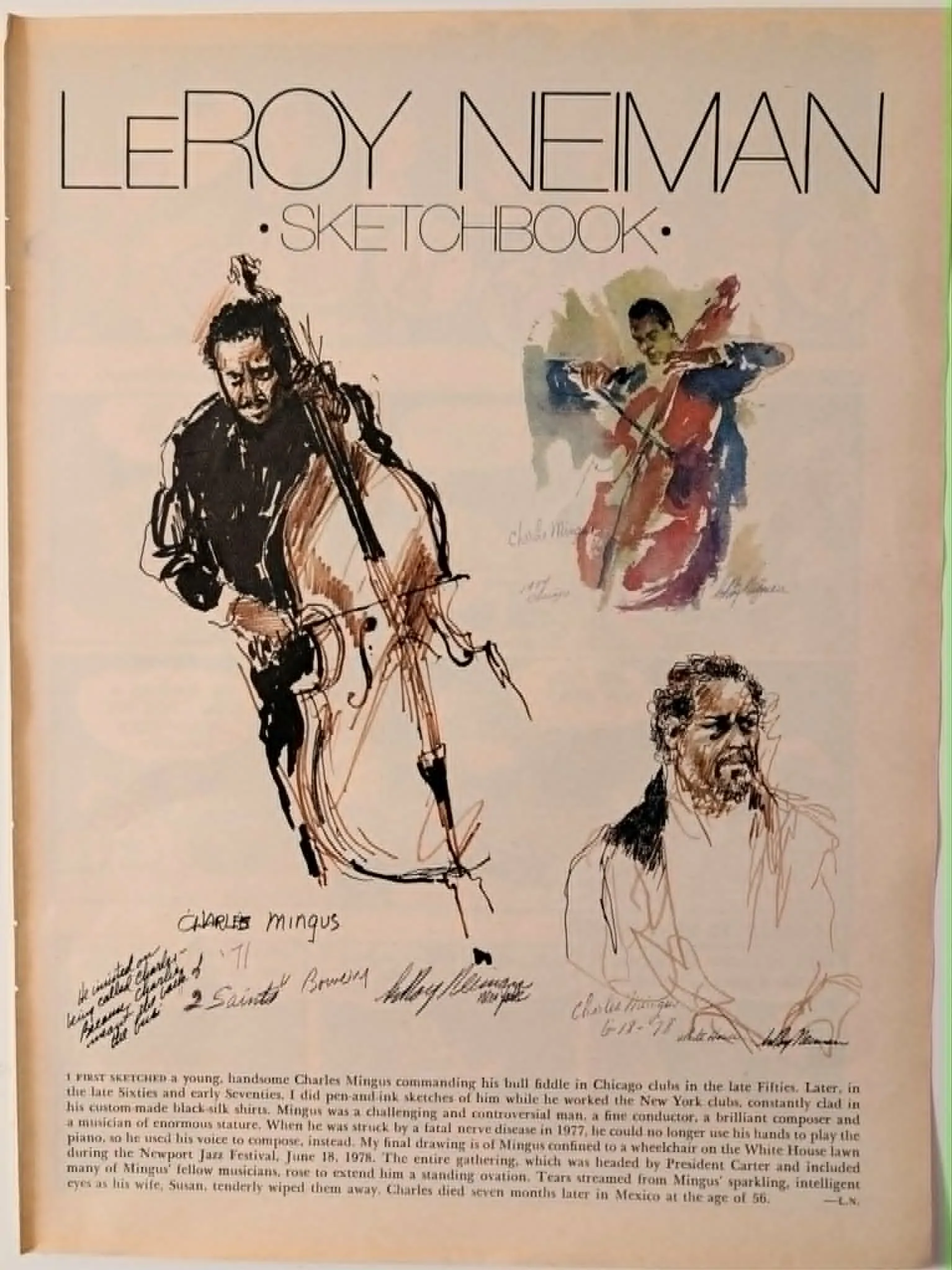
Then: The kinetic titan. The commander of the bull fiddle. The architect of organized acoustic chaos. Now: The immobile observer. The paralyzed genius. The man weeping on the White House lawn. This artifact is not merely a page from a mid-century publication. It is a neurological and cultural timeline compressed into three distinct visual moments. It documents a fundamental shift. We witness the terrifying transition from physical dominance to physical atrophy, dictated by a fatal nerve disease. We observe the cultural elevation of an art form—from the smoky, segregated clubs of 1950s Chicago to the manicured lawns of the 1978 American presidency. The hand that plucked the heavy strings failed. The mind that composed the symphonies persisted. The illustrator recorded both the peak and the collapse. This is the geometry of human mortality, captured in ink and pulp.
Category: Other
The History
The Era of the Jazz Reportage and the Illustrator as Journalist Before the ubiquity of the high-speed digital camera, the visual documentation of American culture relied heavily on the kinetic hands of reportage illustrators. LeRoy Neiman occupied a unique space in this ecosystem. Working prominently for publications that defined mid-century American masculinity and leisure, Neiman was dispatched to the front lines of sports and entertainment. His task was not to capture a photorealistic image, but to capture the velocity of the moment. In the late 1950s, jazz was undergoing a seismic ideological shift. It was shedding its identity as mere background music for dance halls and demanding recognition as high art. The clubs of Chicago were the laboratories for this evolution. Here, Neiman first encountered Charles Mingus. Mingus was not just a bassist; he was a composer of immense, terrifying complexity. The physical act of playing the upright bass—the "bull fiddle"—requires extreme physical exertion. It demands calluses, raw muscle, and leverage. Neiman’s early watercolor sketch from 1957 Chicago captures this exact exertion. The colors bleed and blur, mimicking the auditory vibration of thick steel strings slapping against a wooden fingerboard. The historical context here is crucial. This was a time when jazz musicians were cultural gladiators, fighting for acoustic space in crowded, noisy environments, armed only with their physical endurance and their instruments. The Politics of Nomenclature: "Charles" Not "Charlie" The artifact contains a handwritten note of immense historical weight: “He insisted on being called Charles - Because Charlie meant the back of the bus. ’71 2 Saints Bowery.” This single sentence encapsulates the entire racial and social struggle of mid-20th-century America. The diminutive "Charlie" was frequently used by white society to strip Black men of their dignity, a linguistic tool of subjugation rooted in the Jim Crow era. By 1971, the Civil Rights Movement had fundamentally altered the cultural landscape. Black artists were reclaiming their narratives and their names. Mingus’s refusal to accept the diminutive was a political act. It was a demand for the respect afforded to classical composers. He wore custom-made black-silk shirts. He was a conductor. He was a man of "enormous stature." The 1971 pen-and-ink sketch by Neiman reflects this era. The lines are aggressive, sharp, and uncompromising. Mingus looks combative, clutching the neck of his bass like a weapon. The shift is evident: from the colorful, atmospheric entertainer of the 50s to the hardened, uncompromising political artist of the 70s. The artist was no longer asking for a seat; he was demanding the entire room. The Neurological Collapse and the Persistence of the Mind The most profound shift documented in this artifact occurs between 1971 and 1977. The text notes pragmatically: “When he was struck by a fatal nerve disease in 1977, he could no longer use his hands to play the piano, so he used his voice to compose, instead.” The disease was Amyotrophic Lateral Sclerosis (ALS), often known as Lou Gehrig's disease. ALS is a progressive neurodegenerative disease that affects nerve cells in the brain and the spinal cord. For a musician whose entire life was predicated on fine motor control and physical strength, this diagnosis was a specific, cruel form of torture. The motor neurons deteriorate, the muscles atrophy, and paralysis sets in, yet the frontal lobe—the seat of intellect, memory, and creativity—remains entirely intact. This represents a harrowing technological and biological shift. The "technology" of Mingus's body failed. The hardware was destroyed. But the software—his genius—continued to run perfectly. Denied the use of his hands to interface with the piano or the bass, Mingus engineered a new workflow. He bypassed the physical instrument entirely, using his vocal cords to sing the complex melodies and arrangements into a tape recorder, or dictating them to arrangers. This is the ultimate triumph of human intellect over biological decay. The creation of art was no longer a physical act of striking keys or pulling strings; it became a purely cerebral transmission of data from his mind to the outside world. The Institutionalization of the Underground: The White House Lawn The final visual and textual anchor of this document is dated June 18, 1978. The location: The White House. The occasion: The Newport Jazz Festival, hosted by President Jimmy Carter. This represents the absolute apex of the cultural shift. Jazz, a musical form born in the marginalized, impoverished, and legally segregated Black communities of New Orleans, had finally reached the absolute center of global geopolitical power. President Carter, a southerner, was actively attempting to heal a fractured nation post-Vietnam and post-Watergate by embracing distinctly American cultural exports. Inviting Mingus and his contemporaries to the White House was a formal, institutional validation of their life's work. Neiman’s final sketch of Mingus is devastating. It is a portrait of a man confined to a wheelchair. The kinetic energy of the 1957 watercolor and the aggressive lines of the 1971 ink drawing are entirely absent. The lines here are sparse, delicate, and tired. Mingus looks downward, immobile. The text records the heartbreaking climax: “The entire gathering, which was headed by President Carter and included many of Mingus’ fellow musicians, rose to extend him a standing ovation. Tears streamed from Mingus’ sparkling, intelligent eyes as his wife, Susan, tenderly wiped them away.” He could not stand to receive the ovation. He could not raise his hands to wipe his own tears. The titan was trapped inside a failing vessel, forced to watch his own canonization from a wheelchair. Seven months later, he was dead in Mexico at the age of 56. The artifact captures the exact moment the flame was extinguished, leaving only the smoke of his legacy behind.
The Paper
This artifact is a magazine tear sheet, characteristic of high-circulation American print media from the late 1970s. The substrate is a medium-weight, coated mechanical paper, designed specifically to hold the heavy ink loads of four-color (CMYK) web offset printing. The physical aging process of the paper mirrors the biological decline described in the text. We observe distinct margin oxidation—the edges of the page have shifted from a sterile white to a warm, acidic yellow. This is the result of lignin decay. Lignin, an organic polymer found in wood pulp, breaks down when exposed to ultraviolet light and atmospheric oxygen, literally recording the passage of time within its chemical structure. The printing method utilizes standard halftone dot patterns. When viewed under magnification, Neiman’s fluid watercolor washes are revealed to be rigid, geometric grids of cyan, magenta, yellow, and black dots. The paper itself is an artifact of mass distribution—a vehicle engineered to transmit cultural history to millions of living rooms before slowly disintegrating.
The Rarity
Classification: Class A (High Contextual Significance) While pages from vintage magazines are numerically common, their value within an archive is dictated by contextual density, not mere scarcity. This artifact is graded Class A. Its rarity lies in its concentration of historical data. It is highly unusual to find a single, aesthetically cohesive document that simultaneously records the evolution of an artist's technique (Neiman), the racial politics of mid-century America ("Charles, not Charlie"), a definitive medical decline (ALS), and a landmark geopolitical event (Jazz at the White House). It is a perfectly sealed capsule of late 20th-century cultural mechanics. The market price is negligible; its archival and educational value is absolute.
Cite this article
- MLA
- Naodhinsuk, Ronin. “The Time Traveller's Dossier : LeRoy Neiman's Sketchbook - Charles Mingus and the Anatomy of Decline.” The Record Institute, 16 June 2026, https://therecord.institute/journal/the-time-travellers-dossier-leroy-neimans-sketchbook-charles-mingus-and-the-anatomy-of-decline.
- APA
- Naodhinsuk, R. (2026, June 16). The Time Traveller's Dossier : LeRoy Neiman's Sketchbook - Charles Mingus and the Anatomy of Decline. The Record Institute. https://therecord.institute/journal/the-time-travellers-dossier-leroy-neimans-sketchbook-charles-mingus-and-the-anatomy-of-decline
- CHICAGO
- Naodhinsuk, Ronin. 2026. “The Time Traveller's Dossier : LeRoy Neiman's Sketchbook - Charles Mingus and the Anatomy of Decline.” The Record Institute, June 16, 2026. https://therecord.institute/journal/the-time-travellers-dossier-leroy-neimans-sketchbook-charles-mingus-and-the-anatomy-of-decline.