The Time Traveller's Dossier : Leslie's 1917 - The Architecture of Total War
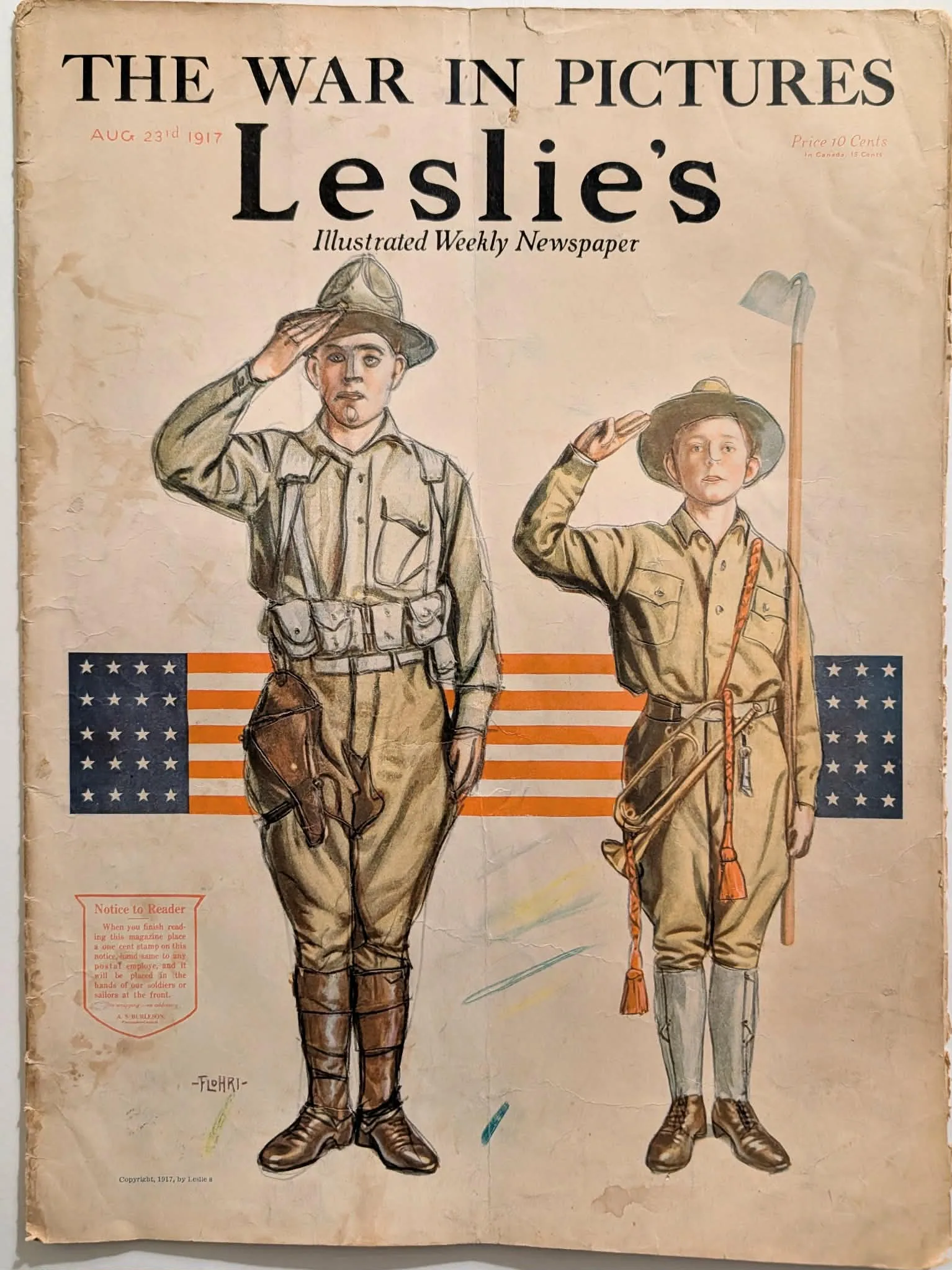
Before the spring of 1917, the American concept of war was geographically and psychologically distant. It was a violent endeavor executed by professional armies across an ocean. The state fought. The civilian watched. This artifact marks the precise moment that paradigm shattered. It documents the birth of the industrialized home front. The child depicted is no longer a mere dependent of the state; he is weaponized as an agrarian asset. The magazine itself is no longer merely a conduit for news; it is a logistical tool repurposed for military morale. By observing this cover, we are witnessing the exact historical pivot where the dividing line between the front line trenches and the domestic living room dissolved into a single, unified machine of national production. The civilian was drafted into the narrative of total war.
Category: Other
The History
The Epoch of Total Mobilization To understand this artifact, we must anchor ourselves in August 1917. The United States had officially entered the Great War only four months prior, in April. The initial romanticism of voluntary enlistment had already collided with the brutal arithmetic of industrial-scale slaughter. The government quickly realized that a modern war could not be sustained by enthusiasm alone. It required systemic, total mobilization. The Selective Service Act had been passed in May, conscripting millions. But bodies in uniforms were only half the equation. The state needed food, steel, and unyielding domestic compliance. This issue of Leslie’s Illustrated Weekly Newspaper, dated August 23, 1917, serves as a primary psychological mechanism of that mobilization. The artifact does not sell the glory of combat; it sells the necessity of shared sacrifice. It establishes a visual equivalency between the man holding the weapon and the child holding the tool. The message is devoid of subtlety: every citizen, regardless of age, is an active node in the war effort. The conflict is inescapable. The Weaponization of Youth and Agriculture The most striking element of the historical shift present on this cover is the boy on the right. He is clad in a uniform reminiscent of the Boy Scouts, an organization that swiftly pivoted from peacetime character-building to wartime domestic service. However, the tool he shoulders is not a rifle, but a heavy agricultural hoe. A bugle hangs at his waist, ready to sound a call to action. This is the iconography of the United States Boys' Working Reserve, formed in 1917 under the Department of Labor. With millions of adult men shipped to training camps, the American agricultural sector faced a catastrophic labor shortage. The solution was the rapid mobilization of youth. Children were deployed to farms to ensure the food supply chain did not collapse. "Food Will Win the War" was the pervasive doctrine orchestrated by Herbert Hoover’s U.S. Food Administration. By posing the boy executing a crisp, identical salute alongside the armed, adult soldier, the illustrator elevating farm labor to the exact moral equivalent of trench warfare. The child is a soldier of the soil. This represented a profound societal shift. Childhood innocence was temporarily suspended, replaced by industrial utility. The hoe is held at the "shoulder arms" position, a deliberate visual cue that domestic agriculture was now a recognized branch of the military apparatus. Leslie's and The Visual Primacy Shift Leslie’s occupied a unique space in the media landscape of 1917. While competitors like The Saturday Evening Post relied heavily on long-form text and serialized fiction, Leslie’s branded itself boldly across the masthead: "THE WAR IN PICTURES". This was a calculated technological and editorial shift. As the immigrant population in the United States swelled, bringing vast linguistic diversity, text barriers became a friction point for mass communication. Leslie’s bypassed literacy limitations by communicating through immediate, visceral imagery. Visuals became the dominant language of persuasion. The magazine understood that to shape a unified national consciousness, they needed images that could be instantly decoded by anyone, regardless of their native tongue. This cover operates perfectly within that doctrine. It requires no translation. The dual salute against the unbroken horizon of the American flag communicates duty, unity, and sacrifice in a fraction of a second. The Logistical Propaganda: Burleson's Decree The most historically significant element on this cover is not the illustration, but the red stamp on the bottom left: the "Notice to Reader" authorized by A. S. Burleson, Postmaster-General. This small block of text represents an astonishing innovation in wartime logistics and civilian psychology. The text dictates that upon finishing the magazine, the reader need only place a one-cent stamp over the notice and hand it to any postal employee, without a wrapper or address. The United States Postal Service would then guarantee its delivery into the hands of a soldier or sailor at the front. This transformed a disposable, 10-cent piece of civilian media into a physical bridge connecting the home front directly to the trenches of France. It democratized the logistics of morale. The citizen was no longer just consuming news; they were actively participating in a military supply chain. The psychological impact was immense. When a citizen handed this magazine back to the postman, they felt a tangible connection to the war effort. The magazine ceased to be a mere commodity and became an artifact of shared national duty. This mechanism shifted the postal service from a domestic utility into an auxiliary arm of the military. The Economic Engine of the Ten-Cent Weekly Priced at 10 cents (15 cents in Canada), the magazine was positioned for the working and middle classes. In 1917, 10 cents carried the purchasing power of roughly two modern dollars. It was an accessible luxury, yet economically significant enough to demand value. By incorporating the Burleson stamp, the publisher effectively doubled the perceived value of that 10 cents. The buyer was purchasing both personal entertainment and a direct contribution to troop morale. This intersection of media commerce, government infrastructure, and military necessity perfectly encapsulates the profound systemic shifts of the World War I era.
The Paper
The physical composition of the artifact is a testament to the industrial realities of early 20th-century mass media. Printed on highly acidic wood-pulp newsprint, the paper was fundamentally designed for impermanence. The distinct yellowing and edge-brittleness—often referred to as foxing and oxidation—are the inevitable chemical results of lignin breaking down over a century. The printing utilizes a rudimentary, early four-color process (CMYK) characteristic of rapid web presses of the era. The registration is remarkably precise for 1917, though microscopic bleeding is visible along the edges of the heavy black typography. The tactile experience of this paper is dry, fragile, and deeply textured. It was not meant to survive a century; it was engineered to survive a week in a parlor, a day in a postal sack, and perhaps a month in a damp trench. Its current existence is an anomaly of preservation, a fragile timeline recorded in oxidizing pulp.
The Rarity
Classification: Class B (High Contextual/Historical Significance) While Leslie's was mass-produced with a circulation in the hundreds of thousands, survival rates for wartime issues printed on acidic newsprint are exceptionally low. Its rarity does not stem from a limited initial print run, but from an aggressive attrition rate. The true archival value lies in the pristine visibility of the Burleson "Notice to Reader" stamp combined with the specific agrarian-military iconography. It is a vital primary document of the 1917 home front mobilization.
Cite this article
- MLA
- Naodhinsuk, Ronin. “The Time Traveller's Dossier : Leslie's 1917 - The Architecture of Total War.” The Record Institute, 24 July 2026, https://therecord.institute/journal/the-time-travellers-dossier-leslies-1917-the-architecture-of-total-war.
- APA
- Naodhinsuk, R. (2026, July 24). The Time Traveller's Dossier : Leslie's 1917 - The Architecture of Total War. The Record Institute. https://therecord.institute/journal/the-time-travellers-dossier-leslies-1917-the-architecture-of-total-war
- CHICAGO
- Naodhinsuk, Ronin. 2026. “The Time Traveller's Dossier : Leslie's 1917 - The Architecture of Total War.” The Record Institute, July 24, 2026. https://therecord.institute/journal/the-time-travellers-dossier-leslies-1917-the-architecture-of-total-war.