The Time Traveller's Dossier : Leslie's 1917 - The Sub-Sea Pirate and the Death of Naval Honor
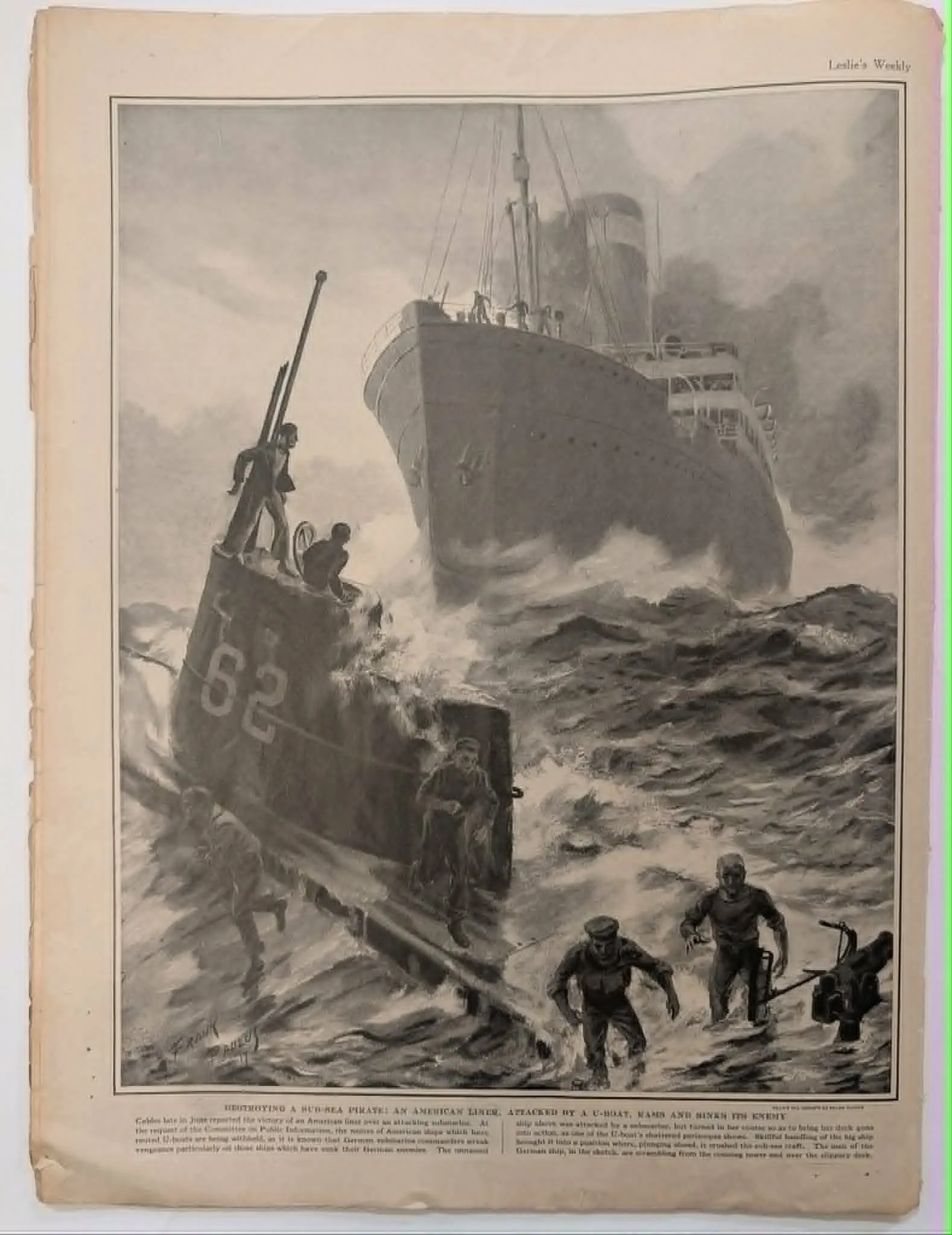
Look at the date. 1917. The ocean is no longer a neutral, predictable expanse. Before this exact epoch, naval warfare was a visible, orchestrated geometry of dreadnoughts and broadsides. The enemy was a distinct silhouette on the horizon. The civilian was a protected spectator of the sea, insulated from the direct horrors of military engagement. This artifact marks the absolute death of naval honor. It introduces a terrifying, absolute new reality: the invisible apex predator. The ocean floor is transformed into a tactical staging ground for anonymous slaughter. The merchant vessel, previously a vulnerable civilian target, becomes a weaponized, blunt-force ram. This is not merely a maritime illustration designed to sell magazines. It is a calculated psychological counter-offensive. It captures the exact moment the state apparatus realized it must invert the paralyzing terror of unrestricted submarine warfare into a narrative of civilian triumph, weaponizing the printing press to sustain a fractured national morale.
Category: Other
The History
The Death of the Horizontal War To comprehend the profound weight of this artifact, one must first dissect the geopolitical fracture of the oceans in 1917. For centuries, maritime conflict operated on a strict, two-dimensional plane. Fleets engaged on the surface, bound by the limits of optical range and the gentlemanly codes of prize rules. Before 1914, naval protocol dictated that a warship must surface, signal a merchant vessel to stop, allow the crew to evacuate into lifeboats, and only then sink the ship. This was a war of surface visibility and honorable conduct. The German U-boat shattered this horizontal paradigm, forcing naval warfare into a terrifying, three-dimensional volume. The depths were no longer a biological abyss; they became a militarized zone. When Germany declared unrestricted submarine warfare, they abandoned cruiser rules entirely. A sailor no longer watched the horizon for the smoke of an enemy funnel; he watched the immediate water for the white streak of a torpedo wake. The ocean was transformed from a thoroughfare of commerce into a vast, unpredictable minefield where death arrived without warning, without a declared flag, and without the possibility of surrender. The submarine converted the sea from a traditional battlefield into a submerged execution chamber. The Engineering of the Invisible Predator To understand the terror of the submarine, one must examine its engineering. The U-boat, specifically models similar to the one prominently marked '62', was a masterpiece of lethal compromise, prioritizing stealth entirely over heavy armor. When submerged, they were completely blind save for the narrow optics of the periscope—which in this specific engagement, the text explicitly notes, were "shattered" during the confrontation. This blinding of the predator is a crucial tactical detail. Without visual confirmation, the submarine is a helpless, submerged tube. The deck gun, designed for surface engagements against unarmed merchants to save expensive torpedoes, is rendered utterly useless against the sheer bulk of a charging steamship. The artifact illustrates the exact moment the hunter realizes it has fatally become the hunted. The Kinetic Mathematics of the Ram This illustration captures a profound inversion of the established predator-prey dynamic. The caption details an American liner that "rams and sinks its enemy". The merchant ship is not attempting a desperate evasion. Instead, it utilizes its sheer industrial mass as a kinetic weapon. The text notes the "skillful handling of the big ship brought it into a position where, plunging ahead, it crushed the sub-sea craft". This represents a brutal application of fluid dynamics and raw tonnage. A submarine is engineered to withstand the distributed static pressure of the deep ocean, but it is catastrophically fragile against the dynamic, localized impact of a massive steel prow slicing into its side. The image illustrates this physical reality perfectly, showing the towering bow of the liner completely dominating the fragile hull of the U-boat. This act violently blurs the line between the civilian merchant fleet and the commissioned navy. It demonstrates that in the calculus of total war, every industrial asset, regardless of its original peacetime intent, is a potential weapon of mass destruction. The Architecture of State Censorship Beyond the immediate maritime violence, this artifact serves as a masterclass in the birth of modern information control. The caption clearly states that "At the request of the Committee on Public Information, the names of American ships which have routed U-boats are being withheld". The Committee on Public Information (CPI), established by President Woodrow Wilson just days after the United States entered the war, was America's first official ministry of propaganda. This document shows the CPI actively managing reality. By censoring the name of the victorious ship, the state achieves two critical, strategic objectives. First, as the text explicitly states, it ensures that "German submarine commanders wreak vengeance particularly on those ships which have sunk their German enemies". This is operational security in its absolute infancy. Second, and more philosophically significant, it transforms a specific, localized event into a universal myth. By remaining unnamed, the liner ceases to be a single, identifiable ship; it becomes an avatar for all American resolve. The unnamed captain becomes every captain. Information security is born here not merely to protect military assets, but to manufacture unassailable national legends. The Lexicon of Dehumanization The title of the piece leverages a highly specific, legally loaded lexicon: "DESTROYING A SUB-SEA PIRATE". In the rigid frameworks of international maritime law, a pirate is classified as hostis humani generis—an enemy of all mankind. Pirates operate outside the bounds of statehood, military convention, and the established rules of engagement. By officially labeling German submarine crews as "pirates" rather than naval sailors, the American media and government effectively stripped them of their status as legitimate combatants. This is a critical psychological shift required for mobilizing a civilian population for total war. It legally and morally justifies unrestricted violence against them and entirely removes the ethical burden of chivalry or quarter. The German sailors, seen frantically abandoning their crippled vessel, are not depicted as defeated military men worthy of respect, but as exterminated pests fleeing a sinking nest. The Tactical Theater of the Printing Press In 1917, mass publications were the primary battlefield for the civilian mind. Magazines like Leslie's Weekly functioned as the central nervous system of public opinion. This illustration was a tactical deployment of ink and paper, designed to actively counter the paralyzing fear generated by unrestricted submarine warfare. By documenting the destruction of U-boat '62', the magazine provided the American public with a desperately needed, tangible catharsis. It proved visually that the invisible enemy could be forced to the surface, outmaneuvered, crushed, and utterly defeated. The frantic scramble of the German crew from the conning tower over the slippery deck, desperately abandoning their deck gun, reinforced the grand narrative of American industrial and moral superiority.
The Paper
To hold this artifact is to interface with the ephemeral architecture of wartime urgency. The substrate is a low-grade, highly acidic wood pulp, manufactured for immediate mass distribution rather than archival permanence. Over a century, the lignin within the fibers has oxidized violently, resulting in a pronounced aged paper texture. This physical decay—the browning edges and brittle corners—is not merely damage; it is the time-stamp of its survival. When transforming this print into a living 2D artwork, one must rigorously preserve this original flat illustration style. The halftone printing technique relies on the human mind to blend crude dots into cohesive shading. To maintain the artifact's profound historical authenticity, any digital recreation must adhere strictly to its period color palette—avoiding modern saturation in favor of the stark, high-contrast greyscale that defines early 20th-century newsprint. The medium itself visually records the anxiety and speed of 1917.
The Rarity
Classification: Class A. While Leslie's Weekly was a mass-produced publication, the contextual value of this specific page elevates its rarity exponentially. Its true worth is not derived from its market price, but from its function as a primary source document capturing real-time government censorship. The explicit textual acknowledgment of the Committee on Public Information withholding data makes this a vital anchor point for historians studying the genesis of the modern military-industrial-media complex. It is a fragile, surviving blueprint of psychological warfare.
Cite this article
- MLA
- Naodhinsuk, Ronin. “The Time Traveller's Dossier : Leslie's 1917 - The Sub-Sea Pirate and the Death of Naval Honor.” The Record Institute, 27 June 2026, https://therecord.institute/journal/the-time-travellers-dossier-leslies-1917-the-sub-sea-pirate-and-the-death-of-naval-honor.
- APA
- Naodhinsuk, R. (2026, June 27). The Time Traveller's Dossier : Leslie's 1917 - The Sub-Sea Pirate and the Death of Naval Honor. The Record Institute. https://therecord.institute/journal/the-time-travellers-dossier-leslies-1917-the-sub-sea-pirate-and-the-death-of-naval-honor
- CHICAGO
- Naodhinsuk, Ronin. 2026. “The Time Traveller's Dossier : Leslie's 1917 - The Sub-Sea Pirate and the Death of Naval Honor.” The Record Institute, June 27, 2026. https://therecord.institute/journal/the-time-travellers-dossier-leslies-1917-the-sub-sea-pirate-and-the-death-of-naval-honor.